Why is my FM transmitter not covering the full distance?
Your FM transmitter isn’t covering as far as you expected? You’re not alone—many broadcasters face the same issue.
FM transmitters fail to cover full distance due to five main causes: antenna height too low (most common – reduces coverage by 40-60%), poor quality cables losing 30-60% power, wrong antenna type wasting directional energy, high SWR from bad connections reflecting power back, and obstacles like hills or buildings blocking line-of-sight. A 1,000 W transmitter can reach about 40-60 km under extremely ideal conditions, but in many real-world setups we measured only 25-30 km when the antenna height was 30 m.
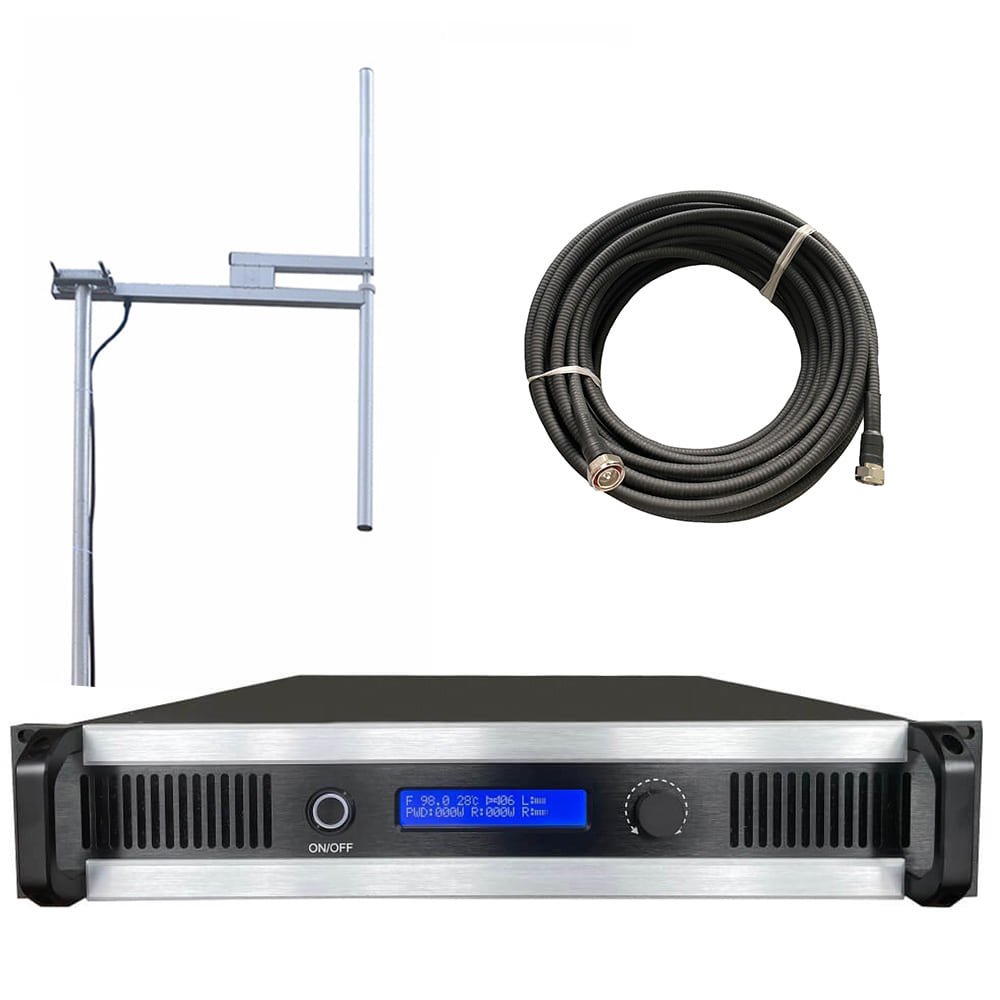
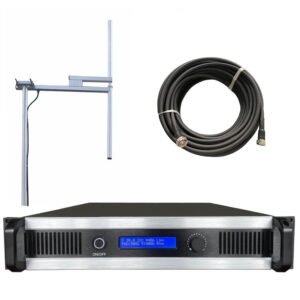
1000W FM Transmitter Basic Kit
Professional-grade FM broadcast transmitter kit with stable signal and energy-efficient design — ideal for community and regional radio stations.
I run a radio station and regularly help station owners around the world fix their coverage problems. Most of the time, it’s not the transmitter that’s at fault—it’s the installation.
How can I increase the range of my FM transmitter?
If you want to increase the range of your FM transmitter, you don’t necessarily need to buy a higher power unit. With a few simple adjustments, you can often double your effective coverage.
Increase FM transmitter range by raising antenna height (adds 3–6km when increasing from 20m to 30m in good terrain, but not linearly), ensuring SWR below 1.5 (prevents 10–15% power loss), and considering multi-bay antennas (4-bay adds 20–30% range vs 1-bay but often costs more than a low-power transmitter itself). A 300W transmitter with a 30m antenna normally reaches 15–20km; if coverage is below this range, check the above factors. If all are optimized and coverage is still insufficient, upgrading to a higher-power transmitter is the most effective solution.
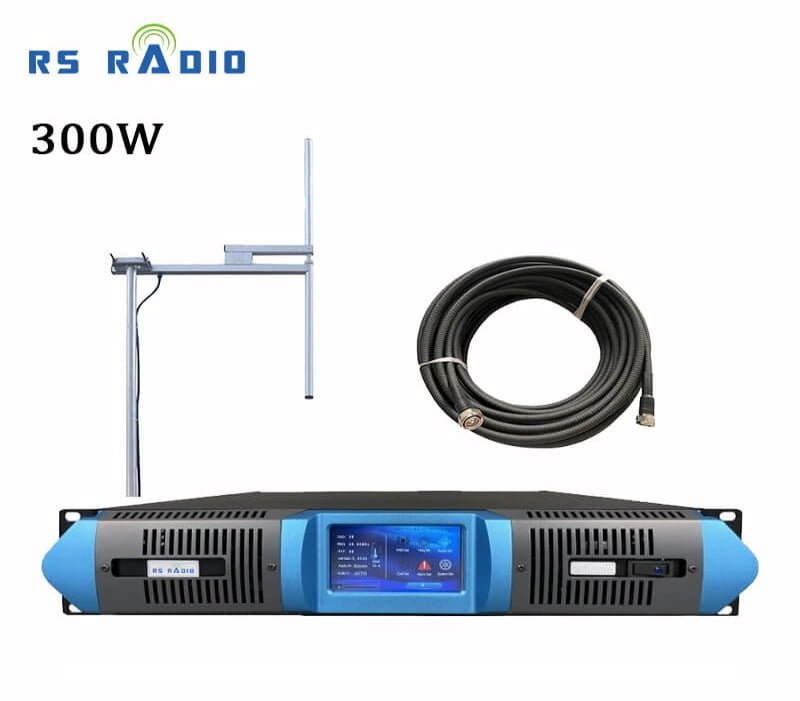
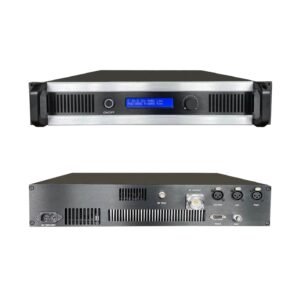
300W Touch Screen FM Transmitter Basic Kit
Energy-efficient 300W FM transmitter with touchscreen control, ideal for community and regional radio stations needing stable and clear broadcast performance.
Increasing antenna height is the easiest way to improve FM coverage. We helped a church station in Kenya using a 300W transmitter that cost $1,339. At first, their antenna was only 12 meters high, and the signal reached about 8–10 km. After moving the antenna to a 32-meter tower, with no other changes, the coverage expanded to about 18–20 km. That’s almost double the range just by raising the antenna. People who could not hear anything before suddenly received a clear signal.
The cable between your transmitter and antenna decides how much power actually reaches the air. Cheap RG8 cable can lose 50–60% of your power over a 30-meter run at FM frequencies. So if you use a 500W transmitter with RG8, only about 200–250W reaches the antenna — basically half power. With LMR-600 cable, the loss is only about 18–22%, so you get around 390–410W out. That’s a huge difference. This is why transmitters above 300W should always use LMR-600 to avoid wasting power and losing coverage.
| Range Increase Method | Typical Coverage Gain | Priority Level |
|---|---|---|
| Raise antenna height | +8-10km | Highest priority |
| Upgrade to 4-bay antenna | +12-18km | High priority |
| Replace with LMR-600 cable | +8-15km | High priority |
Location affects FM coverage more than power or antenna height. We tested two stations using the same setup — 500W transmitters and antennas at 30 meters. In flat farmland in Kansas, the station covered about 25–30 km. But in the mountains of Colorado, the same system reached only about 12–15 km, because hills block FM signals and create dead zones. A station in Nigeria moved a 1000W transmitter from a valley to a hilltop 6 km away. Even though the antenna height dropped from 35m to 28m, the coverage actually increased. In hilly areas, ground elevation matters more than antenna height above ground.
SWR (Standing Wave Ratio) indicates connection quality between your transmitter and antenna system. Good SWR below 1.5 means most power radiates from the antenna. High SWR above 2.0 means 10-20% of your power reflects back into the transmitter instead of radiating. I found a station with SWR 3.8 using a 300W transmitter reaching only 14km instead of expected 20km. The problem came from corroded connectors and damaged cable. Replacing three bad N-type connectors and repairing cable jacket lowered SWR to 1.2. Coverage immediately increased to 20km. Check SWR monthly using the built-in meter on RS transmitters. Values above 1.8 indicate problems needing immediate attention. The RS transmitter includes automatic SWR protection reducing power when SWR exceeds safe levels protecting your equipment from damage.
Why is my FM signal weak or fading out?
You may face a problem that your transmitter is on the air, but some listeners might notice the signal getting weak or fading in and out—especially farther from the station. It can be frustrating for them, and many will switch to another channel when the audio isn’t clear.
FM signals weaken or fade from insufficient transmitter power for distance (most common), antenna height too low, obstacles blocking line-of-sight (buildings, hills, trees), and receiver location in valleys or behind structures.
Insufficient power is one of the most common reasons for weak FM signals. For example, a 50W transmitter priced at $488 can cover about 8–12 km with a clear signal, but listeners around 15 km often hear the signal fade in and out. The transmitter itself is not broken — it simply doesn’t have enough power to reach that far.
Many weak-signal problems come from incorrect antenna height. FM signals travel line-of-sight, so height controls how far they reach. Based on real measurements, 30 meters is the best installation height. Below 30m, buildings and trees block the signal and coverage drops sharply. Far above 30m, long feeder cables cause power loss and the tower structure becomes difficult.
Physical obstacles between transmitter and listeners block or absorb FM signals. Hills create complete signal shadows behind them. Tall buildings reflect and absorb signals reducing coverage in urban areas by 30-40% compared to rural areas. Dense forests with foliage absorb signals reducing coverage by 20-30% especially in summer when trees have leaves. I remember a station receiving complaints every June that their signal became weak. We investigated and found listeners behind a forested area. Seasonal foliage changes affect coverage more than most station operators realize.
| Weak Signal Cause | Symptom | Solution |
|---|---|---|
| Insufficient power | Weak at distance | Upgrade transmitter power |
| Low antenna height | Fade beyond horizon | Raise antenna higher |
| Physical obstacles | Dead zones, shadows | Relocate antenna or increase height |
Multipath interference happens when signals reflect off buildings, hills, or water reaching listeners from multiple directions at different times. A listener sitting in a parking lot may have perfect signal but driving 50 meters experiences complete fade then perfect signal again 100 meters further. Higher antenna can clear building reflections.
How far can different wattage FM transmitters reach?
Choosing the right transmitter power depends on how far you need your signal to reach. If you understand how wattage affects coverage distance, you can avoid buying too little power that causes weak signals—or spending extra money on power you don’t actually need.
FM transmitter coverage by power level with 30m antenna height on flat terrain: 15W reaches 1-3km ($249 kit), 50W reaches 3-5km ($488), 100W reaches 7-12km ($650), 300W reaches 15-20km ($1339), 500W reaches 20-25km ($1560), 1000W reaches 25-30km ($1890), 1500W reaches 25-38km ($2230), 2000W reaches 30-60km ($3580), 3000W reaches 40-70km ($6800), and 5000W reaches 60-80km ($9900). Mountainous terrain reduces coverage by 40-50% while flat farmland increases coverage by 15-20% compared to these baseline figures.
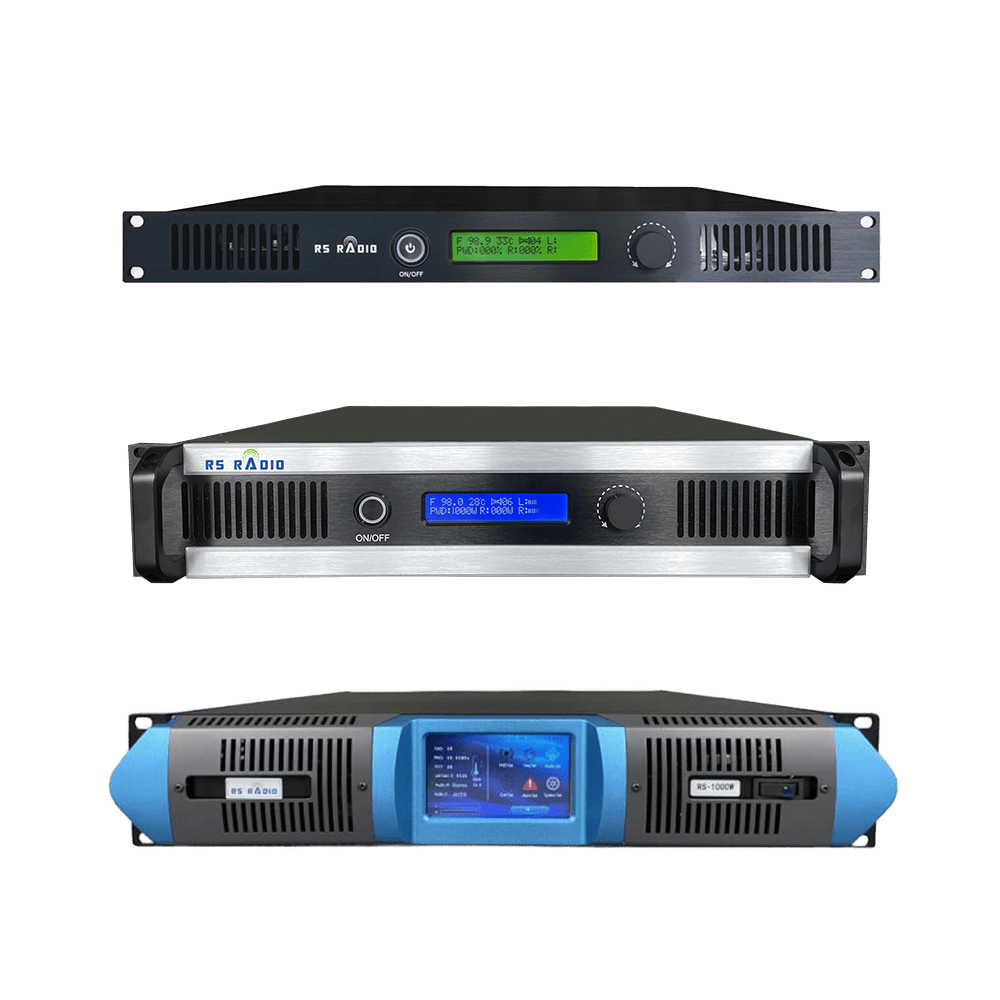
Low-power FM transmitters are the most cost-effective choice for small local coverage. A 15W complete kit at $249 reaches about 1–3 km with a 30m antenna on flat terrain. This works well for drive-in theatres, small church events, campus broadcasts, and neighborhood communication. For larger local areas, a 50W transmitter at $488 reaches 3–5 km, suitable for small towns, colleges with 5,000–15,000 students, or community radio. Stepping up to a 100W transmitter at $650 extends coverage to 7–12 km, enough to reach multiple towns without overspending on unnecessary power. Matching your transmitter wattage to your real coverage needs prevents weak signals—and prevents wasting money on power you don’t actually need.
Medium-power transmitters are ideal for covering towns and small cities without overspending. A 100W transmitter at $650 reaches about 7–12 km with a 30m antenna on flat terrain—enough to cover most towns and nearby neighborhoods. Upgrading to a 300W transmitter at $1339 extends coverage to about 15–20 km, reaching surrounding suburbs and nearby communities. I worked with a station that upgraded from 50W (3–5 km) to 100W (7–12 km) for only $162 more ($650–$488). Their coverage more than doubled and reached several new neighborhoods, adding thousands of additional listeners. The increased audience improved their local advertising revenue and quickly paid for the upgrade.
Professional-level FM transmitters are designed for city and regional coverage. A 300W transmitter at $1339 reaches about 15–20 km with a 30m antenna on flat terrain—ideal for mid-sized towns and community radio. Stepping up to a 500W transmitter at $1560 extends coverage to about 20–25 km, suitable for covering multiple neighboring towns or outer city areas. A 1000W transmitter at $1890 reaches about 25–30 km, providing solid regional coverage when terrain is flat. For even larger service areas, a 2000W transmitter at $3580 covers roughly 30–60 km, depending on elevation and obstacles. These power levels are commonly used by educational broadcasters, commercial community stations, and regional networks needing wide coverage without excessive infrastructure cost.
| Power Level | Coverage Distance (30m antenna, flat terrain) | Typical Application |
|---|---|---|
| 15W – 50W | 1 – 5 km | Local events, neighborhoods, campus |
| 100W – 300W | 7 – 20 km | Town & community radio |
| 500W – 2000W | 20 – 60 km | City & regional coverage |
High-power FM transmitters are used for large cities, regional networks, and broad provincial coverage. A 3000W transmitter at $6800 reaches about 40–70 km with a 30m antenna on flat terrain, covering multiple towns and urban districts. A 5000W transmitter at $9900 extends coverage to about 60–80 km, suitable for major cities or regional broadcasting across several connected communities. These systems typically require strong supporting infrastructure such as tall towers, multi-bay antennas, and high-grade feeder cables to operate effectively.
Increasing transmitter power provides diminishing returns on coverage distance. Doubling wattage does not double your range—usually it adds only about 30–40% more distance. For example, moving from 500W to 1000W may increase coverage from around 25–30 km to 35–45 km, and from 1000W to 2000W might only extend reach another 10–15 km, especially in hilly terrain. At a certain point, improving infrastructure—like raising the antenna height or upgrading from a 2-bay to a 4-bay antenna—delivers far better coverage for the same investment than buying more power. Power increases help, but smart antenna and tower improvements often produce bigger gains.
How to choose the right FM transmitter for long-range coverage?
Getting long-range coverage isn’t only about choosing higher power, which requires evaluating multiple factors together.
Choose FM transmitters for long-range coverage by calculating required distance (determine farthest listener location), assessing terrain (mountains reduce coverage 40-50%, flat land increases 15-20%), planning antenna height (Normally at a height of 30 meters), selecting proper antenna (Most commonly a dipole antenna), budgeting for quality cable, and adding 20% power margin for obstacles. At a 30-meter antenna height, For coverage around 50 km, a 2000W transmitter is an appropriate choice. For coverage closer to 70 km, selecting a 3000W transmitter is more suitable. Always invest in proper infrastructure before buying excess transmitter power.
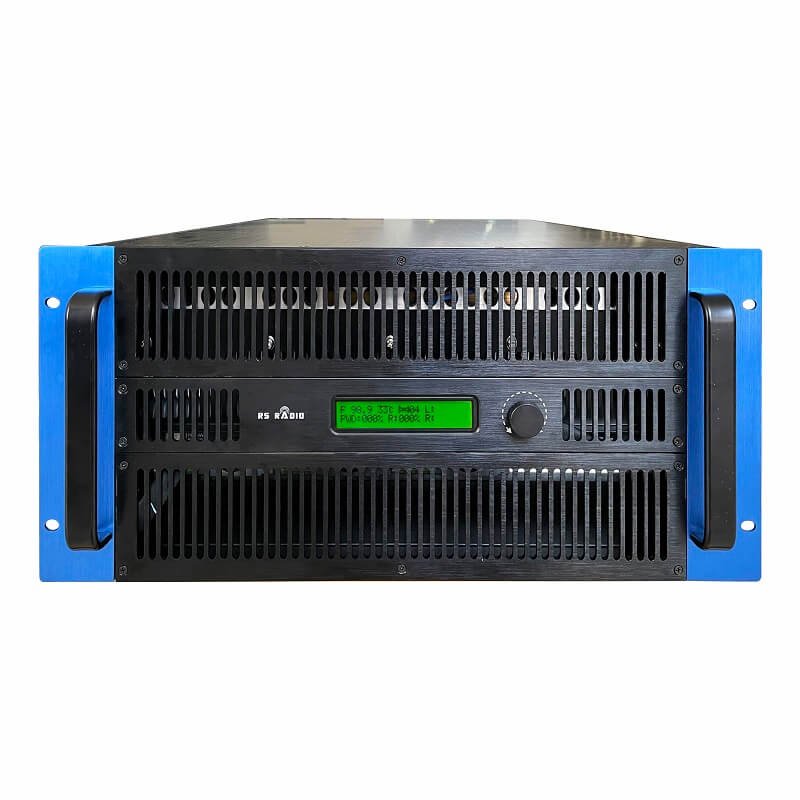
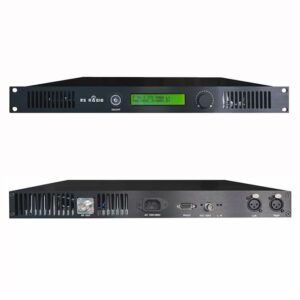
3000W FM Transmitter
Professional 3000W FM transmitter designed for long-range broadcasting, suitable for regional stations and wide-area coverage needs.
Calculate your required coverage distance before selecting transmitter power. Draw a circle on a map centered on your planned transmitter location, marking all towns and communities that must be covered. Measure the distance to the farthest required listener — this distance determines the minimum transmitter power. For example, I worked with a church planning regional broadcasting. Their coverage circle included six nearby towns, with the farthest located about 38km away. With a 30m antenna height, a 500W transmitter covers roughly 20–30km, which would not reliably reach their farthest community. We recommended 1000W, which typically provides 35–50km coverage, offering enough margin to handle obstacles, vegetation, or seasonal weather. Planning to meet only the exact distance is risky — always include 15–20% coverage margin instead of selecting the minimum power.
Terrain analysis determines how much power you actually need for desired distance. Flat farmland allows FM signals to travel maximum distance with minimal obstacles. Mountainous areas create signal shadows requiring 40-50% more power for the same coverage distance. Urban areas with tall buildings need 30-40% more power than rural areas. Forested regions need 20-30% more power in summer when trees have leaves. Survey your terrain carefully using topographic maps or Google Earth elevation data before selecting transmitter power. Contact sales@fmradiotx.com or WhatsApp +86 188 4203 6851 with your location for personalized power recommendations.
Antenna height budget significantly affects transmitter power choice. Because sometimes raising the antenna height can achieve the desired coverage range, and the budget required for height increase is usually cheaper than buying a higher-power transmitter.
| Selection Factor | Evaluation Method | Impact on Power Choice |
|---|---|---|
| Coverage distance | Map farthest listener | Determines minimum power |
| Terrain type | Assess mountains, obstacles | Increases power need 40-50% |
| Antenna height budget | Calculate tower costs | Allows lower power choice |
Antenna selection impacts transmitter power requirements dramatically. For example, when the coverage requirement is the same, choosing a 4-bay antenna requires less transmitter power compared to a standard dipole antenna. However, the price difference between a 4-bay and a dipole antenna should also be evaluated to make the most cost-effective decision.
Budget for a complete system, not just the transmitter price. Long-range coverage requires quality components throughout the signal chain. A 1000W transmitter needs a 4-bay antenna, low-loss LMR-600 cable, connectors and lightning protection, a 35m tower, and professional installation to achieve full performance. Attempting to save money by using a 2-bay antenna and cheaper cable can reduce coverage by 18–22 km, defeating the purpose of buying a 1000W transmitter. Build complete systems with matched components for optimal performance.
Contact RS directly at sales@fmradiotx.com or WhatsApp +86 188 4203 6851 for personalized transmitter recommendations. Provide your desired coverage distance, terrain type, expected antenna height, and budget. RS engineers will recommend the optimal transmitter power level and component combination for your specific situation. Custom quotes include transmitter, antenna, cables, and accessories matched to your requirements. Package pricing typically costs 15-20% less than buying components separately while ensuring all parts work together properly.
Conclusion
FM transmitters fail to reach full distance mainly from low antenna height, poor cables, and high SWR – not transmitter problems. Raise your antenna 10-20m higher for the biggest coverage boost. Replace cheap cables with LMR-600. Fix SWR below 1.5 by checking all connections. Those three fixes typically increase effective range by roughly 30–60%. Choosing the right power level matters too – calculate your needed coverage radius and add 20% margin. Buy adequate power from the start rather than trying to stretch insufficient power. RS transmitters from 15W to 5000W cover every application with 5-year warranty and factory-direct pricing. Contact sales@fmradiotx.com or WhatsApp +86 188 4203 6851 for coverage planning help and detailed equipment recommendations for your specific situation.