Top 10 Types of FM Transmitters for Radio Broadcasting
I work as an FM transmitter engineer. I spent the last six years installing and maintaining broadcast equipment across different continents. Maybe this field experience can help you choose the right transmitter type. Some types work perfectly for churches and schools. Others suit commercial stations better.
1. Low Power FM Transmitters (15W-100W)
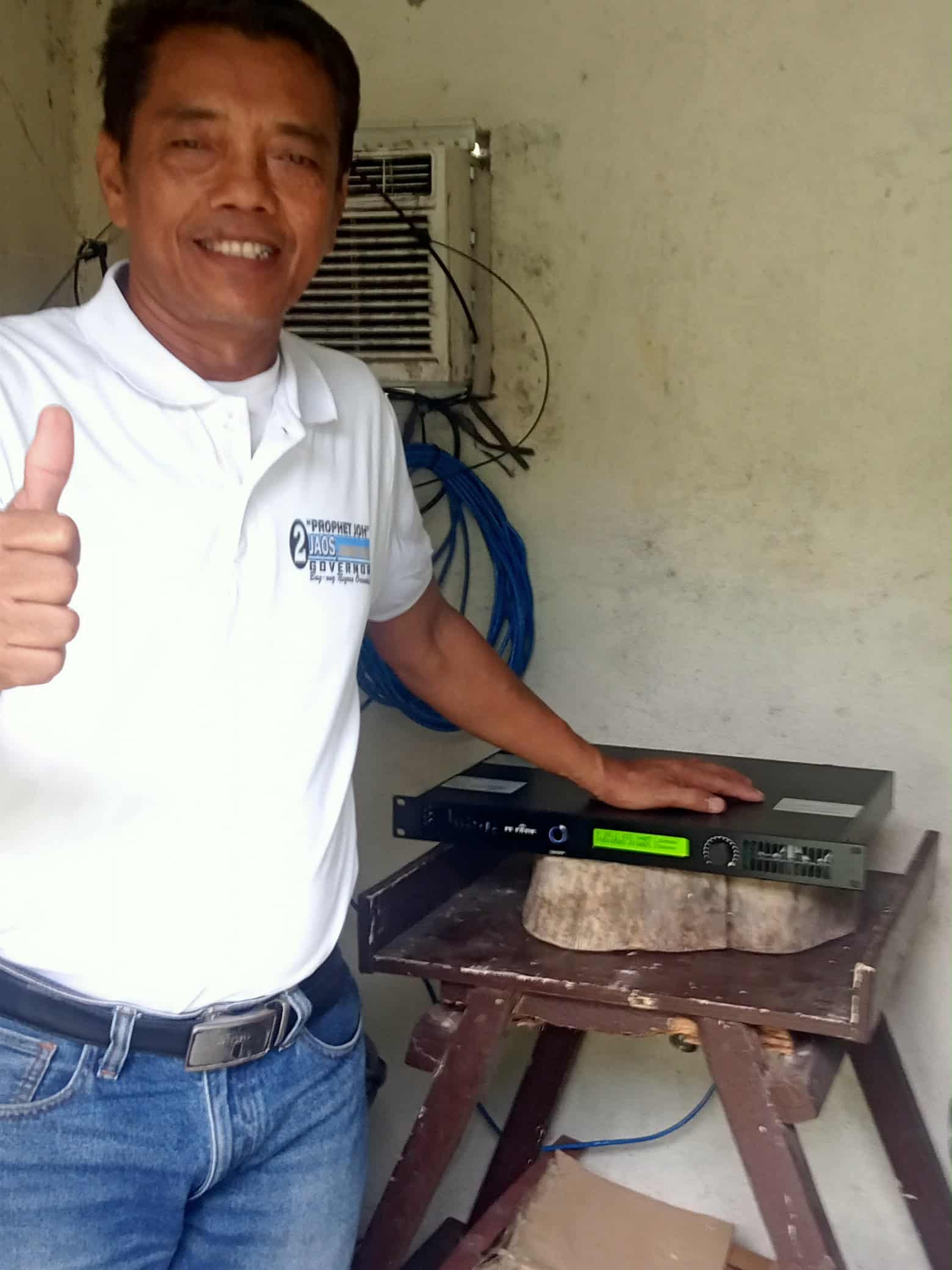
Low power transmitters serve localized broadcasting needs. I install these units for churches, small community stations, and drive-in cinemas. The coverage depends heavily on antenna height and terrain. A 15W transmitter on a 30-meter tower covers roughly 1-3km on flat ground. Hills cut this range in half. I measured actual field strength in rural Tanzania using a spectrum analyzer.
| Power Level | Coverage (30m antenna, flat) | Power Consumption | Audio Input |
|---|---|---|---|
| 15W | 1-3km | ~25W | XLR, RCA |
| 50W | 3-5km | ~70W | XLR, RCA |
| 100W | 7-12km | ~140W | XLR, RCA, USB |
The installation takes two to three hours for someone with basic skills. I trained church volunteers in the Philippines to set up complete systems. They mounted the antenna, ran the cable, and connected everything correctly. These transmitters use solid-state amplification. The failure rate stays low because there are no tubes to burn out. I service units that run continuously for three years without problems.
Power consumption matters for operating costs. A 50W transmitter draws about 70 watts from the wall. That translates to roughly $8-12 monthly electricity cost in most countries. The compact design fits on a shelf or small table. I installed a 15W system in a church storage room that was only 2 square meters. The cooling fan keeps components under 50°C in tropical heat.
2. Medium Power FM Transmitters (300W-1KW)
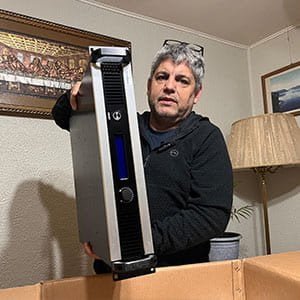
Medium power transmitters cover small towns and rural areas effectively. I work with these models for regional religious networks and community stations serving multiple villages. A 500W transmitter on a 30-meter tower reaches 20-25km in open terrain. Urban areas with buildings reduce this to 12-15km. I tested coverage using actual signal strength measurements, not theoretical calculations.
| Power Level | Coverage (30m antenna) | Typical Application | Electrical Requirement |
|---|---|---|---|
| 300W | 15-20km | Multi-village coverage | 220V single-phase |
| 500W | 20-25km | Small town radio | 220V single-phase |
| 1000W | 25-30km | Regional broadcasting | 220V or 380V |
The modular design allows quick repairs. I keep spare amplifier modules in stock. When one fails, I swap it out in 20 minutes instead of shipping the entire transmitter back. Most units include automatic power reduction when output gets too high. This protects the final amplifier stage from damage. I saw this feature save a transmitter when someone connected a mismatched antenna.
These transmitters need proper ventilation. I measure the equipment room temperature before installation. If it exceeds 35°C, I add exhaust fans or air conditioning. The 1KW models produce noticeable heat. I calculate roughly 300-400 watts of waste heat that needs removal. Some stations in Mexico run multiple 500W transmitters on different frequencies. This distributes coverage across a wider area.
3. High Power FM Transmitters (2KW-5KW)
High power transmitters serve cities and large coverage areas. I installed a 3KW system for a religious network covering an entire province. The signal reached 40-70km from the transmitter site. Maybe this power level makes sense when you need to serve 200,000+ people. The investment increases significantly compared to lower power options.
| Power Level | Coverage Range | Equipment Cost |
|---|---|---|
| 2KW | 30-60km | ~$3,500 |
| 3KW | 40-70km | ~$6,800 |
| 5KW | 60-80km | ~$9,900 |
The cooling requirements increase substantially. A 5KW transmitter might have four or five cooling fans running continuously. I measure airflow using an anemometer to ensure adequate cooling. Room temperature should stay below 30°C for reliable operation.
Power consumption becomes a major operating expense. I help stations calculate the total cost of ownership before purchasing. Sometimes two 1KW transmitters on different frequencies serve audiences better than one 3KW transmitter. The coverage overlap provides redundancy.
4. Solid-State FM Transmitters
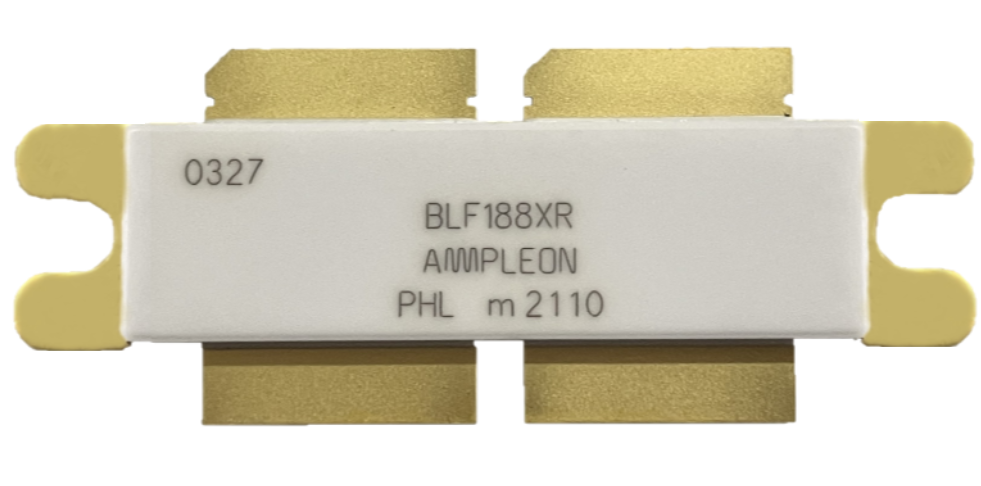
Solid-state transmitters use transistors instead of vacuum tubes. I exclusively install solid-state models now. The technology improved significantly over the past decade. Power efficiency reaches 70-75% compared to 40-50% for tube designs. This means less electricity waste and lower operating costs. I measured actual power consumption using a wattmeter on multiple installations.
Solid-State Technology Advantages:
| Feature | Solid-State | Old Tube Design |
|---|---|---|
| Start-up Time | Instant | 10-15 minutes warm-up |
| Component Life | 10+ years typical | 2-5 years (tubes need replacement) |
| Operating Temperature | 45-55°C | 70-85°C |
| Power Tolerance | Handles 180-260V | Requires stable 220V |
| Maintenance Frequency | Annual inspection | Quarterly tube checks |
The voltage tolerance impresses me most. I work in countries where power quality varies significantly. Solid-state transmitters handle voltage swings from 180V to 260V without problems. The switching power supply regulates automatically. I tested a 300W transmitter on a diesel generator that fluctuated between 200V and 240V. The RF output stayed stable throughout.
Replacement components cost less and arrive faster. Transistors and MOSFETs are standard electronics parts. Local suppliers stock them in major cities. I keep spare transistors for common models. The repair time drops from days to hours. Tube transmitters need specialized vacuum tubes shipped from manufacturers. Maybe this explains why most new installations choose solid-state technology.
5. All-in-One Package Systems
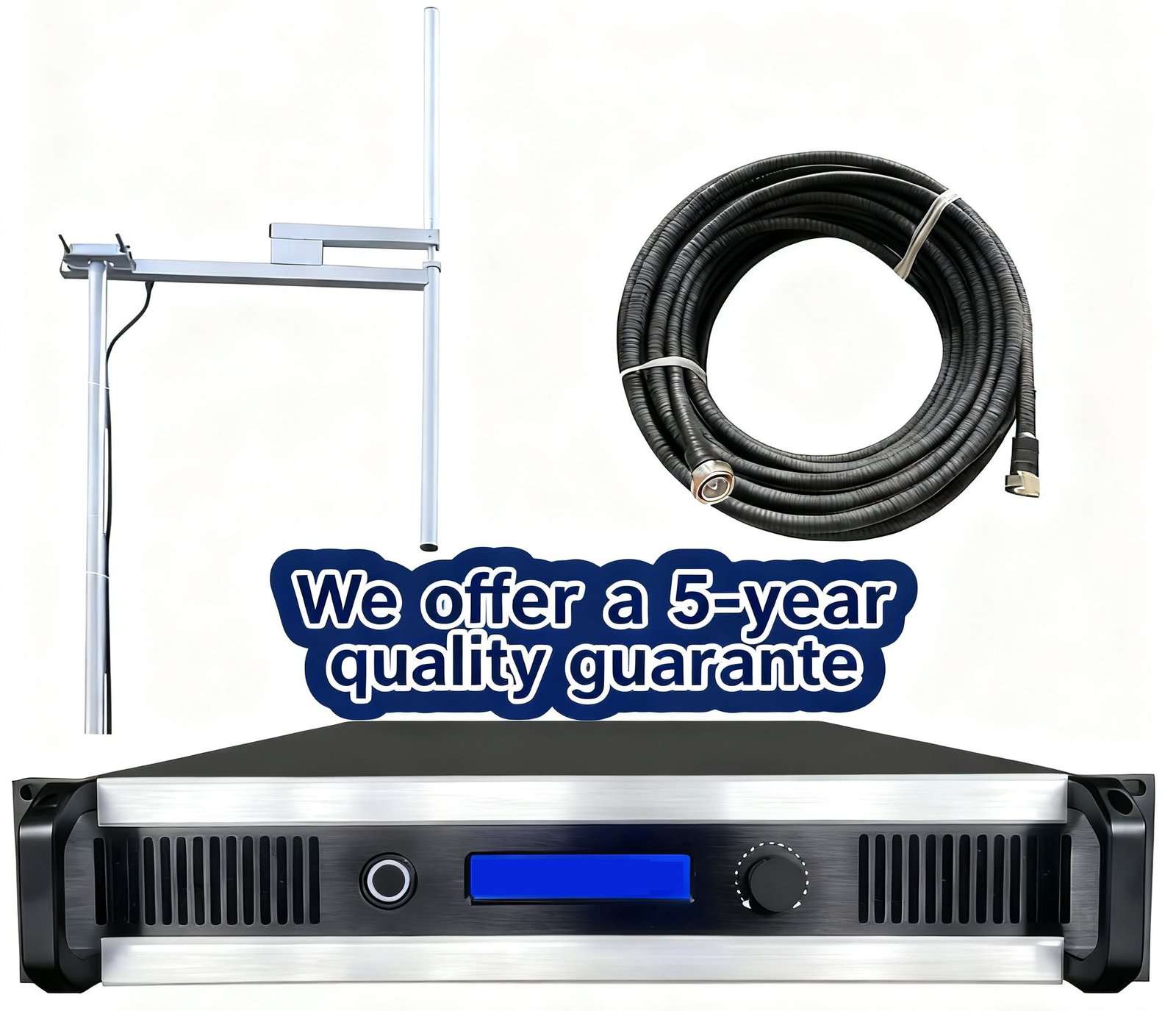
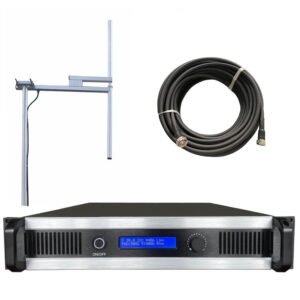
Package systems include transmitter, antenna, and coaxial cable together. I recommend these kits for first-time broadcasters. You receive everything needed to start broadcasting except the audio source. The components match properly for optimal performance. I see too many stations buying mismatched equipment that underperforms.
Typical Package Components:
| Power Level | Package Includes | Setup Difficulty | Typical Buyer |
|---|---|---|---|
| 15W Kit | Transmitter, Dipole antenna, 20m cable | Easy – 2 hours | Churches, drive-in cinemas |
| 50W Kit | Transmitter, 1-bay antenna, 30m cable | Moderate – 3 hours | Community radio |
| 2000W Kit | Transmitter, 4-bay antenna, 50m cable | Moderate – 4 hours | commercial radio stations |
The antenna matching saves significant trouble. I calculate antenna impedance and cable length during package design. The VSWR (voltage standing wave ratio) stays below 1.3:1 in properly designed packages. Mismatched systems waste 10-20% of transmitter power as reflected energy. I measured a poorly matched antenna reflecting 15W from a 100W transmitter. The operator paid for 100W but radiated only 85W.
Package systems cost 10-15% less than buying components separately. The manufacturer tests everything together before shipping. I install these kits for churches and small community groups. They appreciate the simplicity. The complete system arrives in one shipment instead of three separate deliveries from different suppliers.
6. Rack-Mount Professional Transmitters
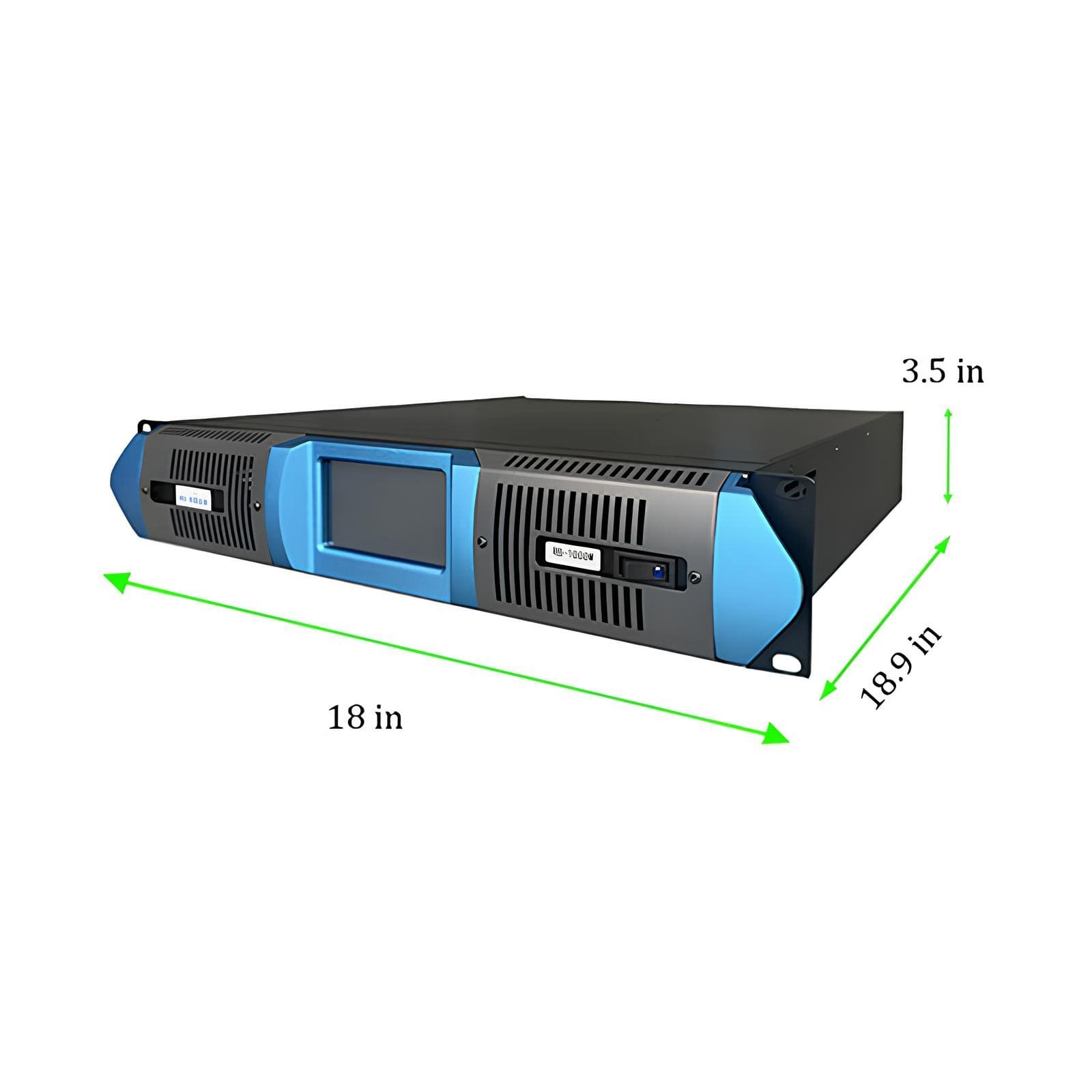
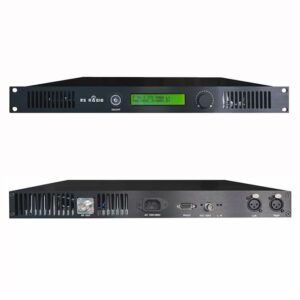
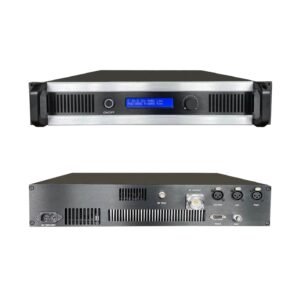
Rack-mount transmitters fit standard 19-inch broadcast equipment racks. I install these in professional studios with multiple equipment pieces. The organized layout simplifies maintenance and cable management. Maybe this configuration suits stations planning future expansion. You add new equipment vertically without rearranging everything.
Rack Space Requirements (actual measurements):
| Transmitter Power | Height (Rack Units) | Weight | Panel Access |
|---|---|---|---|
| 50-100W | 1U (1.8inch) | 6-8kg | Front panel |
| 300-2000W | 2U (3.5inch) | 12-18kg | Front panel |
The standardized mounting uses cage nuts and rack screws. I install transmitters tool-free in properly equipped racks. The front panel provides all controls and status displays. Back panel connections handle RF output, audio input, and remote control. I route cables through vertical cable managers between rack rails. This prevents cable strain and looks professional.
Many rack-mount models include Ethernet interfaces for remote monitoring. I check transmitter status from my phone while away from the station. The web interface shows RF power output, reflected power, and internal temperature. Email alerts notify me immediately if problems occur. I received a cooling fan failure alert and replaced it before temperature became critical.
7. Compact Desktop Transmitters
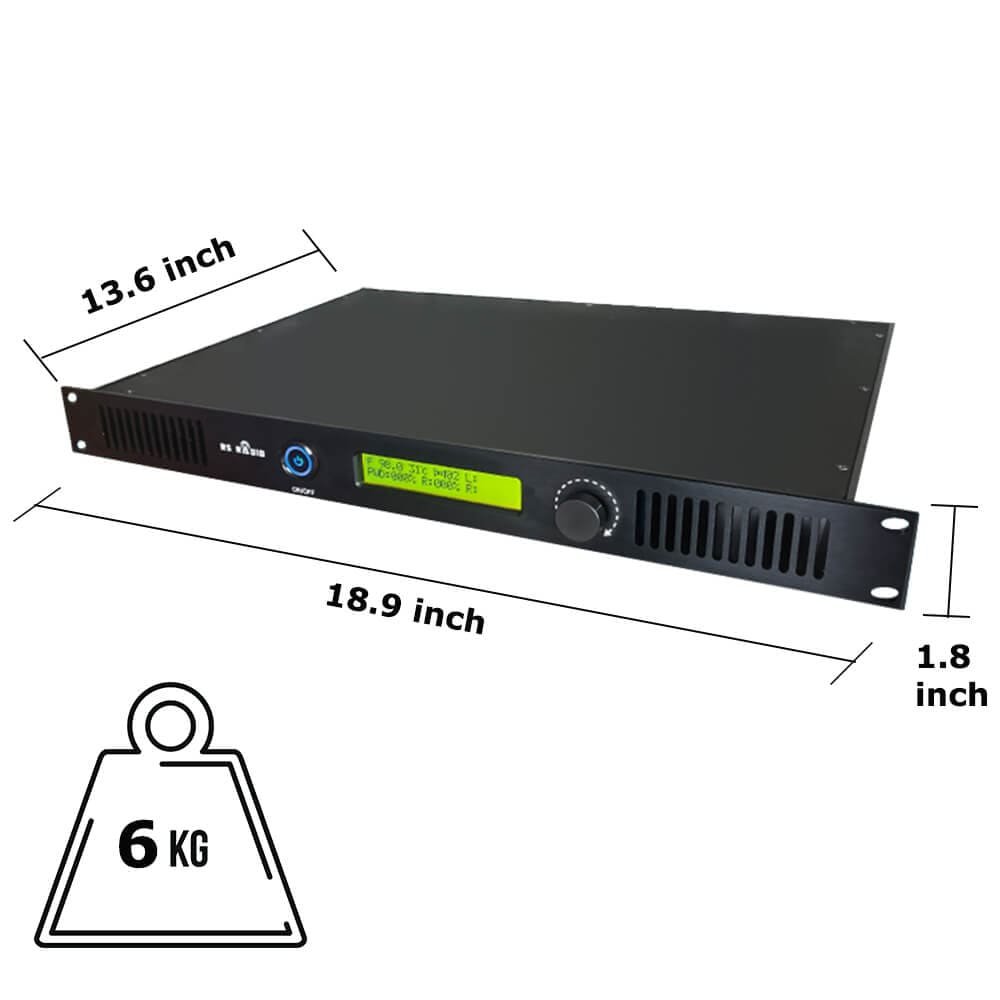
Compact desktop transmitters sit on tables or shelves in small spaces. I use these for low-power applications under 100W. The all-in-one enclosure includes everything in a single box. Maybe this simplicity helps non-technical operators. I trained complete beginners to run desktop transmitters in under 30 minutes.
The plug-and-play design requires minimal setup. I connect three cables: power, audio input, and antenna. The transmitter starts broadcasting immediately. Front panel LEDs show power output and operating status. I check these indicators during installation to verify proper operation. Red LED means overheating or antenna problems. Green LED confirms normal operation.
Desktop transmitters work well in limited spaces. I installed a 15W unit in a church storage closet measuring only 1.5 square meters. The built-in cooling fan exhausts heat adequately for powers under 50W. Higher power models need more ventilation. I measure room temperature after one hour of operation. If it exceeds 40°C, I add ventilation.
8. Portable Battery-Powered Transmitters
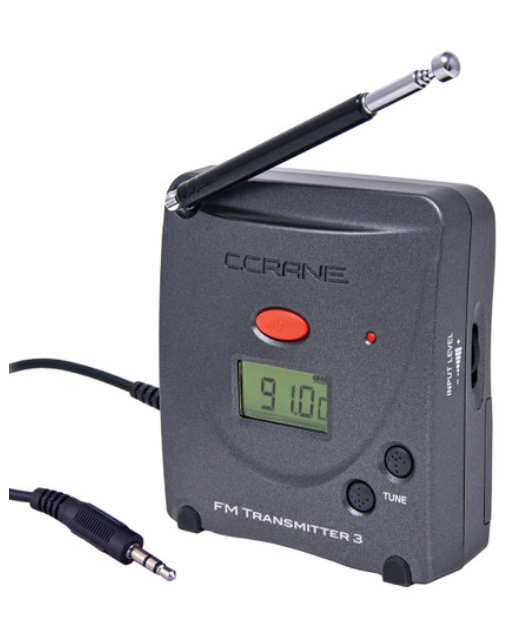
Portable transmitters serve temporary events and mobile broadcasting. I use battery-powered systems for outdoor church services and sports events. The complete system weighs 4-12kg depending on power level. Maybe this mobility helps venues without electrical power. I set up portable stations in parks, beaches, and parking lots.
Portable System Specifications:
| Power Output | Battery Type | Run Time | Setup Time | Coverage |
|---|---|---|---|---|
| 7W | Lithium 12V 10Ah | 10-12 hours | 5 minutes | 300-500m |
| 15W | Lithium 12V 20Ah | 6-8 hours | 10 minutes | 1-2km |
| 50W | Lithium 12V 40Ah | 4-6 hours | 15 minutes | 3-5km |
The quick deployment impressed event organizers. I assembled a complete portable station in 12 minutes including antenna setup. The telescoping antenna extends from 50cm to 2 meters. Built-in audio mixer accepts two microphone inputs. I connected wireless microphones directly without external equipment. The LCD screen displays battery voltage and transmitter power output.
Battery capacity determines operating time. I carry spare battery packs for all-day events. The charging time takes 3-4 hours for empty batteries. Some portable transmitters accept car battery connections for extended runtime. I ran a 15W system for 20 hours using a car battery. The transmitter drew 25 watts continuously. These systems work well for temporary broadcasts, outdoor events, emergency communications, and mobile religious services.
9. Drive-In Cinema Transmitters

Drive-in cinema transmitters deliver movie audio to car radios. I install these systems specifically for outdoor theaters. The coverage area needs to be precise – strong enough throughout the parking area but contained to avoid interference. A 15W or 50W transmitter typically covers a drive-in cinema lot. I measured field strength at 200 parking spots to verify adequate coverage.
Drive-In Cinema Requirements:
| Lot Capacity | Transmitter Power | Coverage Needed | Audio Processing | Typical Setup |
|---|---|---|---|---|
| 50-100 cars | 15W | 150-200m radius | Stereo, compressor | Single screen |
| 100-200 cars | 50W | 200-300m radius | Stereo, compressor | Single screen |
| 200+ cars | 100W | 300-400m radius | Stereo, dual audio | Multiple screens |
The audio processing matters significantly. Movie soundtracks have wide dynamic range. I install audio compressors to reduce volume differences between quiet dialogue and loud action scenes. This prevents viewers from constantly adjusting their car radio volume. The compression ratio should be 3:1 or 4:1. I set attack time to 5ms and release time to 100ms for natural sound.
Multiple screen operations need separate frequencies for each screen. I space frequencies at least 0.4 MHz apart to prevent interference. A three-screen cinema might use 87.7 MHz, 88.1 MHz, and 88.5 MHz. I verify frequency separation using a spectrum analyzer. The transmitter should include stereo encoding for full movie audio experience. I test both left and right channels before opening night.
10. Educational/Campus Radio Transmitters
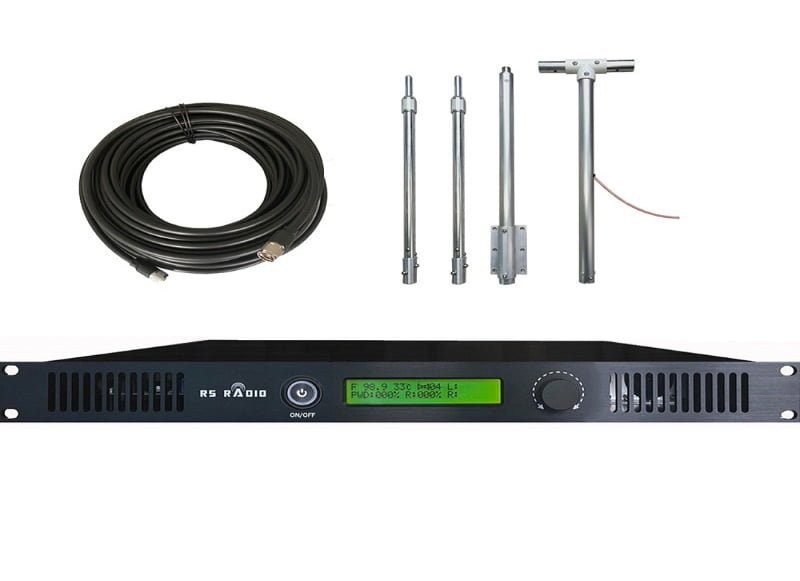
Educational transmitters serve schools and universities with limited coverage areas. I install campus radio systems following local broadcasting regulations. The power typically ranges from 10W to 100W depending on campus size. Maybe these systems help students learn broadcasting without expensive commercial equipment. I set up campus stations at five universities over the past three years.
Campus Radio Specifications:
| Campus Size | Power Level | Coverage Area | Features | Student Training Time |
|---|---|---|---|---|
| Small (1,000 students) | 10-15W | 1-2km | Basic controls | 1-2 hours |
| Medium (5,000 students) | 30-50W | 3-5km | Audio processing | 3-4 hours |
| Large (10,000+ students) | 50-100W | 5-10km | Full remote control | 4-6 hours |
The simplified interface prevents operational mistakes during student training. I configure critical settings like frequency and maximum power with password protection. Students access only audio level controls and on/off functions. This protects the broadcast license from accidental violations. The front panel displays show audio levels and transmitter status clearly.
Most educational stations operate part-time schedules. The transmitter might run only 4-6 hours daily during school terms. I program automatic on/off timers for consistent scheduling. The built-in audio processor maintains consistent sound quality despite varying operator skill levels. I set moderate compression and limiting to prevent overmodulation. Campus radio transmitters often include streaming encoders for simultaneous internet broadcast. This extends reach beyond the campus FM coverage area.
Choosing the Right FM Transmitter Type
Select your transmitter type based on actual coverage needs, not maximum possible power. I see many stations overspend on power they never effectively use. A 50W transmitter covers most church parking lots and small community areas. Religious networks serving multiple towns need 300W to 1KW models. Commercial stations covering cities require 2KW or higher. Calculate your coverage area first, then choose appropriate power.
Consider your technical skill level honestly. Desktop and package systems suit operators with minimal technical knowledge. Rack-mount professional transmitters need trained staff for maintenance. I recommend starting with lower power and upgrading later if needed. This approach costs less initially and provides operational experience. Match the transmitter type to your application – drive-in cinemas need different features than campus radio stations.