Top 10 Questions to Ask Your FM Transmitter Supplier Before You Buy
I’ve watched dozens of stations buy cheap transmitters, then struggle with frequency drift, overheating, or zero technical support. Maybe the worst case: a church in Nigeria spent $800 on transmitter that failed after 3 months—supplier disappeared, no spare parts available, total loss. The right questions before purchase prevent expensive mistakes. These 10 questions separate professional suppliers from equipment resellers.
Question 1: What Broadcast Power Levels Do You Specialize In?
Why This Question Matters:
Not all manufacturers excel at all power levels. Maybe a supplier makes great 5000W commercial transmitters but their 100W community models are poorly designed. Or they primarily sell consumer-grade equipment and don’t understand professional broadcasting requirements.
What to Look For:
Comprehensive Power Range: Professional supplier should offer multiple power levels from low power (15-100W) through medium power (300-1000W) to high power (3000W+). This shows engineering capability across different designs.
Specialization Evidence: Ask which power levels sell most. If they say "we sell everything equally," they might be generalists without deep expertise. Strong suppliers have popular models where engineering is refined through hundreds of deployments.
Real Coverage Data: Professional suppliers provide coverage estimates by power level with antenna height specifications. For example:
- 100W with 2-bay antenna at 30m height: 10-15 km radius
- 300W with 4-bay antenna at 50m height: 18-25 km radius
Warning Signs:
- Only sell one or two power levels (limited engineering capability)
- Can’t explain power selection for different applications
- Provide unrealistic coverage claims without antenna/height context
- Push highest power regardless of your needs
Good Supplier Response Example:
"Our most popular models are 100W ($650) for community radio and 300W ($1,339) for commercial stations. We manufacture from 15W to 5000W. For your coverage goal of 20 km radius, I’d recommend 300W with our 4-bay antenna at minimum 30m height. The 500W option ($1,560) gives you expansion room if you want to serve additional area later. Here’s coverage map showing expected field strength at various distances…"
Bad Supplier Response Example:
"We have all powers. Just tell me your budget and I’ll send you something. 1000W is best—more power is always better. Coverage? Maybe 50-100 km, depends on many factors…"
What You Should Ask Specifically:
| Question | Purpose |
|---|---|
| What’s your most popular power level and why? | Reveals specialization and experience |
| How many stations have you deployed at my target power level? | Verifies track record |
| Can you provide coverage calculations for my specific site? | Tests engineering capability |
| What power do you recommend for my coverage goal and why? | Assesses honest technical guidance |
Professional suppliers will recommend appropriate power for your situation, not maximum power for maximum sale.
Question 2: Are Your Transmitters PLL or DDS Based?
Why This Question Matters:
Frequency stability is critical for legal broadcasting. Drift off your licensed frequency by even 0.01 MHz creates regulatory violations and interference with adjacent channels. The frequency synthesis method determines stability.
Technology Comparison:
| Feature | PLL (Phase-Locked Loop) | DDS (Direct Digital Synthesis) |
|---|---|---|
| Frequency Stability | ±2 ppm (excellent) | ±10-50 ppm (variable) |
| Regulatory Compliance | Professional standard | Sometimes inadequate |
| Temperature Stability | Excellent | Moderate |
| Typical Use | Professional broadcasting | Consumer equipment |
| Cost | Moderate | Lower |
What Professional Suppliers Answer:
"All our transmitters use PLL frequency synthesis with TCXO (temperature-compensated crystal oscillator). Frequency stability is ±2 ppm across -10°C to +50°C operating range. This ensures you stay within ±0.002 MHz of licensed frequency even in hot transmitter room. We provide frequency stability test reports with each transmitter."
What to Look For:
PLL Confirmation: Transmitter should use PLL-based frequency generation, not simple VCO (voltage-controlled oscillator) or basic DDS.
Stability Specification: Ask for frequency stability spec in ppm (parts per million). Professional broadcasting requires ±5 ppm maximum, ±2 ppm is better.
Temperature Performance: Frequency shouldn’t drift as transmitter heats up during operation. Ask about stability across operating temperature range.
Verification Method: Can supplier provide spectrum analyzer plots showing actual frequency stability over time?
Why This Matters in Practice:
Your licensed frequency: 96.5 MHz
Adjacent channel station: 96.3 MHz (200 kHz below you)
Scenario A – Poor Frequency Stability (±50 ppm):
- Your transmitter drifts ±0.005 MHz (5 kHz) with temperature
- Over several hours, you might drift from 96.500 MHz to 96.495 MHz
- Now you’re only 195 kHz from adjacent channel instead of 200 kHz
- Interference risk increases, regulatory violation possible
Scenario B – Professional PLL (±2 ppm):
- Frequency stays within ±0.0002 MHz (0.2 kHz)
- Remains solidly at 96.500 MHz regardless of temperature
- Full 200 kHz protection maintained to adjacent channel
- Regulatory compliant, no interference risk
Warning Signs:
- Supplier can’t explain frequency synthesis method
- No frequency stability specification provided
- Claims "frequency is adjustable" without mentioning stability
- Price is significantly lower than competitors (often indicates VCO not PLL)
Technical Follow-Up Questions:
| Question | What It Reveals |
|---|---|
| What reference oscillator do you use? | TCXO or crystal? Quality level |
| Can I see spectrum analyzer plot of your transmitter output? | Verifies actual frequency accuracy |
| How often does frequency need recalibration? | Stability over time |
| What frequency accuracy do you guarantee? | Contractual commitment |
Maybe supplier says "we use microprocessor control" or "digital frequency display"—these don’t guarantee PLL. Ask specifically about PLL frequency synthesis.
Real Example:
Supplier A: "Yes, PLL-based with ±2 ppm stability. Here’s spectrum plot from our 300W model showing 96.500 MHz ±0.0001 MHz over 24-hour test. Crystal oscillator is temperature-compensated for -10°C to +60°C."
Supplier B: "Frequency is very stable, digital control. You can set any frequency from 87-108 MHz. Very accurate."
Supplier A demonstrates professional engineering. Supplier B avoids technical details—possible warning sign.
Question 3: What Is the Real Coverage Range (ERP-Based) for Each Model?
Why This Question Matters:
Many suppliers advertise "30 km coverage!" for 100W transmitter without mentioning this requires professional antenna at significant height. Real coverage depends on transmitter power, antenna gain, antenna height, and terrain.
The ERP Concept:
ERP (Effective Radiated Power) = Transmitter Power × Antenna Gain × Efficiency – Feedline Loss
Example Calculation:
- Transmitter: 100W
- Antenna: 2-bay circular (6 dB gain = 4× multiplier)
- Cable loss: 2 dB (60% efficiency)
- ERP: 100W × 4 × 0.6 = 240W ERP
Coverage calculations use ERP, not transmitter power alone.
What Professional Suppliers Provide:
Realistic Coverage Tables:
| Transmitter Power | Antenna Setup | Approximate ERP | Coverage Radius (Flat Terrain) |
|---|---|---|---|
| 100W | 2-bay at 30m | ~250W | 10-15 km |
| 300W | 4-bay at 30m | ~900W | 15-22 km |
| 500W | 4-bay at 50m | ~1500W | 20-28 km |
| 1000W | 4-bay at 50m | ~3000W | 28-35 km |
Note: These are guidelines for flat terrain. Actual coverage varies with terrain, obstacles, receiver sensitivity.
Good Supplier Response:
"Our 300W transmitter ($1,339) with our 4-bay antenna ($650) at 30m height provides approximately 900W ERP. On flat terrain, this typically covers 18-25 km radius reliably. If you’re in hilly area or have urban obstacles, expect 15-20 km. We can run Radio Mobile simulation for your specific location using terrain data if you provide coordinates."
Bad Supplier Response:
"Our 300W transmitter covers 50 km easily! Very powerful signal, can reach entire district!"
Warning Signs:
- Coverage claims without antenna specifications
- Unrealistic distances for power level
- No mention of terrain or height factors
- Can’t explain ERP calculation
- Won’t provide coverage modeling tools or services
Follow-Up Questions:
| Question | Purpose |
|---|---|
| What antenna gain is included in your coverage estimate? | Separates transmitter power from system ERP |
| At what antenna height is coverage measured? | Height dramatically affects coverage |
| Can you show Radio Mobile or similar modeling for my site? | Professional engineering capability |
| What’s the expected field strength at coverage edge? | Technical accuracy (should be 48-54 dBμV/m) |
Real-World Coverage Reality Check:
Station in Tanzania, 300W Transmitter:
Supplier Promise: "40 km coverage guaranteed"
Actual Results:
- Antenna at 20m height (short tower)
- Hilly terrain with scattered mountains
- Urban obstacles in some directions
- Actual coverage: 12-18 km depending on direction
Problem: Supplier made unrealistic promise. Station disappointed despite transmitter working perfectly to specifications.
Better Supplier Approach: "With 300W and our 4-bay antenna at 20m height in hilly terrain, expect 12-18 km coverage. To reach 30 km, you’d need either 50m tower height or upgrade to 500-1000W. Let’s discuss your specific terrain and target coverage areas."
What You Should Verify:
✓ Coverage estimates include complete system (transmitter + antenna + height)
✓ Terrain type specified (flat, rolling hills, mountains, urban)
✓ Supplier willing to provide modeling for your specific site
✓ Understands difference between transmitter power and ERP
✓ Coverage claims match industry standards for power level
Don’t accept vague promises. Get specific coverage predictions based on your site conditions.
Question 4: What Kind of Protection and Safety Features Are Built In?
Why This Question Matters:
FM transmitters operate at high RF power continuously. Without proper protection systems, equipment damage from fault conditions is expensive. Professional transmitters protect themselves and connected equipment automatically.
Essential Protection Features:
| Protection Type | Purpose | What Happens Without It |
|---|---|---|
| Over-Temperature Shutdown | Prevents thermal damage | Transmitter overheats, components fail, expensive repair |
| High SWR (Standing Wave Ratio) Protection | Prevents damage from antenna problems | Output stage burns out ($200-$800 repair) |
| Over-Current Protection | Prevents electrical damage | Circuit board damage, total transmitter failure |
| Under/Over Voltage Protection | Handles power supply fluctuations | Random failures, shortened component life |
| Soft-Start Circuit | Reduces power-on stress | Premature component aging |
Professional Transmitter Protection Systems:
Good Example – RS 300W Transmitter Protection:
Temperature Protection:
- Continuous temperature monitoring
- Auto power reduction at 55°C
- Complete shutdown at 60°C
- LED indicator shows temperature status
- Automatic restart after cooling
SWR Protection:
- Monitors forward and reflected power
- Reduces power if SWR exceeds 1.5:1
- Shuts down if SWR exceeds 2.0:1
- Protects expensive output stage
Power Supply Protection:
- Operates safely from 200-250V AC
- Under-voltage lockout below 180V
- Over-voltage protection above 260V
- Soft-start reduces inrush current
Over-Current Protection:
- Current limiting on all critical circuits
- Fast-acting fuses protect transformers
- LED indicators show fault conditions
What to Look For in Supplier Response:
Detailed Protection Explanation: Supplier should be able to explain each protection system, not just list features.
Automatic vs Manual: Professional systems protect automatically without operator intervention. Manual shut-off requirements indicate inadequate design.
Temperature Threshold: Ask at what temperature transmitter protects itself. 60-65°C shutdown is professional standard. Above 70°C is risky.
SWR Threshold: Good transmitters detect antenna problems at SWR 1.5:1 and shut down by 2.0:1. No SWR protection means certain output stage failure eventually.
Protection Testing: Can supplier demonstrate protection features? Professional manufacturers test protection systems during production.
Warning Signs:
- Vague answers about protection ("yes, it has protection")
- No temperature shutdown specified
- No SWR protection mentioned
- Claims "built very strong, doesn’t need protection"
- Fuses only protection mentioned (inadequate)
Real Cost of No Protection:
Station in Ghana, Cheap Transmitter Without Protection:
Month 3: Lightning nearby creates power surge
- No surge protection
- Power supply damaged: $150 repair
Month 6: Antenna cable connector loosens
- High SWR condition
- No SWR protection
- Output stage burns out: $400 repair
Month 10: Hot season, transmitter room reaches 45°C
- No temperature protection
- Continuous operation at extreme temperature
- Capacitors fail prematurely: $200 repair
Total damage in 10 months: $750 in repairs
vs
Station with Professional Protected Transmitter:
Same conditions occur, but:
- Surge protection handles power fluctuation
- SWR protection shuts down when antenna loosens (operator fixes connection, no damage)
- Temperature protection reduces power in extreme heat
Total damage: $0
The protected transmitter costs $200-300 more initially, but saves $750+ in repairs. Protection systems pay for themselves.
Questions to Ask Specifically:
| Question | What It Reveals |
|---|---|
| At what temperature does transmitter shut down? | Temperature protection threshold |
| What happens if antenna connection fails? | SWR protection functionality |
| How does transmitter handle power fluctuations? | Voltage protection capability |
| Can you show me protection system activation? | Willingness to demonstrate features |
Professional Supplier Response Example:
"Temperature protection activates at 60°C—you’ll see yellow LED warning first at 55°C. SWR protection monitors continuously—if antenna SWR exceeds 1.5:1, power reduces automatically, and transmitter shuts down at 2.0:1 to protect output stage. Front panel LEDs show all protection status. Power supply handles 180-260V safely. We can demonstrate these protections during testing if you’d like."
Protection systems are invisible until you need them—then they’re invaluable. Don’t buy transmitter without comprehensive protection features.
Question 5: Do You Provide Compliance Certificates (FCC, CE, ITU Standards)?
Why This Question Matters:
Many countries require imported radio equipment to have international compliance certificates. Without proper documentation, your equipment might be:
- Blocked at customs
- Refused licensing by broadcasting authority
- Subject to regulatory fines if operating illegally
- Rejected by insurance companies
Professional suppliers provide necessary compliance documentation automatically.
Key Compliance Standards:
| Certificate | Coverage | Required For |
|---|---|---|
| FCC (Federal Communications Commission) | USA market requirements | US stations, some international buyers |
| CE (Conformité Européenne) | European Union standards | EU countries, widely accepted globally |
| ITU (International Telecommunication Union) | International standards | Many countries recognize ITU compliance |
| RoHS | Hazardous materials restriction | Environmental compliance |
What Professional Suppliers Provide:
Certificate Package:
- FCC Part 15 compliance (for transmitters exported to USA)
- CE marking with DoC (Declaration of Conformity)
- Test reports from accredited laboratories
- Technical specifications conforming to ITU-R standards
- RoHS compliance for environmental safety
Why This Matters Practically:
Station Importing 300W Transmitter to Kenya:
Scenario A – No Certificates:
- Transmitter arrives at customs
- Customs requests compliance documentation
- Station cannot provide CE or standards compliance
- Customs holds shipment pending documentation
- Station pays storage fees ($20/day)
- Eventually must pay penalty fee ($200-500) or return shipment
- Timeline: 2-4 weeks delay, additional costs $300-800
Scenario B – Full Compliance Documentation:
- Transmitter arrives with FCC/CE certificates in package
- Customs reviews documentation
- Shipment clears within 2-3 days
- No additional fees
- Station installs equipment on schedule
Licensing Requirements:
Broadcasting Authority Application:
Most countries require equipment specifications including:
- Frequency stability certification
- Spurious emission limits compliance
- Harmonic suppression test results
- Power output accuracy verification
Professional manufacturers provide these test reports automatically. Suppliers without certificates cannot provide required documentation for license applications.
Insurance Considerations:
Broadcast Insurance Policies often require:
- Equipment meets recognized safety standards (CE, FCC)
- Installation by qualified technicians
- Regular maintenance documentation
Using non-compliant equipment might void insurance coverage. If transmitter causes fire or equipment damage, insurance may refuse claim.
Warning Signs:
- Supplier says "certificates not needed"
- Offers to "help you get certificates" after purchase (likely fake)
- Shows generic documents not specific to purchased model
- Can’t provide certificate numbers for verification
- Certificates look photocopied or unclear
How to Verify Certificates Are Real:
FCC Verification:
- Check FCC database at fcc.gov/oet/ea/fccid
- Enter FCC ID from certificate
- Verify manufacturer and model match
- Confirm grant date and current status
CE Verification:
- Certificate should show notified body number (4-digit code)
- Include Declaration of Conformity signed by manufacturer
- Test report from accredited laboratory (with lab accreditation number)
Questions to Ask:
| Question | Purpose |
|---|---|
| What compliance certificates do you provide? | Understand what’s included |
| Can you send me copies before purchase? | Verify authenticity |
| Are certificates specific to my model or generic? | Ensure model-specific compliance |
| What test lab conducted compliance testing? | Verify legitimate testing |
| How do I verify certificate authenticity? | Check for red flags |
Professional Supplier Response:
"Every transmitter ships with FCC Part 15 and CE compliance certificates. Here’s our FCC ID: [specific number] which you can verify at fcc.gov/oet/ea/fccid. CE testing was conducted by [laboratory name], an ISO 17025 accredited lab. We’ll include original certificates, test reports, and Declaration of Conformity with your shipment. I can email you sample certificates now if you’d like to review before ordering."
Cost Impact of Non-Compliance:
Compliant Transmitter: $1,339 (includes certification)
Non-Compliant Transmitter: $1,100 initially (seems cheaper)
Hidden costs of non-compliance:
- Customs delays: $200-500
- Regulatory penalty: $500-2,000
- Possible equipment seizure: $1,100 total loss
- License application rejection: delayed revenue $5,000-10,000
Real total cost: $1,100 + $2,800-13,600 in problems = $3,900-14,700
The $239 saved buying non-compliant equipment costs $2,561-13,361 in problems. Compliance certificates aren’t optional extras—they’re essential cost savings.
What You Should Verify Before Purchase:
✓ Supplier provides FCC and CE certificates automatically
✓ Certificates are original, not photocopies
✓ Certificates match your specific model number
✓ You can independently verify certificate authenticity
✓ Test reports from accredited laboratories included
✓ Declaration of Conformity properly signed and dated
Don’t accept "we’ll provide certificates later" or "certificates not necessary"—these are red flags indicating potential compliance problems.
Question 6: What Are the Cooling and Efficiency Specs?
Why This Question Matters:
FM transmitters convert electrical power to RF power, generating significant heat. Cooling system quality determines:
- Transmitter reliability and lifespan
- Operating costs (efficient transmitters use less electricity)
- Installation requirements (forced-air vs passive cooling)
- Maintenance frequency
Poor cooling design causes premature failures and high operating costs.
Efficiency Comparison:
| Transmitter Power | Efficient Design Power Consumption | Inefficient Design Power Consumption | Annual Cost Difference (at $0.15/kWh) |
|---|---|---|---|
| 100W | 280W (~36% efficiency) | 450W (~22% efficiency) | $223 |
| 300W | 750W (~40% efficiency) | 1200W (~25% efficiency) | $592 |
| 1000W | 2200W (~45% efficiency) | 3500W (~29% efficiency) | $1,711 |
Efficient transmitter saves substantial money every year in electricity costs.
Professional Cooling Systems:
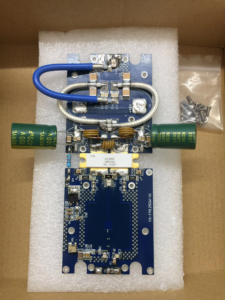
High-Efficiency Class-C Amplifier Design:
- Modern RF transistors (MOSFET or LDMOS)
- Optimized bias circuits minimize heat generation
- Efficiency typically 35-45% depending on power level
Advanced Cooling Features:
- Large aluminum heatsinks with finned design
- Forced-air cooling with temperature-controlled fans
- Thermal compound on all RF transistors
- Strategic airflow path keeping hottest components coolest
- Intake filters preventing dust accumulation
Temperature Monitoring:
- Sensors on critical components
- LED or display shows real-time temperature
- Automatic fan speed adjustment based on temperature
- Over-temperature protection activates before damage occurs
What to Ask Suppliers:
| Question | What It Reveals |
|---|---|
| What’s the total power consumption at full output? | True efficiency (power out ÷ power in) |
| What type of cooling system (passive, forced-air, both)? | Cooling capability |
| What’s the maximum safe operating temperature? | Design thermal margin |
| How often do cooling fans need replacement? | Maintenance requirements |
| Can transmitter operate in tropical climates (35-40°C ambient)? | Cooling system adequacy |
Good Supplier Response Example:
"Our 300W transmitter consumes 750W at full power—that’s 40% efficiency, typical for Class-C design. Cooling uses three temperature-controlled fans pulling air across finned aluminum heatsinks. Internal temperature stays below 50°C even at 35°C ambient. Fans are rated 50,000 hours (5-7 years continuous operation). Transmitter operates safely in ambient up to 45°C. Over-temperature protection activates at 60°C, so there’s 10-15°C safety margin."
Bad Supplier Response Example:
"It has fan cooling, works fine. Power consumption is not too much. Can work in any weather."
Real Operating Cost Analysis:
Station Running 300W Transmitter 24/7:
Efficient Transmitter (750W consumption):
- Daily: 750W × 24h = 18 kWh
- Monthly: 18 × 30 = 540 kWh
- Annual: 540 × 12 = 6,480 kWh
- Annual cost at $0.15/kWh: $972
Inefficient Transmitter (1200W consumption):
- Daily: 1200W × 24h = 28.8 kWh
- Monthly: 28.8 × 30 = 864 kWh
- Annual: 864 × 12 = 10,368 kWh
- Annual cost at $0.15/kWh: $1,555
Difference: $583/year wasted on inefficient design
Over 5 years: $2,915 wasted
Over 10 years: $5,830 wasted
The efficient transmitter might cost $200 more initially but saves $5,830 over 10 years—that’s $5,630 net savings.
Cooling System Reliability:
Professional Design:
- Large passive heatsinks handle bulk of cooling
- Fans supplement during high ambient temperature
- If fan fails, transmitter reduces power but continues operating
- Fan replacement is simple maintenance
Poor Design:
- Small heatsinks require fans to run constantly
- If fan fails, transmitter overheats immediately
- Emergency shutdown, station off-air until repair
- Fan failure = potential transmitter damage
Installation Environment Considerations:
Tropical Climate (35-40°C ambient):
- Needs robust forced-air cooling
- Oversized heatsinks
- Temperature-controlled fan management
Temperate Climate (15-25°C ambient):
- Can operate with minimal cooling
- Fans run less = longer fan life
- More forgiving of design limitations
High Altitude (above 2000m):
- Thinner air reduces cooling efficiency
- May need derating (running 300W transmitter at 250W)
- Critical to ask supplier about altitude operation limits
Dust and Harsh Environments:
- Intake filters essential
- IP-rated enclosures for dusty locations
- Sealed components prevent contamination
Warning Signs of Poor Cooling Design:
- Supplier can’t specify power consumption
- No information about cooling system type
- Temperature specifications absent
- No ambient temperature operating limits mentioned
- Fan noise complaints from other customers
- Short fan lifespan (less than 2-3 years)
Questions About Maintenance:
| Question | Purpose |
|---|---|
| How often should cooling fans be cleaned/replaced? | Ongoing maintenance requirements |
| Are replacement fans available and what’s the cost? | Parts availability |
| Can transmitter operate temporarily without fans? | Redundancy and safety margin |
| What’s the typical heatsink temperature during normal operation? | Thermal design adequacy |
Efficiency Testing:
Professional supplier should be able to provide:
- Power consumption measurements at various output levels
- Thermal imaging showing heat distribution
- Long-term reliability data from deployed transmitters
Ask: "Can you show me power consumption test data for the transmitter I’m considering?"
What You Should Verify:
✓ Power consumption specified for full output
✓ Efficiency at least 35-40% (power out ÷ power in)
✓ Forced-air cooling with temperature control
✓ Operates safely in your climate conditions
✓ Cooling fans rated minimum 30,000 hours
✓ Over-temperature protection included
✓ Replacement fans available and affordable
Cooling and efficiency directly affect operating costs and reliability. A transmitter that’s 10% more efficient saves hundreds of dollars annually—these savings compound over the transmitter’s 10-15 year life.
Question 7: What After-Sales and Technical Support Can I Expect?
Why This Question Matters:
Equipment is only as good as the support behind it. When technical problems arise—and they will—your supplier’s response determines whether you’re off-air for 2 hours or 2 weeks. Support quality separates professional manufacturers from equipment dealers.
Essential Support Elements:
| Support Type | What It Includes | Why It Matters |
|---|---|---|
| Warranty Coverage | Repair/replacement duration and terms | Protection against defects |
| Technical Response Time | How quickly engineers respond to problems | Minimizes downtime |
| Remote Diagnosis | Phone, email, video call troubleshooting | Solves problems without shipping |
| Spare Parts Availability | Can you get replacement components quickly? | Fast repairs when needed |
| Documentation Quality | Manuals, schematics, troubleshooting guides | Enables self-repair |
| Training Availability | Installation and operation instruction | Prevents user errors |
Professional Support Structure:
Good Example –
RS Support System:
5-Year Warranty:
- All transmitters 50W and above: 5-year parts and labor warranty
- 15W-30W models: 3-year warranty
- Covers manufacturing defects and component failures
- No-hassle replacement for defective units
WhatsApp Engineering Support Group:
- Direct access to technical engineers
- Response within 4-12 hours (usually faster)
- Engineers speak English, French, Spanish, Portuguese
- Video call support for complex troubleshooting
- Screenshot/photo diagnosis of problems
Remote Technical Guidance:
- Step-by-step troubleshooting instructions
- Help interpreting test equipment readings
- Configuration assistance
- Performance optimization tips
Spare Parts Access:
- Replacement boards, transistors, filters available
- International shipping within 3-5 days
- Parts pricing reasonable (not inflated)
- Lifetime parts availability commitment
Documentation Package:
- User manual in English with clear diagrams
- Installation guide with step-by-step photos
- Troubleshooting flowcharts
- Schematic diagrams for technical staff
- Spare parts list with part numbers
What to Ask Specifically:
Warranty Questions:
"What exactly does your warranty cover? Manufacturing defects only, or also component failures? How long is coverage? What’s the process if I need warranty service—do I ship transmitter back or do you send replacement parts? Who pays shipping costs?"
Professional Response:
"5-year warranty covers all manufacturing defects and component failures under normal use. If problem occurs, we diagnose remotely first—maybe 80% of issues we can solve by phone/video without shipping anything. If part replacement needed, we ship spare part to you with installation video. You don’t ship transmitter back unless complete board replacement needed. Shipping cost for parts under warranty is our responsibility."
Response Time Questions:
"If my transmitter stops working, how quickly can I reach your technical team? What hours are they available? What languages do they speak? Can they help via phone or video call?"
Professional Response:
"Technical support available 24/7 via WhatsApp +86-181-2459-4271. Engineers respond within 4-12 hours, usually much faster. We speak English primarily, also French, Spanish, Portuguese. Video call support available—we can see your problem and guide you through diagnosis. Most technical issues solved within 24 hours."
Spare Parts Questions:
"What if I need replacement part in 2 or 3 years? Will parts still be available? How much do common spare parts cost? How long does shipping take?"
Professional Response:
"We maintain spare parts inventory for all transmitter models. Committed to parts availability for life of product. Common parts like RF transistors ($30-50), power supply boards ($80-120), filters ($40-60) available immediately. International shipping 3-5 days via DHL/FedEx. We’ll help you identify exactly which part needed before ordering."
Real Support Comparison:
Station A – Professional Supplier Support:
Problem: Transmitter shows reduced power output
Timeline:
- Hour 0: Contact supplier via WhatsApp
- Hour 2: Engineer responds, requests photos of front panel and power meter
- Hour 4: Diagnosis: likely RF transistor aging
- Hour 6: Engineer ships replacement transistor ($35) via FedEx
- Day 3: Part arrives
- Day 3 + 2 hours: Engineer guides installation via video call
- Total downtime: 3 days
Station B – Poor Supplier Support:
Problem: Same issue
Timeline:
- Day 0: Send email to supplier
- Day 3: Generic response: "Please check antenna connection"
- Day 5: Follow-up email explaining antenna is fine
- Day 8: Supplier says "maybe need send back for repair"
- Day 10: Ship transmitter back (customer pays $120 shipping)
- Day 17: Transmitter arrives at supplier
- Day 24: Supplier emails "fixed, shipping back"
- Day 31: Transmitter returns
- Total downtime: 31 days
Station A was back on air in 3 days. Station B lost 31 days of broadcasting—maybe $500-2,000 in advertising revenue lost.
Warning Signs of Poor Support:
- No warranty period specified or very short (1 year or less)
- No direct technical contact provided (only sales email)
- Support only available during limited hours
- No spare parts availability mentioned
- Documentation is minimal or only in Chinese
- Previous customers complain about support response
The Training Component:
Installation Support:
- Professional suppliers provide installation guidance
- Step-by-step instructions with photos/videos
- Help with antenna connection, grounding, configuration
- Available during your installation time
Operation Training:
- How to adjust power levels
- How to set frequency
- How to monitor performance
- How to recognize problems early
Maintenance Training:
- What to check regularly
- When to clean cooling fans
- How to verify antenna SWR
- Preventive maintenance schedule
Maybe supplier offers free video training session after purchase—this is valuable professional service.
Support Cost Analysis:
Transmitter A: $1,339 with excellent 5-year warranty and lifetime support
Transmitter B: $1,100 with 1-year warranty and poor support
Real costs over 5 years:
Transmitter A:
- Purchase: $1,339
- Support incidents: 2 (both handled remotely, no cost)
- Total 5-year cost: $1,339
Transmitter B:
- Purchase: $1,100
- Year 2 problem: $150 repair + $120 shipping = $270
- Year 4 problem: $200 repair + $120 shipping = $320
- Lost revenue from downtime: $800
- Total 5-year cost: $2,490
Transmitter B "saved" $239 initially but cost $1,151 more overall—plus the stress of poor support.
Questions to Ask:
| Question | Purpose |
|---|---|
| What warranty period do you provide? | Coverage duration |
| How do I contact technical support when I have problems? | Access to help |
| What’s your typical response time? | Speed of support |
| Can you show examples of how you’ve helped other customers? | Support quality evidence |
| Are spare parts available long-term and what’s the cost? | Future maintenance feasibility |
| What documentation and training do you provide? | Self-service capability |
Getting Support Commitment in Writing:
Professional suppliers will put support terms in purchase agreement:
- Warranty period and coverage
- Response time commitment
- Spare parts availability guarantee
- Technical support access methods
If supplier won’t commit to support terms in writing—walk away.
What You Should Verify:
✓ Minimum 3-year warranty (5-year for professional equipment)
✓ Direct technical support contact (phone, WhatsApp, email)
✓ Response time commitment (within 24 hours at minimum)
✓ Spare parts availability with pricing
✓ Comprehensive documentation included
✓ Remote troubleshooting capability
✓ Real customer references showing good support
Support quality determines your station’s uptime and success. Equipment price is one-time cost—support relationship is forever. Choose supplier you can rely on when problems arise.
Question 8: How Customizable Is Your System (Inputs, Control, Telemetry)?
Why This Question Matters:
Modern broadcasting needs flexibility. Maybe you start with simple audio input but later want to add RDS, remote control, or network streaming. Maybe you need specific input connectors to match existing equipment. Professional transmitters offer configuration options that adapt to your evolving needs.
Key Customization Areas:
Audio Inputs:
- Balanced XLR professional audio input
- Unbalanced RCA consumer input
- Composite input for RDS/subcarrier services
- PC/USB audio input
- IP audio streaming input
Control Options:
- Front panel local control
- Remote control via internet
- RS-232/RS-485 serial control
- Contact closure inputs for automation
- SNMP network management
Monitoring Features:
- Forward/reflected power display
- Temperature monitoring
- Modulation level metering
- Remote status monitoring
- Alarm outputs for fault conditions
Professional System Example:
RS 300W Transmitter Customization:
Standard Configuration ($1,339):
- Balanced XLR audio input
- Front panel LCD control
- Forward/reflected power meters
- Temperature monitoring with LED indicators
- Composite input ready for future RDS
Optional Additions:
- RDS encoder: +$280
- Remote control via internet: +$200
- Automation contact inputs: +$100
- SNMP monitoring: +$150
Total customized system: $2,069 with all features
Why Customization Matters:
Scenario: Community Radio Growth:
Year 1: Simple operation
- Audio from mixer to transmitter
- Manual frequency/power control at transmitter site
- Basic monitoring
Year 2: Adding features
- Implement RDS for station identification
- Need composite input (already available)
- Add RDS encoder ($280)
Year 3: Remote operation
- Move studio to different location
- Need remote transmitter control
- Add internet remote control ($200)
Year 4: Automation
- Schedule automatic power changes
- Need contact closure inputs
- Add automation module ($100)
Total growth cost: $580 in additions vs buying new $2,000+ transmitter
The customizable system grows with station needs affordably.
Non-Customizable Transmitter Problem:
Cheap Transmitter ($900, basic features only):
- Audio input: unbalanced RCA only (no professional audio)
- Control: front panel only
- No composite input (cannot add RDS)
- No remote control capability
- Basic power meter only
Year 2 needs change:
- Want to add RDS: Impossible, no composite input
- Want remote control: Impossible, no control interface
- Want professional audio: Difficult, need audio transformer
- Solution: Buy new transmitter $1,300+
Result: The "cheap" transmitter actually costs $900 + $1,300 = $2,200 total
The customizable transmitter costs $1,339 + $580 = $1,919 total—saved $281 plus avoided hassle of changing transmitters.
Input Compatibility Questions:
What to Ask:
"What audio input types do you support? I’m using [describe your audio source]. Can I connect directly or do I need adapters? What input level and impedance?"
Professional Response:
"We provide balanced XLR input (professional standard) with +4 dBu nominal level, 10kΩ impedance. Your mixer outputs balanced XLR, so direct connection works perfectly. We also include RCA unbalanced input for consumer equipment. Input level adjustable from -10 dBu to +10 dBu to match various sources. If you plan to add RDS, the composite input is already built in—just add RDS encoder when ready."
Remote Control Capabilities:
Basic Remote Control Needs:
- Turn transmitter on/off from studio
- Adjust power level remotely
- Monitor transmitter status
- Receive alarms if problems occur
Advanced Remote Control:
- Full control via web browser from anywhere
- Automatic power scheduling
- Data logging and performance tracking
- Email/SMS alerts for fault conditions
- Multi-transmitter network management
Professional Transmitters (like RS 300W+) offer remote control options:
Internet Remote Control Kit (+$200):
- Web interface accessible from any browser
- Turn on/off remotely
- Adjust power, frequency, modulation
- View all meters and status
- Configure alarm notifications
- Automatic status logging
This is essential if:
- Transmitter site is remote/difficult to access
- You want unmanned operation
- Multiple people need to monitor status
- You’re building transmitter network
Automation Interface:
Contact Closure Inputs/Outputs:
- Trigger transmitter actions from automation system
- Report transmitter status to automation
- Schedule power changes
- Emergency alert system integration
Example Uses:
- Lower power automatically at night (save electricity, comply with regulations)
- Shut down during maintenance windows
- Start backup transmitter if main fails
- Integrate with studio automation
Monitoring and Telemetry:
What You Can Monitor:
- Output power (forward and reflected)
- Internal temperature
- Power supply voltage
- Modulation level
- Frequency accuracy
- SWR status
- Fan operation
How You Access Monitoring:
- Front panel display (local)
- Web interface (remote)
- SNMP polling (network management system)
- API integration (custom software)
- Email alerts (automatic notifications)
Professional Example:
Station monitors 5 remote transmitters:
- Web dashboard shows all transmitter status
- If any transmitter temperature exceeds 55°C: email alert
- If any transmitter goes off-air: SMS alert
- Historical data logged for trend analysis
- Predictive maintenance based on performance trends
This level of monitoring prevents problems and enables proactive maintenance.
Questions to Ask:
| Question | Purpose |
|---|---|
| What audio input types are included and what’s the input level? | Compatibility with your equipment |
| Can I add RDS later without replacing transmitter? | Future expandability |
| What remote control options do you offer? | Remote operation capability |
| Can I integrate with studio automation systems? | Automation compatibility |
| What parameters can I monitor and how? | Monitoring flexibility |
| Can I add features later or must I order complete system now? | Upgrade path |
Warning Signs:
- Only one audio input type (limited compatibility)
- No mention of RDS capability or composite input
- No remote control options available
- Cannot add features later (buy complete system or nothing)
- Monitoring limited to basic power meter
- Supplier doesn’t understand what customization means
Cost-Benefit of Customization:
Fixed System (non-customizable):
- Initial cost: $900
- Meets current needs: Yes
- Future expandability: No
- Replacement cost when needs change: $1,300
- 10-year total: $2,200+
Modular System (customizable):
- Initial cost: $1,339
- Meets current needs: Yes
- Future expandability: Yes
- Addition costs over time: $500
- 10-year total: $1,839
Modular system saves $361 and avoids replacement hassle.
What You Should Verify:
✓ Multiple audio input types available
✓ RDS composite input included or available
✓ Remote control options offered
✓ Monitoring capabilities meet your needs
✓ Features can be added later without replacing transmitter
✓ Clear upgrade path with reasonable costs
✓ Compatibility with your existing equipment
Customization flexibility protects your investment. Broadcasting needs change—your transmitter should adapt rather than require replacement.
Question 9: Can You Supply the Full Station Kit (Antenna, Cable, Power Supply)?
Why This Question Matters:
Buying transmitter alone doesn’t create working radio station. You need antenna system, cables, connectors, possibly power conditioning, mounting hardware, and more. Suppliers offering complete kits save you time, ensure compatibility, and often cost less than buying components separately.
Complete FM Station Components:
Essential Equipment:
- Transmitter (the RF generator)
- Antenna (radiates signal)
- Coaxial cable (connects transmitter to antenna)
- Connectors (N-type typically)
- Lightning arrestor (protects from surges)
- Power supply (if not built into transmitter)
- Mounting brackets (antenna tower installation)
Professional Installation Items:
- Grounding kit (electrical safety)
- Cable hangers/supports (secure cable run)
- Weatherproofing materials (outdoor connections)
- Test equipment (for verification)
Complete Kit Advantages:
Component Compatibility:
- Antenna impedance matches transmitter output (50Ω)
- Cable type correct for power level (low-loss for higher power)
- Connectors properly sized for cable and equipment
- All components work together optimally
Single-Source Accountability:
- One supplier responsible for complete system
- No finger-pointing if problems occur
- Integrated technical support
- Warranty covers entire system
Cost Savings:
- Bundle pricing lower than separate purchases
- Single shipping cost vs multiple shipments
- No duplicate small parts (connectors, adapters)
Time Savings:
- Everything arrives together
- No waiting for multiple suppliers
- Installation proceeds without delays
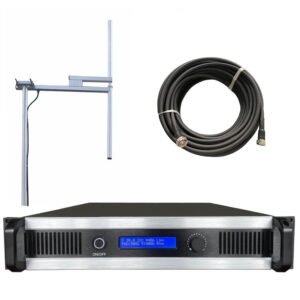
RS Complete Station Kit Example:
100W FM Station Complete Kit ($1,050):
Included Equipment:
- 100W transmitter: $650
- 2-bay dipole antenna (circular polarization): $280
- 30m LDF4-50A low-loss cable: $150
- N-type connectors: $20
- Lightning arrestor: $45
- Mounting brackets: $25
- Installation manual: Included
System Specifications:
- Transmitter power: 100W
- Antenna gain: 6 dB (4× multiplier)
- Cable loss: ~2 dB (40% efficiency at 30m)
- Effective ERP: 100W × 4 × 0.6 = 240W
- Expected coverage: 12-18 km radius (flat terrain)
Total cost: $1,050 (package price)
Buying separately: $1,170
Savings: $120 plus time and hassle
Antenna Selection Guidance:
Professional supplier helps you choose appropriate antenna:
Low Power (15-100W):
- 1-bay or 2-bay antenna sufficient
- Omnidirectional pattern serves all directions equally
- Moderate cost ($150-280)
Medium Power (100-300W):
- 2-bay or 4-bay antenna recommended
- More gain = better coverage efficiency
- Professional quality construction ($280-500)
High Power (500W+):
- 4-bay minimum for effective ERP
- May need directional pattern to protect co-channel stations
- Heavy-duty construction for wind loading ($500-1,200)
Questions About Antenna:
"What antenna do you recommend for my transmitter power and coverage goal? What gain does it provide? Is it omnidirectional or directional? What’s the polarization (vertical, horizontal, circular)?"
Professional Supplier Response:
"For your 300W transmitter and 25 km coverage goal, I recommend our 4-bay circular polarization antenna. It provides 9 dB gain (8× multiplier), giving you 2,400W ERP. Circular polarization improves mobile reception. Omnidirectional pattern serves all directions equally. Rated for 500W maximum, so safe margin with your 300W. Cost $520, or $460 if bundled with transmitter."
Cable Selection Importance:
Cable Loss Varies by Type and Length:
Example: 30m cable run
RG-213 Cable (cheap):
- Loss at 100 MHz: ~4.5 dB
- Power efficiency: 35%
- Cost: $60
- Result: 100W transmitter becomes 35W at antenna
LDF4-50A Cable (professional):
- Loss at 100 MHz: ~2 dB
- Power efficiency: 63%
- Cost: $150
- Result: 100W transmitter becomes 63W at antenna
The $90 more expensive cable delivers 80% more power to antenna—improves coverage significantly. Professional suppliers calculate cable loss and recommend appropriate type for your power level and distance.
Complete Kit Pricing Comparison:
DIY Approach (buying separately):
| Component | Cost | Source |
|---|---|---|
| Transmitter | $650 | Supplier A |
| Antenna | $320 | Supplier B |
| Cable 30m | $180 | Supplier C |
| Connectors | $35 | Supplier D |
| Lightning arrestor | $50 | Supplier E |
| Shipping total | $220 | Multiple shipments |
| Total | $1,455 | 5 different suppliers |
Timeline: 2-4 weeks (waiting for multiple shipments)
Risk: Components might not be compatible
Complete Kit Approach:
| Component | Included in Kit |
|---|---|
| All equipment above | $1,050 package price |
| Shipping | $85 (single shipment) |
| Total | $1,135 |
Timeline: 1 week (single shipment)
Risk: All components guaranteed compatible
Savings: $320 plus faster installation
Installation Support with Complete Kits:
Professional suppliers provide:
- Detailed installation manual with photos
- Step-by-step antenna mounting instructions
- Cable routing best practices
- Grounding and lightning protection guidance
- Video calls during installation if needed
- Troubleshooting if assembly questions arise
Real Installation Example:
Church in Kenya bought RS 100W complete kit:
Day 1: Package arrives, everything opens and inventories
Day 2: Mount antenna on existing tower (supplier provides mounting instructions)
Day 3: Run cable from transmitter building to tower (supplier specifies proper routing)
Day 4: Connect all equipment (supplier provides wiring diagram)
Day 5: Power up and test (supplier on WhatsApp for guidance)
Day 6: On air, broadcasting successfully
Total installation time: 6 days with minimal technical experience
vs
Community station bought components separately:
Week 1: Transmitter arrives
Week 2: Antenna arrives (from different supplier)
Week 3: Cable arrives (wrong type, have to reorder)
Week 5: Correct cable arrives
Week 6: Start installation, discover connectors don’t fit cable
Week 7: Order correct connectors
Week 8: Finally complete installation
Total installation time: 8 weeks, much frustration
Questions to Ask:
| Question | Purpose |
|---|---|
| Do you offer complete station kits or just transmitters? | Package availability |
| What’s included in your kit? | Component list verification |
| How much do I save buying kit vs separate components? | Cost comparison |
| Is the antenna appropriate for my power level and coverage goal? | Proper system matching |
| What cable type and length is included? | Cable quality verification |
| Do you provide installation guidance? | Support availability |
Warning Signs:
- Supplier only sells transmitter (you source everything else)
- Cannot recommend antenna for your situation
- Doesn’t ask about cable length needed (every site is different)
- Kit components seem mismatched (cheap cable with expensive transmitter)
- No installation support provided
- Won’t explain component choices
Customizing Complete Kits:
Professional suppliers customize kits:
Standard Kit: 30m cable (works for most installations)
Your Site: Tower is 80m from transmitter building
Solution: Supplier adjusts kit:
- Replace 30m cable with 80m cable (+$180)
- Upgrade to lower-loss cable for longer run (+$120)
- Adjust antenna connectors for terrain (+$0, included)
- Adjusted kit price: $1,050 + $300 = $1,350
Still cheaper and more compatible than sourcing separately.
What You Should Verify:
✓ Supplier offers complete station kits, not just transmitters
✓ Kit components properly matched for your power level
✓ Cable type and length appropriate for your site
✓ All necessary connectors and hardware included
✓ Lightning protection included
✓ Installation manual and support provided
✓ Kit pricing saves money vs buying separately
✓ Customization available for your specific site needs
Complete kits are smarter approach for most stations. Professional suppliers handle compatibility, provide cost savings, and support successful installation. Don’t make broadcasting harder than necessary—buy complete solution from single reliable source.
Question 10: What Real Customer Projects Can You Show?
Why This Question Matters:
Anyone can claim their transmitters are great. Professional suppliers prove quality through deployed stations you can verify. Real customer projects demonstrate engineering capability, reliability, and support quality. If supplier can’t show you successful installations, maybe their equipment isn’t as good as they claim.
What to Request:
Customer Case Studies:
- Station name and location (with permission)
- Transmitter power level used
- Antenna configuration
- Coverage achieved
- How long operating successfully
- Any special challenges solved
Photographic Evidence:
- Installation photos showing equipment
- Antenna mounted on tower
- Coverage area photos
- Station studio setup
Customer References:
- Contact information for previous customers
- Permission to speak with them about experience
- Specific questions you can ask them
Coverage Verification:
- Field strength measurements from deployed stations
- Coverage maps showing actual vs predicted coverage
- Drive test results
Professional Supplier’s Project Portfolio:
RS Customer Projects Examples:
Project 1: Community Radio – Tanzania
Station Details:
- Location: Mwanza region
- Power: 100W RS transmitter
- Antenna: 2-bay at 25m height
- Target: Serve 3 villages, population 28,000
- Coverage achieved: 15 km radius
- Operating since: March 2022
- Special note: Installation in remote area, RS provided phone support throughout setup
Customer Feedback:
"We researched many transmitter suppliers before choosing RS. The 100W kit ($1,050) included everything we needed. Installation took 5 days with WhatsApp support from RS engineers. Signal covers all three villages clearly. We’ve operated 18 months with zero technical problems. When we had question about adjusting modulation, RS engineer guided us via video call within hours."
Project 2: Religious Broadcasting – Nigeria
Station Details:
- Location: Lagos state
- Power: 300W RS transmitter
- Antenna: 4-bay at 40m height
- Target: Serve metro area, population 200,000
- Coverage achieved: 22 km radius
- Operating since: August 2021
- Special note: Added RDS in Year 2, RS provided configuration support
Customer Feedback:
"Initially bought cheaper transmitter from different supplier—it failed after 8 months. Replaced with RS 300W ($1,339) and haven’t looked back. Quality is obviously better. When we wanted to add RDS, RS helped us configure everything remotely. Their 5-year warranty gives peace of mind. Worth every penny."
Project 3: Educational Institution – Kenya
Station Details:
- Location: University campus
- Power: 50W RS transmitter
- Antenna: 1-bay at 15m height
- Target: Campus and surrounding 5 km
- Coverage achieved: 8 km radius (more than needed)
- Operating since: January 2020
- Special note: Students operate station, RS provided training materials
Customer Feedback:
"We needed simple reliable transmitter for student radio. RS 50W kit ($488) was perfect. Setup was straightforward with their manual. Students learn broadcast engineering using this equipment. Four years of daily operation, zero failures. When we upgrade to 100W next year, we’ll definitely buy RS again."
How to Verify Customer Projects:
Request Contact Information:
"Can you provide contact details for 2-3 customers operating transmitters similar to what I’m considering? I’d like to ask them about their experience."
Professional Supplier Response:
"Of course. Here are three recent installations similar to yours:
- Pastor James, Community FM, Tanzania: +255-xxx-xxx (He’s agreed to answer questions)
- Station Manager Mary, University Radio, Kenya: mary@university.edu
- Engineer John, Commercial FM, Nigeria: +234-xxx-xxx
Feel free to contact them directly. Most common question they get is about reliability and support quality."
Questions to Ask References:
| Question | What It Reveals |
|---|---|
| How long have you operated this transmitter? | Reliability track record |
| Have you had technical problems? How responsive was support? | Support quality |
| Does coverage match what supplier promised? | Accuracy of specifications |
| Would you buy from this supplier again? | Overall satisfaction |
| What surprised you (good or bad) about the equipment? | Unexpected issues |
| Any advice for someone considering same supplier? | Real-world wisdom |
Coverage Documentation:
Professional suppliers can provide:
Field Strength Measurements:
"We measured field strength at various distances from customer’s 300W installation. At 20 km, we recorded 56 dBμV/m—excellent signal matching our predictions. Here’s the test report with GPS coordinates and field strength data at 15 measurement locations."
Drive Test Results:
"Customer performed drive testing throughout coverage area. Here’s the coverage map showing strong signal (green) to 18 km, usable signal (yellow) to 25 km, weak fringe (orange) to 30 km. Matches our Radio Mobile predictions closely."
Before/After Comparisons:
"Customer upgraded from different brand 100W to our 300W. Here’s coverage map showing 40% coverage increase with our equipment. Better RF design and antenna system made significant difference."
Installation Photo Documentation:
What Professional Suppliers Show:
Transmitter Room Photos:
- Clean professional installation
- Proper cable management
- Grounding system visible
- Equipment rack mounting
Antenna Installation Photos:
- Antenna mounted securely on tower
- Cable routing showing proper practices
- Weatherproofing of connections
- Overall site appearance
Coverage Area Photos:
- Photos from edge of coverage showing signal strength
- Mobile reception demonstrations
- Urban and rural reception examples
These photos prove supplier has real deployments, not just marketing claims.
Warning Signs of Fake/Exaggerated Projects:
- Supplier shows photos but can’t provide customer contact information
- Projects described are vague (no specific locations, dates,
names) - Photos look generic or stock images
- No coverage data or measurements provided
- Can’t verify projects independently
- Customer references not available
- Projects all sound too perfect (no challenges mentioned)
How to Independently Verify:
Online Search:
- Search station name + location
- Check if station actually exists and broadcasts
- Look for station website or social media
- Verify they use claimed transmitter brand
Regulatory Database Check:
- Many countries publish licensed station lists
- Verify station is legally licensed
- Check licensed power matches supplier’s claim
- Confirm station has been operating claimed duration
Social Media Investigation:
- Real stations have online presence
- Photos and updates from actual operations
- Community engagement showing active broadcasting
- Equipment visible in behind-the-scenes content
Geographic Verification:
- Use Google Maps to verify tower locations
- Satellite imagery might show antenna installations
- Street view can sometimes confirm site existence
Questions to Ask Supplier:
| Question | Purpose |
|---|---|
| Can you show me 3-5 recent customer installations? | Project portfolio depth |
| May I contact these customers directly? | Reference verification |
| Can you provide coverage measurements from deployed stations? | Performance verification |
| What challenges have customers faced and how did you solve them? | Problem-solving capability |
| What’s your customer retention rate for repeat purchases? | Long-term satisfaction |
| Can I visit a nearby installation to see equipment operating? | Direct verification opportunity |
The Site Visit Option:
If possible, ask to visit nearby installation:
What to Observe:
- Is transmitter actually operating reliably?
- What’s equipment condition after months/years of use?
- How professional is installation quality?
- Does coverage match what supplier claimed?
- Is customer satisfied with support experience?
Maybe supplier arranges visit to customer site in your area. This is excellent sign of confidence in product quality.
Customer Testimonial Authenticity:
Real Testimonials Include:
- Specific details about installation and operation
- Both positive aspects and minor challenges
- Actual customer names and station information
- Verifiable contact methods
- Realistic language (not marketing hype)
Fake Testimonials Sound Like:
- Generic praise ("best transmitter ever!")
- No specific details or station information
- Unverifiable sources
- Perfect with no challenges mentioned
- Marketing language rather than technical details
The Repeat Customer Test:
Powerful Question: "How many of your customers have purchased additional transmitters from you after the first one?"
Strong Supplier Answer: "About 40% of our customers come back for second or third transmitters when expanding operations. We have customers operating 3-5 of our transmitters across multiple sites. Customer retention is high because equipment performs reliably and support is responsive."
Weak Supplier Answer: "Not sure, we have many customers but don’t track that."
Repeat purchases prove customer satisfaction better than marketing claims.
Real Project Complexity:
Professional suppliers share challenging projects:
Example: Mountainous Terrain Installation
"Customer in Ecuador needed 100 km coverage through mountain valleys. Standard antenna couldn’t work. We designed custom directional antenna system with multiple relay transmitters. Required 6 months planning and three site visits. Successfully deployed system now serves 180,000 people across difficult terrain. Here’s coverage map and customer contact for verification."
This level of detail and problem-solving demonstrates real engineering capability.
What You Should Verify:
✓ Supplier provides multiple real customer references
✓ Customer contact information verifiable
✓ Projects match your planned power level and application
✓ Coverage results documented with measurements
✓ Installation photos show professional quality
✓ Customers willing to discuss their experience
✓ Supplier transparent about challenges and solutions
✓ Repeat customer rate indicates satisfaction
The Bottom Line:
Real customer projects separate professional manufacturers from equipment dealers. If supplier can show successful installations you can verify and customers you can contact, confidence in equipment quality increases dramatically.
Don’t buy transmitter based only on specifications and price. Talk to real customers who’ve operated equipment for months or years. Their experience predicts your future.
Summary: Make Smart Supplier Selection
These 10 questions protect you from expensive mistakes. Professional FM transmitter suppliers answer all questions confidently with technical details, real specifications, comprehensive support commitments, and verifiable customer references. Poor suppliers provide vague answers, unrealistic promises, and no verification methods. Take time to evaluate suppliers thoroughly—equipment quality, support reliability, and long-term partnership value matter far more than initial price. Choose supplier who will help your station succeed for years to come.