Top 10 Challenges for FM Radio Stations in Africa (and Recommended Transmitter Types)
Practical Solutions for Power Issues, Budget Constraints, and Coverage Challenges
I’m an RF engineer at RS, and over the past years I’ve worked with radio stations across Africa—from Nigeria to Kenya, Ghana to Tanzania, and DR Congo to South Africa. Maybe the technical challenges African radio stations face are different from other regions. The environment demands equipment that works reliably despite unstable power, limited technical support, and tight budgets.
I’ve seen stations struggle with frequent power outages that damage equipment. I’ve helped community broadcasters cover mountainous terrain with limited resources. These real-world challenges taught me what actually works in African broadcasting environments.
This article identifies the 10 most common challenges African FM radio stations face and recommends specific transmitter types and power levels for each scenario.
Challenge 1: Unstable Power Supply and Frequent Outages
The Power Reality
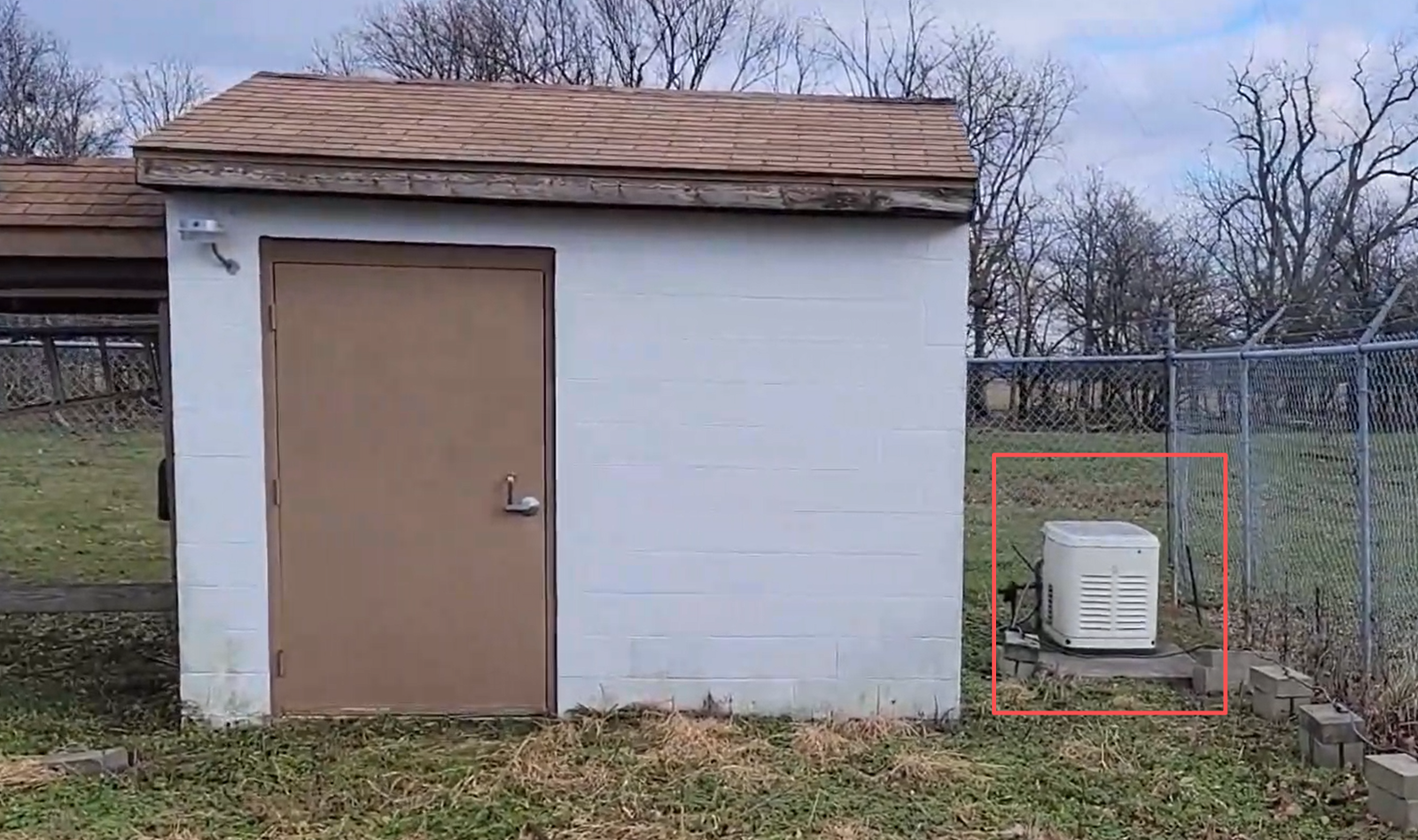
Maybe the biggest challenge for African radio stations is unreliable electrical power. Many regions experience daily power outages lasting hours. I’ve worked with stations in Nigeria where power fails 4-6 times daily. Voltage drops to 160V or surges to 260V stress equipment. Generator power creates dirty voltage with noise and instability.
Running generators burns expensive fuel—maybe $50-100 per day for continuous operation. Solar systems require significant investment. These conditions destroy transmitters designed for stable power grids.
Why Standard Transmitters Fail
Transmitters designed for European or American markets expect clean 220V±10% power. Sudden power failures cause component stress. Frequent power cycling wears out capacitors and switches. Many imported transmitters lack proper input protection against voltage surges from generators.
Recommended Solution
For unstable power environments, you need transmitters with:
High-Efficiency Design: Class E or modern switching amplifiers waste less power as heat. Lower heat generation improves reliability—components last longer at lower temperatures. Efficiency also reduces power consumption, cutting generator fuel costs and reducing solar panel requirements.
Wide Input Voltage Range: The transmitter should operate across 160-260V without damage. Better transmitters include automatic voltage regulation. Some models accept direct DC input (12V or 24V), eliminating inverters and improving efficiency.
Over-Voltage and Under-Voltage Protection: Automatic shutdown when voltage exceeds safe limits prevents damage. The transmitter should automatically resume when power stabilizes, without manual intervention.
Soft-Start Circuitry: When power returns after outage, soft-start prevents inrush current that stresses components and might trip generators.
Recommended Power Levels
Small Community Radio (50W – $488): Covers 3-5 km radius from 30m tower. Power consumption approximately 150W, manageable with small solar system (400W panels + 200Ah batteries) or modest generator. Works for village stations, small campus radio, or local religious broadcasting.
District Coverage (100W – $650): Reaches 7-12 km radius with proper antenna height. Power consumption around 250W makes it feasible for medium solar systems or shared generator power. Suits towns, district centers, or community stations serving multiple villages.
Regional Coverage (300W – $1339): For covering larger areas or cities, 300W reaches 15-20 km radius. Power consumption approximately 650W, requiring substantial solar installation or reliable generator. Consider this for established stations with stable funding for power infrastructure.
Challenge 2: Limited Budget but Large Coverage Requirements
The Coverage-Cost Dilemma
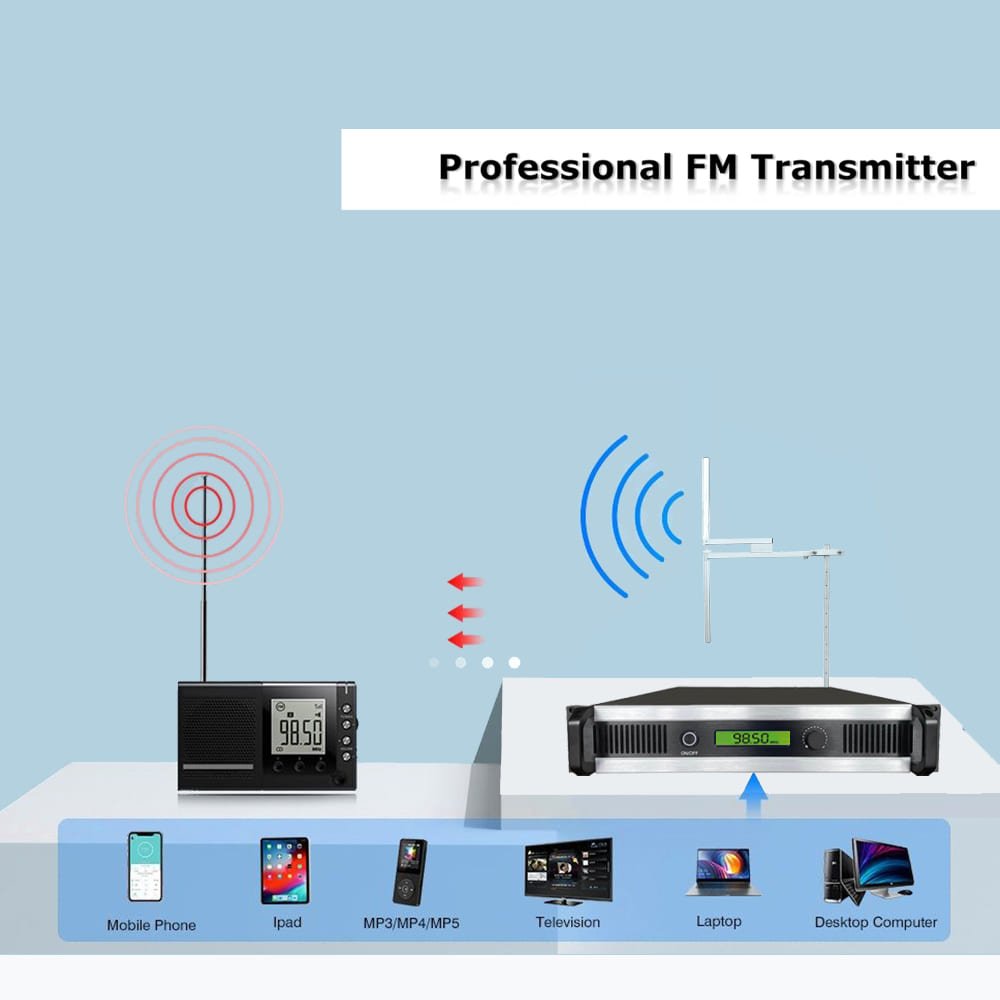
Maybe you need to cover 20-30 km to reach scattered rural communities, but your budget allows only modest equipment investment. I’ve worked with community broadcasters who need to reach 15 villages spread across 30 km radius, but have less than $2000 total budget.
The traditional approach—buying the highest power transmitter you can afford—often isn’t optimal. Transmitter power alone doesn’t determine coverage. Antenna system, tower height, terrain, and frequency all significantly affect how far your signal reaches.
Smart Coverage Strategies
Antenna Gain Matters: A high-gain antenna focuses your signal horizontally toward your coverage area instead of wasting power radiating skyward. A 4-bay antenna with 6 dB gain effectively doubles your transmitter power in the horizontal plane. This might let you use 100W transmitter with good antenna instead of 300W with basic antenna—saving $700 while achieving similar coverage.
Height is Free Coverage: Every doubling of antenna height increases coverage radius by approximately 40%. If you can mount your antenna on 40m tower instead of 20m, you gain significant coverage without increasing transmitter power.
Frequency Selection: Lower FM frequencies (88-92 MHz) propagate slightly better than higher frequencies (106-108 MHz). If you have choice during licensing, request lower frequencies for better rural coverage.
Recommended Budget-Conscious Configurations
Village Station (15W – $249):
Complete kit reaches 1-3 km from 30m height in flat terrain. Works for single village coverage, small campus, or local church broadcasting. Extremely economical—power consumption around 50W makes solar power very affordable.
Multi-Village Coverage (100W + Good Antenna – $850 total):
The 100W transmitter ($650) paired with 2-bay circularly polarized antenna ($200) reaches 10-15 km radius in moderate terrain. Serves several villages, small town with surrounding area, or district center. Consider this the "sweet spot" for community stations—enough power for meaningful coverage at affordable price.
District Coverage (300W – $1339):
For covering 15-20 km radius including challenging terrain, 300W transmitter provides sufficient power without excessive cost. Pair with professional 4-bay antenna for maximum effectiveness. Suits established community stations, district government broadcasting, or religious stations serving multiple congregations.
Budget Optimization
Start with coverage requirement analysis. Map the communities you must reach. Identify potential antenna locations—which buildings, towers, or structures could host your antenna? Higher locations let you use less power.
Invest in quality antenna rather than maximum transmitter power. The $200 difference between basic and good antenna might eliminate need for 100W more transmitter power (saving $500).
Consider phased implementation if necessary. Start with modest power (50-100W) covering core area. Generate revenue or donations. Later upgrade to higher power or add relay transmitters for extended coverage.
Challenge 3: Complex Terrain with Mountains and Scattered Villages
Terrain Reality
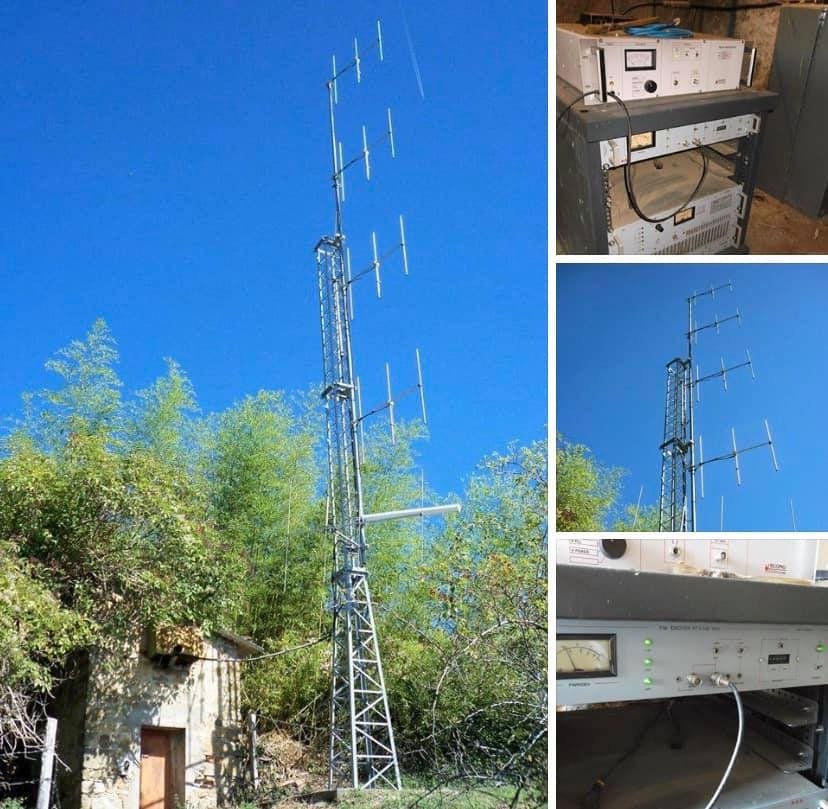
Maybe your station serves mountainous region where valleys create shadow zones, or scattered villages separated by hills that block signals. Much of Africa’s terrain is challenging for radio coverage—highlands in Ethiopia, mountains in Tanzania, valleys in Uganda.
I’ve worked with stations where the transmitter covers 20 km in one direction but only 5 km in another due to mountains. Single high-power transmitter on one location can’t effectively cover complex terrain.
Why Simple Solutions Don’t Work
Adding transmitter power helps overcome some terrain obstacles but has limits. Doubling power from 100W to 200W increases coverage radius by only about 40%. Mountains and valleys create shadow zones that more power can’t penetrate—the signal simply can’t reach behind obstacles.
Very high power (1000W+) becomes expensive to purchase ($1890-2000) and operate (2000W continuous power required). For community stations with limited budgets, this investment might not be feasible.
Multi-Site Solution
Complex terrain often requires multiple transmitter sites rather than single high-power location:
Main Transmitter for Primary Coverage: Place primary transmitter at central high location covering the largest population concentration. This might be 100-300W depending on area size and budget.
Relay Transmitters for Shadow Zones: Add low-power transmitters (15-50W) at strategic locations to fill coverage gaps. These relay transmitters receive the main station signal and rebroadcast it to areas the main transmitter can’t reach.
Recommended Multi-Site Configuration
Main Station (100-300W):
Position on highest available location—mountaintop, hilltop, or tall building. Our 100W transmitter at $650 or 300W at $1339 serves as main station depending on coverage radius required.
Relay Sites (15-50W):
Install in valleys or behind obstacles where main signal doesn’t reach. These smaller transmitters cost $249 (15W) to $488 (50W), making multiple sites affordable. Each relay covers 3-10 km depending on power and local terrain.
Technical Requirements for Relays
Relay transmitters need specific capabilities:
- Frequency Stability: All transmitters must maintain precise frequency. PLL-controlled transmitters with ±2 kHz stability prevent interference.
- Remote Monitoring: Network-enabled monitoring lets you check multiple relay sites from central studio location.
- Power Efficiency: Our 15W and 50W models consume minimal power (50W and 150W), feasible for solar installations.
- Simple Configuration: Straightforward setup with simple frequency setting and clear operational indicators.
Case Example
Consider a district with main town and 8 surrounding villages in hilly terrain:
- Main Site: 100W transmitter ($650) on hilltop covers main town and 4 nearby villages
- Relay Site 1: 50W transmitter ($488) in valley covers 2 villages blocked by mountain
- Relay Site 2: 30W transmitter in another valley covers 2 remote villages
Total investment around $1470 for transmitters provides more effective coverage than single $1890 1000W transmitter at main site. The distributed system fills shadow zones that high power alone cannot penetrate.
Challenge 4: Limited Technical Staff and Weak Maintenance Capacity
The Technical Skills Reality
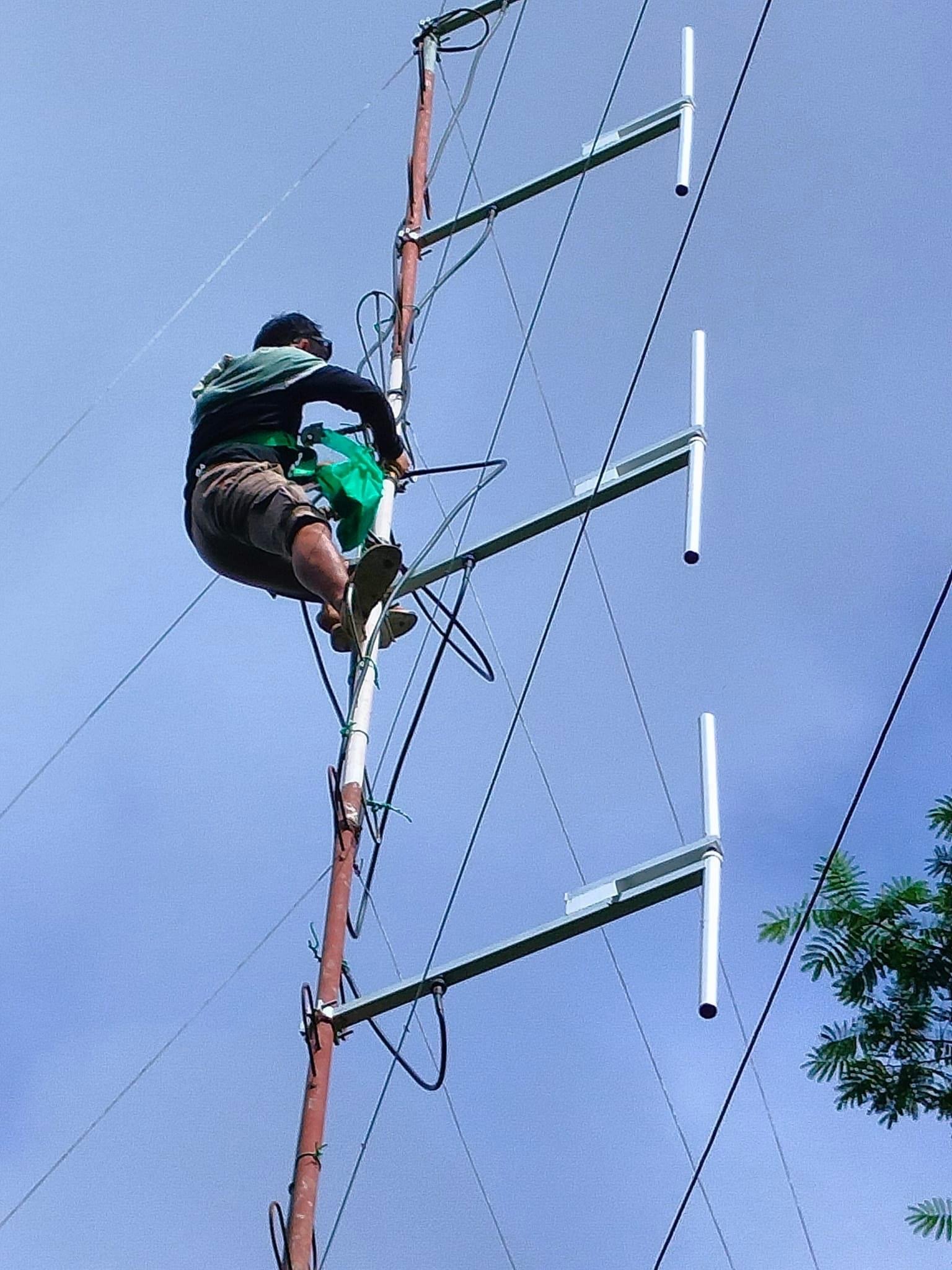
Maybe your station has one person who understands basic technical operations but isn’t a broadcast engineer. Or volunteers run the station with minimal technical training. I’ve worked with stations where the "engineer" is actually a teacher who figured out how to operate the transmitter, or a pastor who handles technical duties alongside ministry responsibilities.
When equipment problems occur, these operators can’t troubleshoot complex issues. The station either stays off air until they find outside help, or broadcasts with degraded quality. Extended off-air periods lose audience and frustrate listeners.
Why Complex Equipment Fails
Traditional broadcast transmitters were designed assuming trained engineers would operate them. They have complex adjustment procedures. They require test equipment for proper setup. Equipment manuals use terminology that confuses general operators. Controls might be unlabeled or use technical abbreviations.
This complexity means problems that professional engineers solve in minutes leave community stations off air for days or weeks.
Recommended Transmitter Characteristics
For stations with limited technical support:
Clear Menu Systems: Modern transmitters with LCD screens and simple menu navigation let operators set frequency, adjust power, and configure basic settings without engineering knowledge. Our transmitters use straightforward menu systems—frequency is labeled "FREQ", power is labeled "POWER", with simple up/down buttons.
Automatic Protection Systems: The transmitter should protect itself from common problems. Over-temperature protection automatically reduces power or shuts down before damage occurs. High VSWR protection detects antenna problems and protects the amplifier. These systems prevent operator errors from destroying the transmitter.
Automatic Recovery: After protection system activates, the transmitter should automatically attempt to resume operation when conditions normalize. If over-temperature protection activated, the transmitter should restart when it cools down.
Visual Status Indicators: LED indicators or screen displays should clearly show operational status. Green LED means normal operation. Yellow means warning. Red means fault requiring attention.
Modular Design: When repairs are necessary, modular design speeds recovery. If power amplifier fails, the entire amplifier board removes and replaces as one unit. You don’t need component-level repair skills—just ability to identify failed module and install replacement.
Recommended Power Levels by Support
Minimal Support (50-100W): Community stations with single technical operator benefit from mid-power transmitters. Our 50W ($488) and 100W ($650) transmitters include all protection systems and clear operation, manageable by operators with basic training.
Moderate Support (300W): Stations with part-time technical person can manage 300W systems. The $1339 300W transmitter includes comprehensive protection and monitoring. Technical support person can address problems during monthly visits while operators handle daily operations.
Strong Support (500W+): Higher power stations really need access to trained technical support. While our 500W ($1560) and 1000W ($1890) transmitters include the same protection and simple operation, station installation complexity benefits from engineering knowledge.
Training and Documentation
Operator Training: Spend time training station operators on basic concepts—what the transmitter does, what normal operation looks like, what warning signs indicate problems, when to call for help.
Simple Procedures: Write step-by-step procedures for common tasks: "How to Start Transmitter", "What to Do if Red Light Turns On". Use photos or diagrams. Store these instructions at the transmitter location.
Remote Support Access: Where internet connectivity exists, remote support capability helps dramatically. Technical support person logs in remotely to check settings without traveling to site.
Parts Availability: Stock spare parts for components that might fail—fuses, cooling fans, power supply modules. Even operators with minimal skills can replace obvious failed components if spare parts are available.
Challenge 5: Poor Equipment Quality and Frequency Instability
The Quality Problem
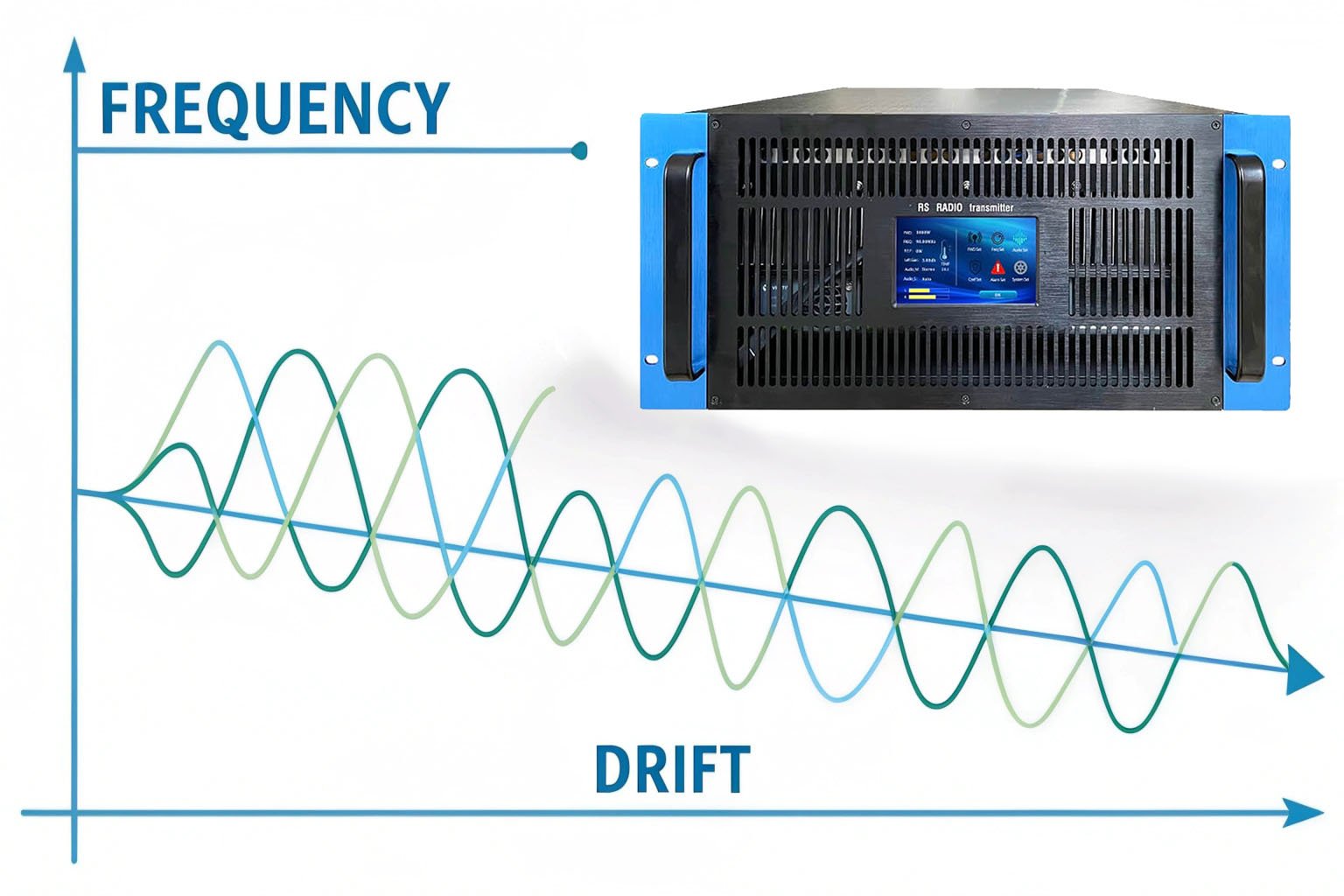
Maybe you purchased an inexpensive transmitter that seemed like great value, but after months of operation the frequency drifts and you receive interference complaints. Or harmonic emissions cause problems with aircraft communications and you face regulatory penalties.
I’ve encountered stations running transmitters that cost $200-300—far below prices of legitimate broadcast equipment. These "bargain" transmitters often use incorrect components, lack proper filtering, have unstable frequency control, and fail within months. The initial saving disappears when the station faces fines for non-compliance or must replace the entire transmitter after short service life.
Technical Quality Standards
Legitimate broadcast transmitters meet specific technical standards:
Frequency Stability: The transmitter should maintain assigned frequency within ±2 kHz even with temperature changes, power variations, and long-term aging. This requires PLL (Phase-Locked Loop) frequency synthesis referenced to crystal oscillator. Cheap transmitters using LC oscillators drift significantly—sometimes 20-50 kHz from assigned frequency, causing interference.
Harmonic Suppression: FM transmitters generate harmonics—signals at multiples of operating frequency. Broadcast standards typically require harmonics at least 60-80 dB below carrier level. Quality transmitters include multi-stage low-pass filters. Cheap transmitters omit adequate filtering, causing harmonic interference sometimes detectable hundreds of kilometers away.
Audio Quality: Professional transmitters process audio correctly maintaining deviation limits, minimizing distortion, and providing proper pre-emphasis. Poor transmitters over-deviate causing adjacent channel interference.
Build Quality: Components should be rated for broadcast service. Proper heat sinking keeps components cool. Quality construction prevents early failures.
Identifying Quality Equipment
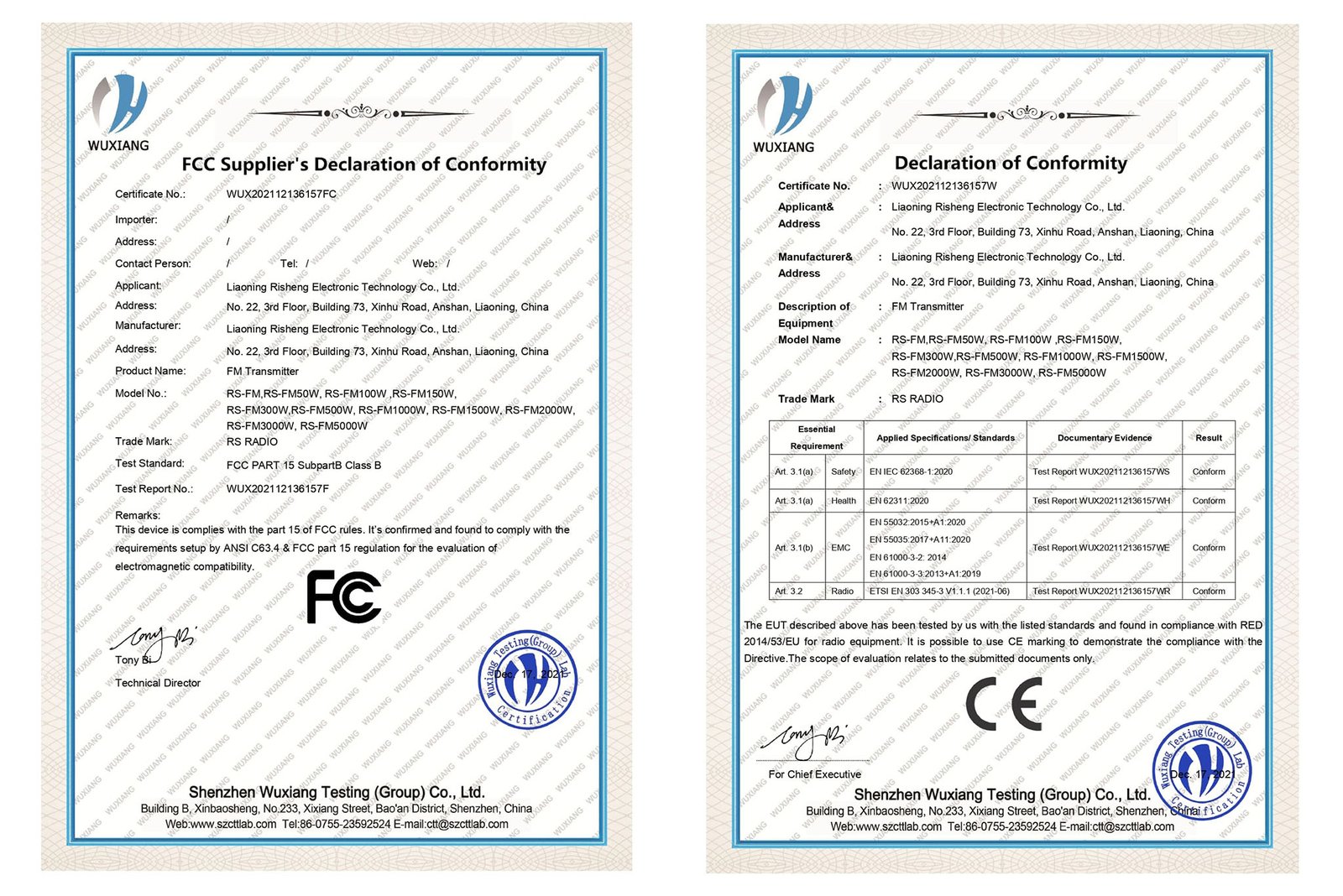
Certification: Look for FCC (USA), CE (Europe), or similar certification. These certifications require testing that verifies compliance with technical standards. Transmitters without certification have no independent verification of quality.
Manufacturer Reputation: Established manufacturers with years in broadcast equipment have reputation to protect. They provide warranties, spare parts availability, and technical support.
Realistic Pricing: Quality broadcast transmitters cost more than consumer electronics. If 50W transmitter costs less than $300, question the quality. Our 50W transmitter at $488 represents realistic pricing for quality equipment.
Warranty: Meaningful warranty (3-5 years) indicates manufacturer confidence in reliability. We provide 5-year warranty because we build transmitters that last.
Recommended Approach
Community Stations (50-100W): Invest in certified quality equipment. Our 50W ($488) and 100W ($650) transmitters include PLL frequency control, harmonic filtering, and all compliance features. The modest price difference versus uncertified equipment pays for itself through reliability and regulatory compliance.
District Coverage (300W): For serving larger areas, 300W transmitter ($1339) provides good value. At this power level, quality is even more critical—regulatory monitoring focuses on higher-power stations, and failures affect more listeners.
Regional Broadcasting (500-1000W): Higher power applications absolutely require quality certified equipment. Our 500W ($1560) and 1000W ($1890) transmitters meet international broadcast standards.
Power Level Reference
- 15W: 1-3 km coverage, $249
- 50W: 3-5 km coverage, $488
- 100W: 7-12 km coverage, $650
- 300W: 15-20 km coverage, $1339
- 500W: 20-25 km coverage, $1560
- 1000W: 25-30 km coverage, $1890
Coverage assumes 30m antenna height on relatively flat terrain.
Challenge 6: Regulatory Compliance and Spectrum Management
Increasing Regulatory Enforcement
Maybe African broadcast regulators are strengthening enforcement of technical standards. Countries that previously had minimal monitoring now actively measure station parameters and penalize non-compliance. Stations that operated informally now face new pressure to meet technical requirements or face closure.
I’ve worked with stations suddenly notified of compliance violations—operating on wrong frequency, exceeding licensed power, generating harmonics. Penalties range from warnings to fines to license suspension. This enforcement serves legitimate purposes—it protects spectrum from interference and ensures fair competition.
Common Compliance Issues
Frequency Deviation: Operating outside assigned frequency creates interference to adjacent channels. Regulators measure frequency and penalize stations more than ±2-3 kHz from assignment.
Power Excess: Operating above licensed power is common violation. Some stations increase power hoping for greater coverage without realizing regulatory monitoring detects this.
Harmonic Emissions: Transmitters without proper filtering generate harmonics that interfere with aircraft communications. This violation carries severe penalties because it creates safety issues.
Compliance Strategies
Accurate Power Control: Your transmitter should output only the power authorized by license. Our transmitters allow power adjustment in small increments—you can set exactly 100W if that’s your licensed power.
Regular Measurement: Invest in basic test equipment to verify transmitter performance periodically. Frequency counter ($50-100) confirms you’re on assigned frequency. Power meter ($200-500) verifies output power.
Compliance Documentation: Maintain logs required by your country’s regulations. Record daily transmitter readings—frequency, power, audio levels. Keep copies of licenses and equipment certificates.
Recommended Features
Precise Frequency Control: PLL synthesized frequency generation with ±1 kHz or better stability. Our transmitters use microprocessor-controlled PLL systems that maintain frequency within ±2 kHz across all operating conditions.
Adjustable Power Output: Ability to set transmitter power precisely to match license authorization. Our transmitters show forward and reflected power on LCD display.
Built-in Harmonic Filters: Multi-stage low-pass filters that suppress harmonics to at least -60 dB below carrier. All our transmitters include harmonic suppression meeting international broadcast standards.
Working with Regulators
Professional Communication: When dealing with regulatory authority, demonstrate professionalism. Maintain organized technical documentation. Respond promptly to inquiries.
Compliance Investment: Budget for compliance requirements as essential operating cost. Proper transmitter and test equipment prevent much larger penalties and license problems.
Proactive Monitoring: Don’t wait for regulator to inform you of problems. Monitor your own technical parameters regularly.
Challenge 7: Backup Capability and Disaster Resilience
Emergency Broadcasting Needs
Maybe natural disasters—floods, droughts, storms—frequently affect your broadcast area. Or infrastructure damage interrupts normal broadcast operations. In these scenarios, your radio station serves as community lifeline providing emergency information and coordination.
I’ve worked with stations in areas experiencing severe flooding that damaged power infrastructure. Stations that needed to continue broadcasting during extended power outages or equipment failures. The ability to maintain operations during emergencies separates truly valuable community stations from those that fail when most needed.
Common Failure Scenarios
Power Infrastructure Damage: Storms or floods damage electrical grid. Power might be unavailable for days or weeks.
Primary Equipment Failure: Any transmitter can fail. Without backup, you’re off air until repairs complete—which might take weeks if spare parts must be imported.
Multiple Simultaneous Failures: Worst case scenarios involve multiple problems—power failure plus equipment failure plus access difficulty.
Resilience Strategy: Backup Transmitter
The most effective resilience strategy is maintaining backup transmitter at ready-to-deploy condition:
Low-Power Backup: Keep spare transmitter (15-50W) stored and ready for emergency deployment. Our 15W transmitter at $249 provides economical backup capability. The 50W at $488 offers better emergency coverage while remaining affordable.
Portable Configuration: Backup transmitter should be portable for flexible deployment. If primary site becomes inaccessible, deploy backup at alternate location—perhaps studio building or nearby hilltop.
Independent Power: Backup transmitter should operate from 12V or 24V DC, compatible with car batteries or solar panels. Our lower-power transmitters accept DC input for emergency operation flexibility.
Recommended Backup Configurations
Community Stations (Primary 50-100W):
Backup: 15W ($249), Emergency coverage: 1-3 km radius, Power: 12V battery. Maintains station presence during primary failures at very low cost.
District Stations (Primary 100-300W):
Backup: 50W ($488), Emergency coverage: 3-5 km radius, Power: 24V battery or small generator. Provides meaningful emergency coverage for main town.
Regional Stations (Primary 300-1000W):
Backup: 100W ($650), Emergency coverage: 7-12 km radius, Power: Small generator or battery bank. Maintains significant coverage during emergencies.
Alternative Power Systems
Battery Backup: UPS or battery bank provides immediate backup when grid power fails. For 50W transmitter with 150W consumption, 200Ah 12V battery provides approximately 8 hours operation.
Solar Power: Solar installation provides independent power eliminating grid dependency. A 50W transmitter needs approximately 400W solar panels and 400Ah batteries for reliable operation.
Generator: Size generator for continuous transmitter operation plus margin—a 50W transmitter needs approximately 1000W generator.
Emergency Planning
Written Procedures: Document step-by-step procedures for deploying backup systems. Include equipment locations, contact information, deployment steps.
Staff Training: Train multiple staff members on backup deployment. Practice periodically to verify procedures work.
Equipment Testing: Test backup transmitter quarterly. Verify it powers up correctly, maintains assigned frequency, and produces rated output.
Challenge 8: Multi-Language and Future Expansion Needs
Diverse Programming Requirements
Maybe your station serves community with multiple tribal languages, requiring different programming for different linguistic groups. Or you plan to start with simple programming but want capability to add features later—stereo audio, RDS station identification, digital audio sources.
I’ve worked with stations in Nigeria broadcasting in three different languages during different time blocks. Stations in Kenya planning to add RDS capability once they establish audience. These requirements demand transmitters with flexibility beyond basic audio broadcasting.
Programming Flexibility Needs
Multiple Audio Sources: Modern stations integrate various audio sources—studio mixer, backup automation computer, emergency systems, internet streams. The transmitter should accept different audio inputs and switch between them reliably.
Stereo Capability: While many African stations broadcast mono, stereo capability provides upgrade path as audience develops. Transmitter should support both mono and stereo operation.
Digital Audio Inputs: Traditional analog audio (XLR, RCA) remains standard, but digital audio interfaces (AES/EBU, S/PDIF) provide better quality. Professional transmitters include both analog and digital inputs.
RDS Encoding: Radio Data System allows transmitting station identification and programming information. RDS displays station name on receiver screens. This feature is spreading in Africa as RDS receivers become more available.
Remote Control: Network-connected transmitters allow monitoring and control via internet from studio or mobile devices.
Recommended Capabilities
Dual Audio Inputs: Minimum requirement is two audio inputs with automatic or manual switching. Our transmitters from 50W upward include dual balanced audio inputs.
Stereo/Mono Operation: Transmitter should support both, selectable through configuration. You might start broadcasting mono then switch to stereo as equipment develops.
Network Interface: Ethernet connection for remote monitoring provides tremendous value. You access transmitter settings and monitor status through web browser without traveling to transmitter site.
Power Levels for Different Applications
Community Multilingual (50-100W): Our 50W ($488) and 100W ($650) transmitters provide audio flexibility needed for community stations. Dual audio inputs allow switching between language programming blocks.
District Multi-Site Network (100-300W): For multi-site network, 100-300W transmitters at each site provide consistent coverage. The 300W transmitter at $1339 provides good coverage for district center.
Regional Programming (500-1000W): Our 500W ($1560) and 1000W ($1890) transmitters include comprehensive audio inputs, stereo capability, RDS encoding, and remote management.
Practical Considerations
Budget Realistic Timelines: Don’t over-invest in capabilities you won’t use for years. But don’t under-invest forcing equipment replacement when needs evolve. A transmitter supporting stereo and digital audio might cost 10-15% more than basic model—modest premium for flexibility.
Start Simple, Build Infrastructure: Begin with basic mono operation using single audio input. But select transmitter that supports stereo and digital audio when you’re ready to implement these features.
Challenge 9: Urban Interference and Dense Competition
The Urban Spectrum Challenge
Maybe you’re launching station in Lagos, Nairobi, Johannesburg, or other major African city where the FM band is crowded with competing stations. Or your frequency neighbors other stations with only 200-400 kHz separation, creating interference potential.
I’ve worked with stations in major African cities where the FM band has 40+ stations in 20 MHz spectrum. Frequency coordination is extremely tight. Adjacent channel stations cause interference if either station exceeds specifications.
Urban Interference Sources
Adjacent Channel Interference: Stations on nearby frequencies cause interference if transmitters have excessive bandwidth. With typical 200 kHz channel spacing, your station on 90.3 MHz might interfere with station on 90.5 MHz.
Electrical Noise: Urban infrastructure—power lines, motors, lighting, electronic equipment—generates broadband noise across radio spectrum.
Multipath Interference: Urban buildings create signal reflections that cause multipath distortion and coverage holes in specific locations.
Required Transmitter Characteristics
Tight Frequency Control: Urban operation requires frequency stability better than ±1 kHz. Our transmitters maintain ±2 kHz stability, well within requirements for dense urban spectrum.
Excellent Spectral Purity: Transmitter must not generate energy outside its assigned channel. This requires low phase noise, suppressed harmonics, and minimal spurious emissions.
Accurate Power Control: Operating at exactly licensed power—no more, no less—is critical in coordinated spectrum environment. Transmitter should maintain stable output power regardless of temperature or supply voltage variations.
Antenna System Considerations
Directional vs. Omni-Directional: Directional antennas focus signal toward your service area, reducing interference to other stations while providing stronger signal where needed.
Circular Polarization: Improves mobile reception and reduces multipath distortion compared to linear polarization.
Recommended Power and Configuration
Small Urban Station (50-100W with Directional Antenna): For community station or neighborhood coverage, 50-100W with directional antenna provides good local service. Our 50W ($488) or 100W ($650) paired with directional antenna ($300-500) serves urban neighborhood efficiently.
City-Wide Station (300W): For covering entire city, 300W transmitter with professional antenna provides good balance. Our $1339 300W transmitter with professional antenna system delivers reliable city coverage.
Major Urban Station (500-1000W): Established stations serving major metropolitan areas use 500-1000W with sophisticated antenna systems. Our 500W ($1560) or 1000W ($1890) transmitters provide maximum coverage within coordination constraints.
Interference Management
Regular Frequency Monitoring: Check your transmitted frequency weekly using frequency counter. Verify you’re exactly on assigned frequency.
Power Measurement: Verify output power monthly. Ensure you’re not exceeding licensed power.
**Coordination with Neighbors: Maintain communication with stations on adjacent frequencies. If they report interference, investigate cooperatively.
Challenge 10: Long-Term Operating Costs and Sustainability
The Total Cost Challenge
Maybe you focused on initial equipment purchase price but didn’t fully calculate ongoing operating costs. Or your station struggles with monthly electricity bills and maintenance expenses that consume most revenue. I’ve worked with stations that purchased inexpensive equipment to save upfront costs, only to spend far more on repairs, excessive power consumption, and early replacement.
Understanding total cost of ownership—not just purchase price—determines long-term station sustainability. For African stations operating on tight budgets with limited revenue, operating cost efficiency directly affects survival.
Major Ongoing Cost Categories
Electricity Consumption: Transmitter runs 24/7 consuming power continuously. In areas with expensive electricity or requiring generator power, energy costs dominate operating budget.
Generator Fuel: Stations using generators face substantial fuel costs. Generator operation might cost $30-100 per day depending on fuel prices and runtime.
Maintenance and Repairs: Equipment requires periodic maintenance—cleaning, component replacement, calibration. Quality equipment has predictable maintenance needs versus poor equipment with frequent unpredictable failures.
Technical Support: Stations without in-house technical expertise pay for consultant or manufacturer support.
Calculating True Operating Costs
50W Community Station Example:
Initial investment:
- 50W transmitter: $488
- Antenna and cable: $150
- Installation: $200
- Total initial: $838
Monthly operating costs:
- Electricity: 150W × 24h × 30 days = 108 kWh/month at $0.15/kWh = $16
- Site rental: $50
- Maintenance reserve: $20
- Technical support: $15
- Total monthly: $101
- Annual operating: $1,212
300W District Station Example:
Initial investment: $2,439 (transmitter $1,339 + antenna $500 + cables $200 + installation $400)
Monthly operating costs:
- Electricity: 650W × 24h × 30 days = 468 kWh at $0.15/kWh = $70
- Site rental: $100
- Maintenance: $50
- Technical support: $30
- License fees: $40
- Total monthly: $290
- Annual operating: $3,480
Efficiency Impact
Our transmitters use modern high-efficiency designs:
| Power Output | Consumption | Efficiency |
|---|---|---|
| 15W | 50W | 33% |
| 50W | 150W | 33% |
| 100W | 250W | 40% |
| 300W | 650W | 46% |
| 500W | 1050W | 48% |
| 1000W | 2000W | 50% |
Better efficiency means:
- Lower electricity costs (direct monthly savings)
- Less heat generation (longer component life)
- Smaller power supplies needed (lower battery/solar/generator capacity)
Reliability Affects Operating Cost
Consider 10-year scenario:
- Quality transmitter: $650 initial + $100/year maintenance × 10 years = $1,650 total
- Cheap transmitter: $350 initial + $200/year repairs × 3 years + $350 replacement + $200/year × 3 years + $350 replacement = $2,450 total
The "inexpensive" option costs 50% more over 10 years while providing inferior service.
Cost Reduction Strategies
Right-Size Your Power: Don’t buy more transmitter power than needed. Use our coverage guidelines to select appropriate power for your service area.
Invest in Efficiency: Higher efficiency transmitters cost slightly more initially but save continuously through operation. The efficiency premium usually pays back within 1-2 years.
Preventive Maintenance: Regular cleaning and inspection prevent major failures. Monthly maintenance costs less than emergency repairs.
Energy Alternatives: Where grid power is expensive, solar power might have favorable economics despite high initial cost.
Revenue and Sustainability
Community Stations: Low operating costs mean more money goes to programming and community service. A station spending $100/month on operations versus $300/month has $200 extra monthly for content.
Commercial Stations: Lower operating costs mean higher profit margins or ability to reinvest in better programming and equipment.
Religious Broadcasters: Demonstrating good stewardship through efficient operations encourages continued financial support.
Recommended Approach by Station Type
Starting Community Station: Begin with 15-50W efficient transmitter ($249-$488). Low operating costs ($60-120/month) remain manageable even with minimal revenue.
Growing Community Station: 100W transmitter ($650) provides good coverage with moderate operating costs ($150-200/month). As station matures, efficient operation frees budget for programming improvements.
Established District Station: 300W ($1339) for substantial coverage with acceptable operating costs ($300-400/month). Revenue covers expenses while generating surplus for growth.
Regional Station: Higher power (500-1000W at $1560-$1890) serves large coverage areas. Operating costs increase ($500-800/month) but stations have revenue justifying the investment.
Real-World Example
I’ve worked with community station in Tanzania that started with 50W transmitter serving single town. Low operating costs ($80/month) left room for content investment. After two years, advertising revenue covered all costs. They upgraded to 100W expanding coverage to three villages. Efficient operations enabled growth from startup to sustainable institution.
Religious broadcaster in Kenya operates 50W transmitter. Operational efficiency (monthly costs around $120) means congregational giving fully covers broadcasting. This sustainability has maintained service for 8 years without financial crisis.
Summary: Practical Solutions for African Broadcasting
African FM radio stations face unique challenges requiring appropriate technology choices and thoughtful system design. The ten challenges—unstable power, budget constraints, complex terrain, limited technical support, equipment quality, regulatory compliance, disaster resilience, programming flexibility, urban interference, and operating costs—all have practical solutions through proper transmitter selection.
Key Recommendations:
Power Solutions: Choose efficient transmitters with wide voltage tolerance (160-260V), over-voltage protection, and DC input compatibility. High-efficiency designs reduce consumption by 30-50%.
Budget-Conscious Coverage: Match transmitter power to actual needs. A 50-100W transmitter with good antenna serves most community needs. Save budget for quality equipment rather than excessive power.
Terrain Adaptation: Complex topography often requires multiple modest transmitters rather than single high-power station. Main transmitter plus relay transmitters fill shadow zones.
Simplified Operation: Modern transmitters with clear menus, automatic protection, and minimal adjustment work reliably with operator-level support. Modular designs enable quick repairs.
Quality Standards: Invest in certified broadcast equipment with PLL frequency control and harmonic suppression. Modest price premium provides regulatory compliance and longer service life.
Resilience Planning: Budget for backup transmitters ($249-488), alternative power systems, and spare parts. Insurance against outages costs far less than lost audience and revenue.
Sustainable Operations: Calculate total cost of ownership over 10 years. Efficient quality equipment typically costs less long-term than cheap alternatives despite higher purchase price.
Recommended Power Levels Summary:
| Power | Price | Coverage | Application |
|---|---|---|---|
| 15W | $249 | 1-3 km | Village, backup |
| 50W | $488 | 3-5 km | Community, campus |
| 100W | $650 | 7-12 km | Small town, district |
| 300W | $1339 | 15-20 km | City, region |
| 500W | $1560 | 20-25 km | District coverage |
| 1000W | $1890 | 25-30 km | Regional station |
Coverage assumes 30m antenna height on relatively flat terrain
Design Principles:
Start Sustainable: Begin with coverage and power you can maintain reliably. Better to start modest and grow than launch ambitiously and fail.
Quality Over Quantity: Invest in certified equipment meeting broadcast standards. Reliability and compliance benefits justify the cost.
Plan for Reality: Design for African conditions—unstable power, limited support, challenging terrain. Don’t assume ideal conditions that don’t exist.
Build Resilience: Include backup systems, spare parts, and alternative power. Insurance against failures costs far less than extended outages.
Community Focus: Technology choices should support your mission through reliability, sustainability, and appropriate investment.
The challenges facing African radio stations are significant but manageable with appropriate technology and realistic planning. Quality equipment matched to actual needs, designed for local conditions, and operated sustainably provides years of reliable community service.