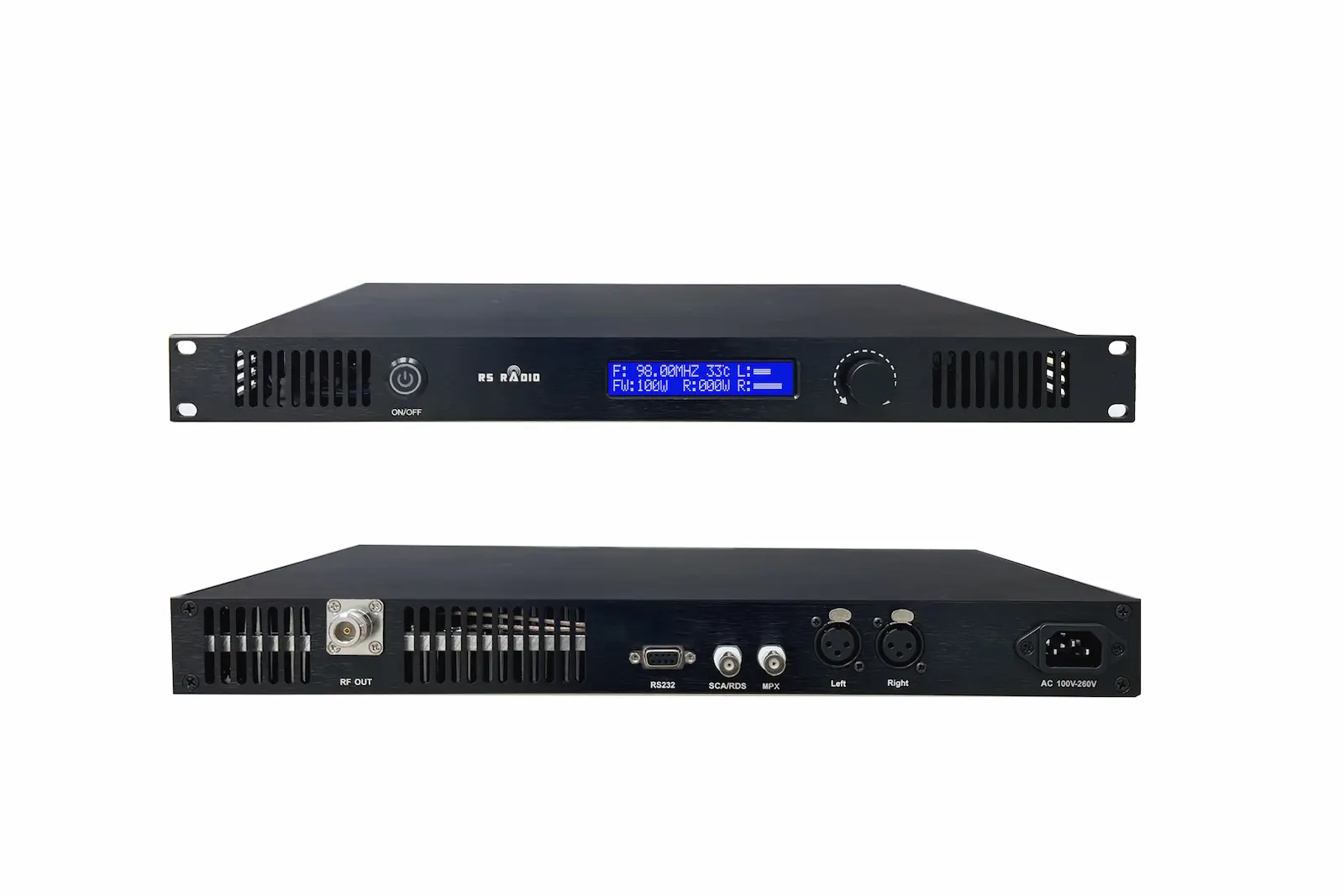
Low Power FM Transmitter (LPFM)
Our LPFM transmitters are designed for community radio, church broadcasting, campus radio stations, and drive-in events, offering stable signal performance and easy setup.
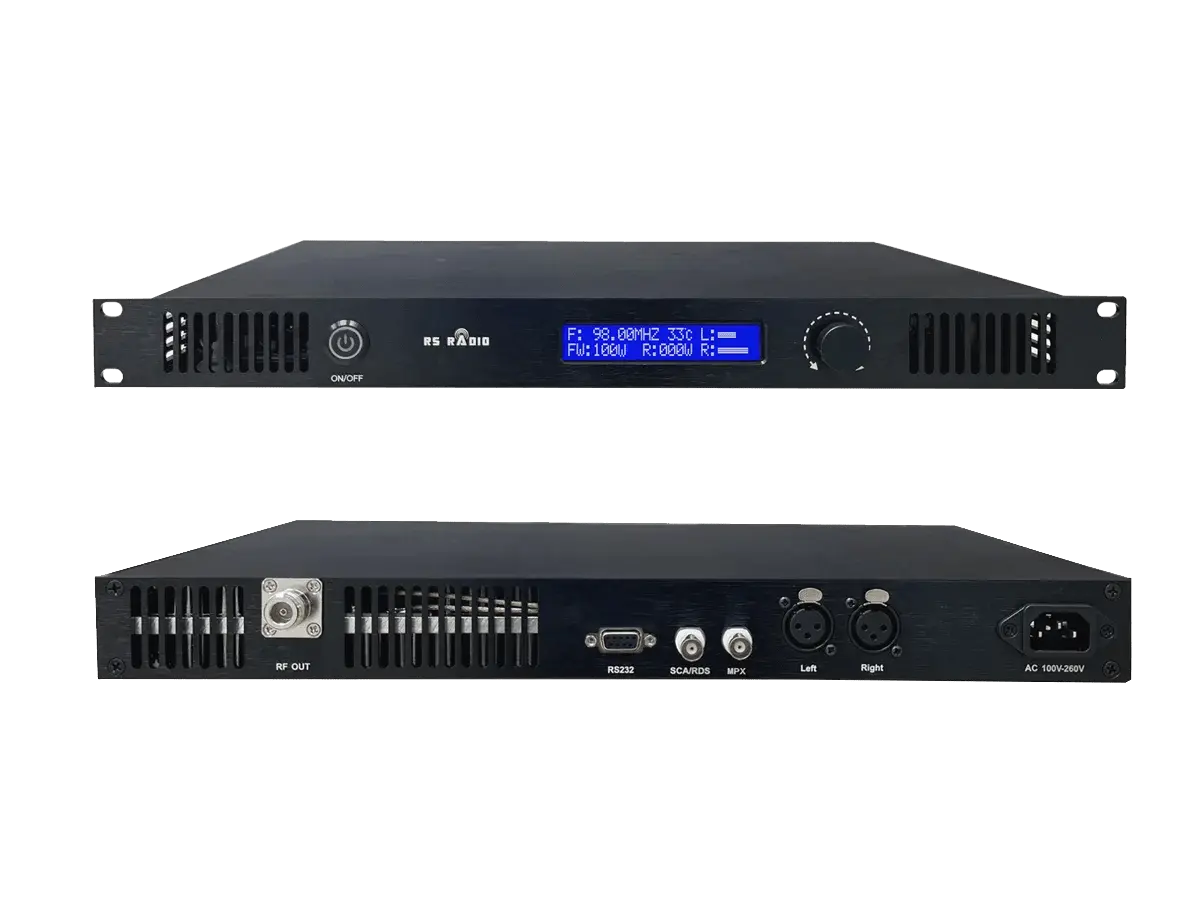
Choose the Right Low Power FM Transmitter
If you are unsure which transmitter wattage to choose, you can start by roughly estimating the coverage area you require, and then select the corresponding wattage and transmitter.
| Est. Coverage | Power Output | Frequency Range | Typical Use Case | Action |
|---|---|---|---|---|
| 1-3 km | 30W | 87.5-108 MHz | Small Events / Campus / Indoor Broadcasting | Get Quote |
| 3-5 km | 50W | 87.5-108 MHz | Church Broadcasting / Parking Lot / Drive-in | Get Quote |
| 6-10 km | 80W | 87.5-108 MHz | Community Radio / Local Broadcasting | Get Quote |
| 7-12 km | 100W | 87.5-108 MHz | Community / Hotel / Factory / industrial park broadcasting | Get Quote |
| 8-13 km | 150W | 87.5-108 MHz | Rural area / Agricultural or farm broadcasting | Get Quote |
| 10-15 km | 200W | 87.5-108 MHz | Small town radio stations | Get Quote |
* Coverage distances are estimates under flat terrain with antenna at 30m height. Actual range varies by environment.
LPFM Transmitters by Power
Each LPFM transmitter comes with a 5-year warranty; All transmitters support adjustable power output for flexible short-range or extended broadcasting use. You can select the compact FM Transmitter that best suits your needs.

30W FM transmitter
A 30W FM transmitter is commonly used for church broadcasting, parking lot radio systems, and drive-in services. It offers reliable short to medium-range coverage.

50W FM transmitter
50W FM transmitters provides a strong balance between coverage, signal stability, and installation flexibility for neighborhood-level broadcasting.

80W FM transmitter
An 80W FM transmitter is suitable for projects requiring broader coverage while maintaining stable audio transmission.

100W FM transmitter
100W FM transmitters are commonly used for LPFM radio stations, community broadcasting, and regional FM coverage.

150W FM transmitter
150W FM transmitters are designed for broadcasters requiring stronger signal penetration and wider outdoor coverage.

200W FM transmitter
A 200W FM transmitter is often used for regional radio systems and public information broadcasting.
Start Broadcasting Today
From a single 30W transmitter to a full 10KW broadcast station -- Risheng has the right solution. Factory-direct pricing, 5-year warranty, and free global shipping.
Complete FM Radio Broadcasting System
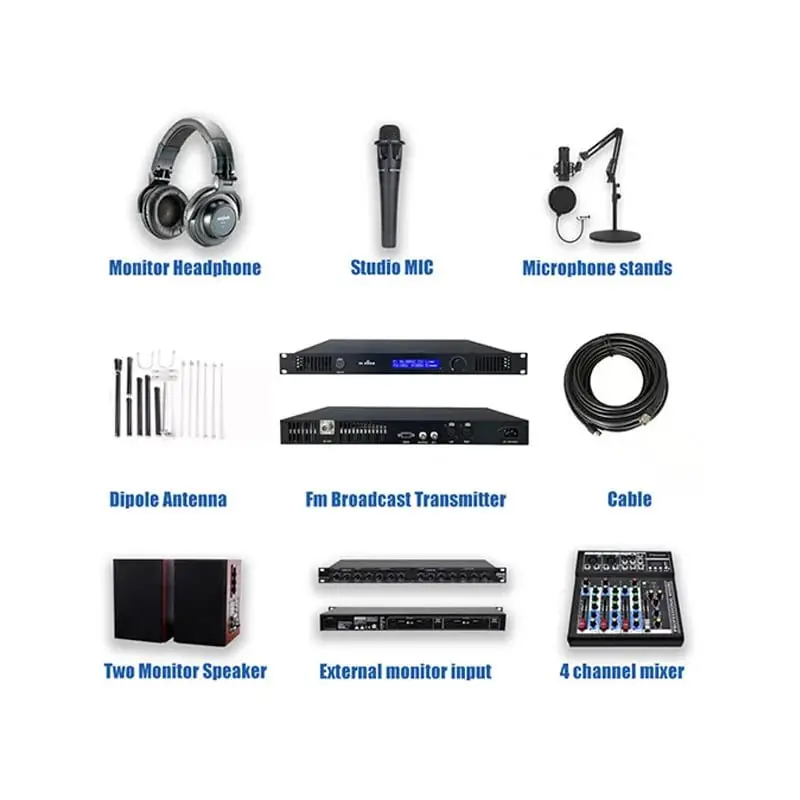
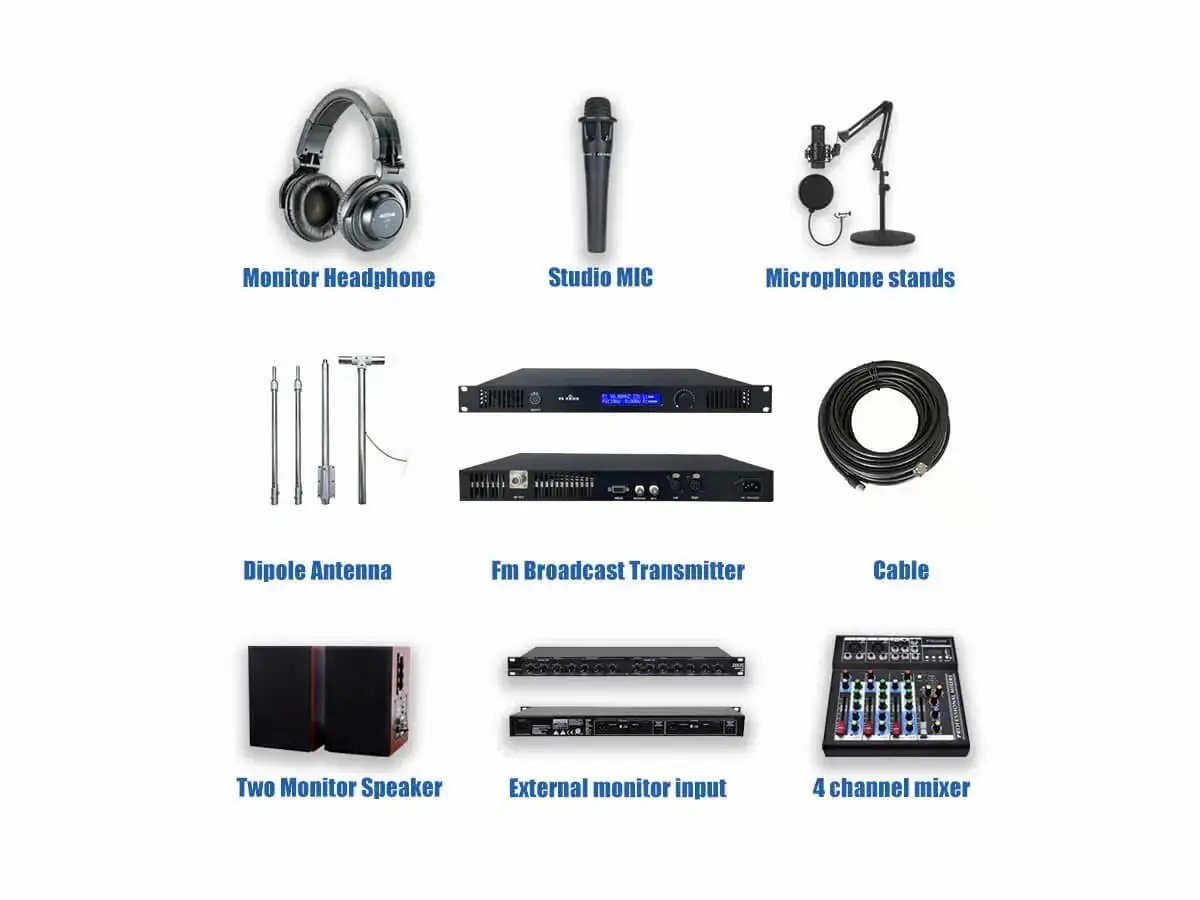
Besides low-power FM transmitters, we supply complete FM broadcast equipment solutions, including all the essential equipment needed to build and operate a community radio station.
We offer a complete range of FM broadcasting and radio studio equipment, including FM dipole antennas, coax feeder cables, mixing consoles, studio microphones, microphone stands, and professional monitoring headphones. If you are looking for other broadcast equipment for your radio station project, our team is ready to help.

FM Broadcast Equipment
Our complete FM broadcast solution is designed to meet most FM broadcasting needs--feel free to contact us for more details.

FM Dipole Broadcast Antenna
Our dipole antenna is easy to install and compatible well with the transmitter.

Coax Feeder Cable
Our coax feeder cable offers low-loss transmission and many sizes for you to choose.

Mixing Console
Our mixing console allows precise control over different audio channels, making it easy to manage and balance multiple sound sources.

Audio Processor
Our audio processor can enhance your audio quality and is built for long-lasting durability.

Monitor Speaker
Monitor speakers allow you to hear your audio exactly as it is for precise monitoring and adjustment.

Studio MIC
The studio microphone can capture clear, detailed sound, ensuring your voice is natural, clean, and professional for broadcasting.

Table Microphone Stands
Our table microphone stands offer 360° rotation, they are very stable and convenient for your broadcasting.

Closed Listening Headphones
Our closed-back headphones provide clear, isolated sound with minimal leakage, ideal for accurate monitoring during broadcasting.
Features of Our Low-Power FM Transmitters
Compared with other low-power transmitters, our FM transmitters offer the following key advantages. We also provide a 5-year warranty to ensure long-term reliability and customer satisfaction.
-
Stable Frequency Prevents signal drift -- no constant retuning required
-
Clean Signal Strong interference resistance in dense urban environments
-
24/7 Operation Broadcast-grade stability for continuous use
-
Efficient Cooling Maintains full output without degrading over time
-
Consistent Power No unexpected fluctuations in transmission range
-
Crystal-Clear Audio Smooth, distortion-free sound that's easy on the ears
How to Build an FM Radio Station
Our FM broadcasting systems are designed for easy installation, making it simple to build and set up an FM radio station for applications such as community radio, church broadcasting, and campus radio. If you need, we can provide free setup guidance.
Choose the Right FM Transmitter
Select a low power FM transmitter based on your coverage area and application, such as church broadcasting, community radio, or campus radio.
Install the Broadcast Antenna
Higher installation positions generally provide better coverage (typically 30 meters high).
Connect Your Audio Source
Connect your audio equipment, such as a mixer, microphone, or computer, to the FM transmitter. This allows you to broadcast music, speech, or live programs over the FM band.
Video Guide
FM Transmitter Installation Demo

Recorded in our factory, this video shows the real setup and testing process of our FM transmitters and broadcasting systems.

Why Choose Us?
We have established 9 overseas warehouses across key markets worldwide -- including the US, Mexico, Nigeria, Kenya, the Philippines, and more. When you need a transmitter urgently, or yours suddenly breaks down, we can ship from the nearest warehouse and get you back on air fast.
- Faster delivery -- local stock in 9 countries means shorter lead times and lower shipping costs.
- On-site engineer support -- professional engineers available in selected warehouse regions.
- Emergency replacement ready -- spare units stocked locally so your broadcast never stays off air for long.
- 10+ years of export experience -- serving 30+ countries with FCC & CE certified equipment and a 5-year warranty.
Source Manufacturer, Built for Broadcast
Liaoning Risheng Electronics Technology Co., Ltd. is a professional FM broadcast transmitter manufacturer with a dedicated R&D and production team. We deliver industrial-grade equipment directly from our factory -- no middlemen, just quality you can count on.
Direct Factory Source
We manufacture every transmitter in-house -- buy directly from the source with no distributor markup
Global Shipping & One-Stop Service
Free shipping to most countries -- FM broadcast transmitter, antennas, cables and complete kits all from one supplier
Full Product Range: 30W - 10KW
From compact low-power FM transmitter to large cabinet systems -- FCC & CE certified, single unit orders welcome

International Certifications & Compliances
Our FM broadcast transmitter meet the highest global standards and are certified by recognized authorities worldwide:
Main Certificates:
United States Federal Communications Commission
European Union safety and quality compliance
Innovation, Science and Economic Development Canada


All products meet international broadcasting standards
Trusted by Broadcasters Worldwide
"We purchased a 100W transmitter for our church. The signal quality is excellent and covers our entire community. The 5-year warranty gave us confidence. Highly recommended!"
"Best price I found for a 200W transmitter. Factory direct means real savings. Technical support via WhatsApp was incredibly helpful during installation."
"Ordered the complete broadcast kit -- transmitter, antenna, and cables. Everything arrived well-packaged. Our station has been running non-stop for 2 years without issues."
Serving Customers in 100+ Countries
Who Uses Low Power FM Transmitters?
Low power FM transmitters serve a wide range of communities and organizations -- from churches and campuses to rural villages and government agencies. What's your broadcasting project?
Church Broadcasting
Transmit sermons and worship audio to attendees in their vehicles using a church FM transmitter.
- Drive-in church services
- Outdoor worship events
- Parking lot broadcasting
Community Radio Stations
Ideal for LPFM broadcasting, delivering local news, music, and public information to your community.
- Local radio stations
- Non-profit organizations
- Neighborhood broadcasting
Campus Radio & Education
Perfect for campus radio stations and FM transmitter kits used in broadcasting education programs.
- Schools and universities
- Media training programs
- Broadcasting education
Event & Temporary Broadcasting
Suitable for event radio systems and temporary FM broadcasting at any scale.
- Drive-in events
- Festivals and exhibitions
- Outdoor movie screenings
Hotel, Resort & Tourism
Provide audio broadcasting for guests and visitors across large resort or attraction areas.
- Resorts and hotels
- Theme parks
- Tourist sites
Rural & Village Broadcasting
A reliable solution for rural communication and village-level radio stations in remote areas.
- Agricultural information
- Local announcements
- Community communication
Government & Public Info
Used for public service announcements and emergency broadcasting systems at the local level.
- Local authorities
- Public safety communication
- Information dissemination
Not Sure Which Model?
Tell us about your project and coverage area -- we'll recommend the right low power FM transmitter for you.
Frequently Asked Questions About Low Power FM Transmitters
Send Inquiry
How Far Can a Low Power FM Transmitter Broadcast?
If you're setting up a small FM station -- for a church, school, drive-in cinema, or community event -- understanding broadcast range is the first thing you need to get right. This guide explains exactly how far a low power FM transmitter can reach, and what factors determine that distance.
What Is a Low Power FM Transmitter?
A low power FM (LPFM) transmitter is an FM broadcast transmitter that operates at a relatively low wattage -- typically ranging from 7W to 200W. These units are designed for localized coverage: a neighborhood, a campus, a parking lot, or a small town. They operate on the standard FM band (87.5-108 MHz) and can be received by any ordinary FM radio or car stereo.
Low power transmitters are popular because they are affordable, easy to install, and require no specialized engineering background to operate. They are widely used across the world for:
Church & Religious Broadcast
Reaching congregation members in the parking lot or surrounding neighborhood.
Drive-In Cinema
Delivering movie audio directly to car radios across the entire parking area.
School & Campus Radio
Educational announcements and student radio programs across campus grounds.
Community FM Station
Local news, music, and community programming for a small town or district.
Farm & Rural Broadcast
Communicating across large agricultural areas without wired PA infrastructure.
Christmas Light Events
Syncing festive music to light displays so visitors can tune in from their cars.
The key question everyone asks before buying is: how far will it actually reach? The answer depends on several variables -- but power output is always the starting point.
FM Transmitter Coverage Range Reference Table
The table below shows estimated broadcast coverage radius for FM transmitters under typical urban and city conditions: standard urban terrain with buildings and obstacles, a properly matched antenna mounted at 30 meters height, and good quality coaxial cable. Real-world results may vary depending on local terrain, obstructions, and regulatory limits.
| Power Output | Est. Coverage Radius | Typical Application |
|---|---|---|
| 7W | 0.5 - 1 km | Drive-in cinema, small parking lot, single building |
| 15W | 1 - 3 km | Church parking lot, small campus, neighborhood event |
| 50W | 3 - 5 km | Small town center, large farm, school district |
| 80W | 6 - 10 km | Small community station, church with wide congregation |
| 100W | 7 - 12 km | Town-wide coverage, local community radio |
| 200W | 10 - 15 km | Regional community station, small city broadcast |
Important: These Are Estimates, Not Guarantees
Coverage figures assume ideal flat terrain. Hills, dense buildings, and trees all reduce effective range. Antenna height and cable quality are equally critical -- a 50W transmitter with a well-placed antenna can outperform a 100W unit with a poorly installed system. Always plan for your specific environment.
Factors That Affect Broadcast Range
Power output is only one piece of the puzzle. The actual range your transmitter achieves depends on a combination of these key variables:
Transmitter Power Output (Watts)
The higher the wattage, the stronger the RF signal generated. Doubling the power does not double the range -- FM signal propagation follows an inverse-square law, so meaningful range increases require significant power jumps. Going from 7W to 30W roughly triples your range.
Antenna Height
This is often the single most impactful factor. FM signals travel in line-of-sight paths, so the higher your antenna, the further the signal can reach before the Earth's curvature blocks it. Mounting an antenna at 30 meters instead of 5 meters can more than double your effective coverage radius.
Antenna Type & Gain
Different antenna designs have different gain ratings (measured in dBd or dBi). A higher-gain antenna focuses the signal horizontally, extending horizontal range at the cost of vertical coverage. Choosing the right antenna type for your environment is essential for maximizing range.
Coaxial Cable Quality & Length
Every meter of coaxial cable introduces signal loss (attenuation). Poor-quality or overly long cable can waste 20-40% of your transmitter's output before the signal even reaches the antenna. Always use the correct cable specification for your power level, and keep runs as short as practically possible.
Terrain & Obstacles
Hills, mountains, dense forests, and urban buildings all block or absorb FM signals. A transmitter in a flat, open rural area will achieve significantly greater range than the same unit operating in a valley surrounded by hills. Urban environments with tall buildings can reduce range by 30-50%.
Receiver Quality
The sensitivity of the listener's FM radio also plays a role. A high-quality car radio with a good antenna will receive your signal further out than a cheap pocket radio. When estimating coverage, it's reasonable to assume standard car radio reception as the baseline.
Real-World Use Cases by Power Level
Here's how different low power FM transmitter wattages map to common real-world scenarios. Use this as a practical guide to identify the right power level for your situation:
- Drive-in cinema: Covers a standard parking lot of 100-300 cars with clear, interference-free audio to every car radio.
- Christmas light display: Visitors tune in from their vehicles to hear synchronized music as they drive through.
- Single-building broadcast: Covers a hospital, hotel, or office complex so staff can tune in on portable radios.
- Small church parking lot: Congregation members who cannot enter the building can follow the service from their cars.
- School campus radio: Reaches all classrooms, dormitories, and sports fields with a single transmitter.
- Large farm or estate: Workers across hundreds of acres can receive announcements and audio programming.
- Neighborhood community station: Covers a residential district or small suburban area with local programming.
- Church with wider congregation: Reaches members' homes within a few kilometers of the church building.
- Small town FM station: Covers an entire small town and surrounding rural areas with consistent signal quality.
- Community radio: Serves a defined geographic community with news, music, and local programming.
- Regional religious broadcast: A church or ministry reaching listeners across multiple districts or counties.
- Factory or industrial complex: Large manufacturing sites where wired PA systems are impractical or cost-prohibitive.
How to Maximize Your Coverage Range
If you want to get the most out of a low power FM transmitter, the good news is that smart installation choices can dramatically extend your effective range -- often more than simply buying a higher-wattage unit. Here are the most impactful optimizations:
Raise Your Antenna as High as Possible
Every extra meter of antenna height increases your line-of-sight range. Mount on the highest available point -- rooftop, tower, or mast. This is the single highest-return investment you can make.
Use Low-Loss Coaxial Cable
Specify the correct cable grade for your power and run length. Thicker, higher-quality cable (e.g., LMR-400 or equivalent) loses far less signal per meter than standard RG-58 or RG-8 cable.
Choose a Directional or High-Gain Antenna
If your listeners are concentrated in one direction, a directional antenna focuses signal energy toward them, effectively increasing range in that direction. For all-around coverage, use an omnidirectional antenna.
Minimize Cable Run Length
Position your transmitter as close to the base of the antenna mast as possible. Shorter cable runs mean less signal loss. Even 10 meters of unnecessary cable can cost you a measurable percentage of your output power.
Ensure Proper Impedance Matching
Mismatched impedance between transmitter, cable, and antenna causes signal reflection and wasted power. All components should be matched to 50 ohms. Our complete kits are pre-matched to eliminate this issue.
Choose a Clear FM Frequency
Broadcasting on or near an existing strong local station causes interference that degrades perceived range. Use a frequency scanner or consult local spectrum data to find the clearest available channel in your area.
Rule of Thumb: Antenna Height Beats Raw Power
A 30W transmitter with an antenna at 20 meters height will typically outperform a 100W transmitter with an antenna at 5 meters. Before upgrading to a higher-power unit, always ask: can I raise my antenna first? It's almost always the cheaper and more effective solution.
The Complete System: Transmitter, Cable & Antenna
One of the most common mistakes first-time buyers make is purchasing only a transmitter and then discovering they cannot go on air without the other components. To broadcast FM radio, you need all three of the following -- no exceptions:
FM Transmitter
Converts your audio source into an FM radio frequency signal ready for broadcast over the air.
Coaxial Cable
Carries the RF signal from the transmitter up to the antenna with minimum signal loss along the way.
FM Antenna
Radiates the signal into the air so any standard FM radio or car stereo can receive it clearly.
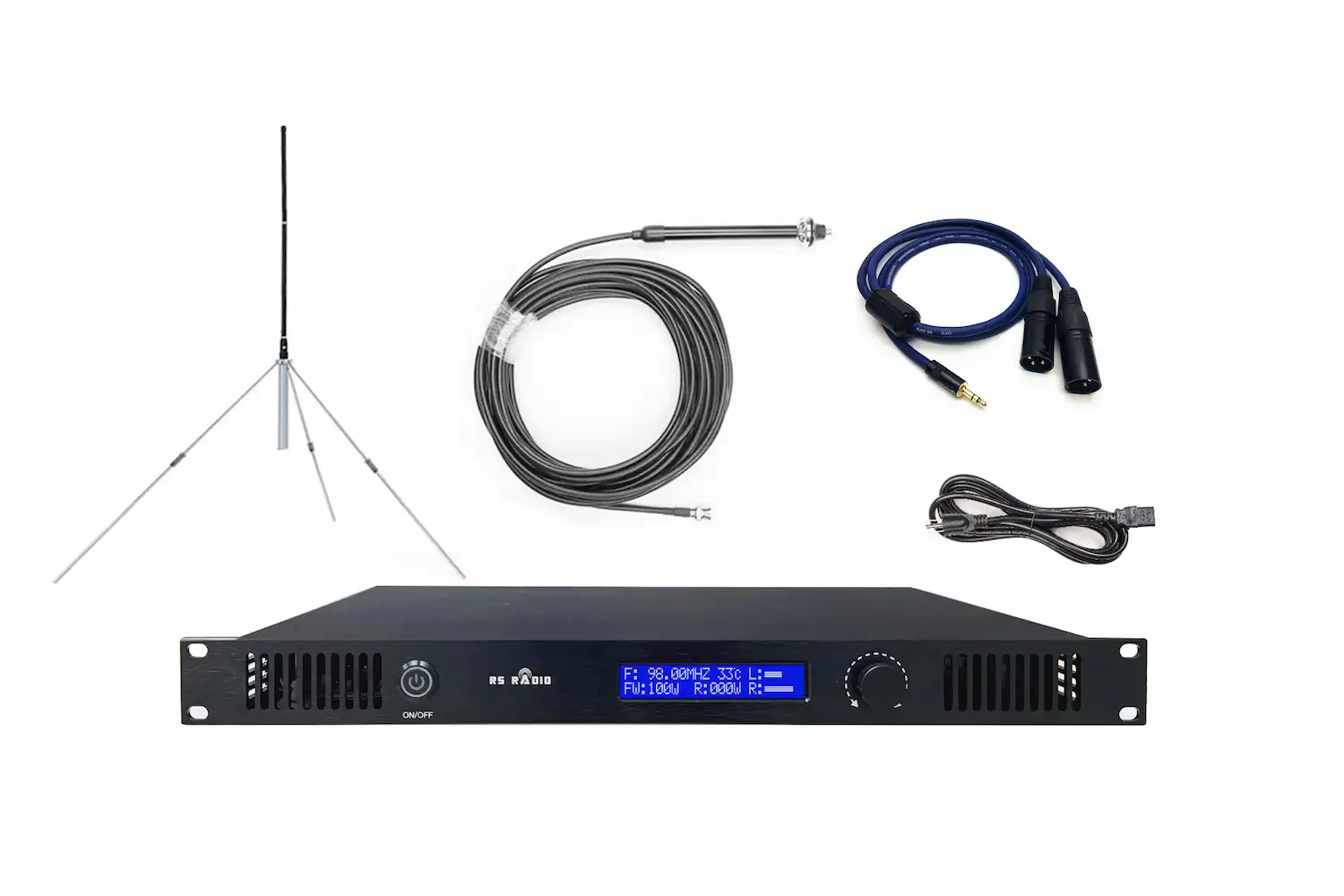
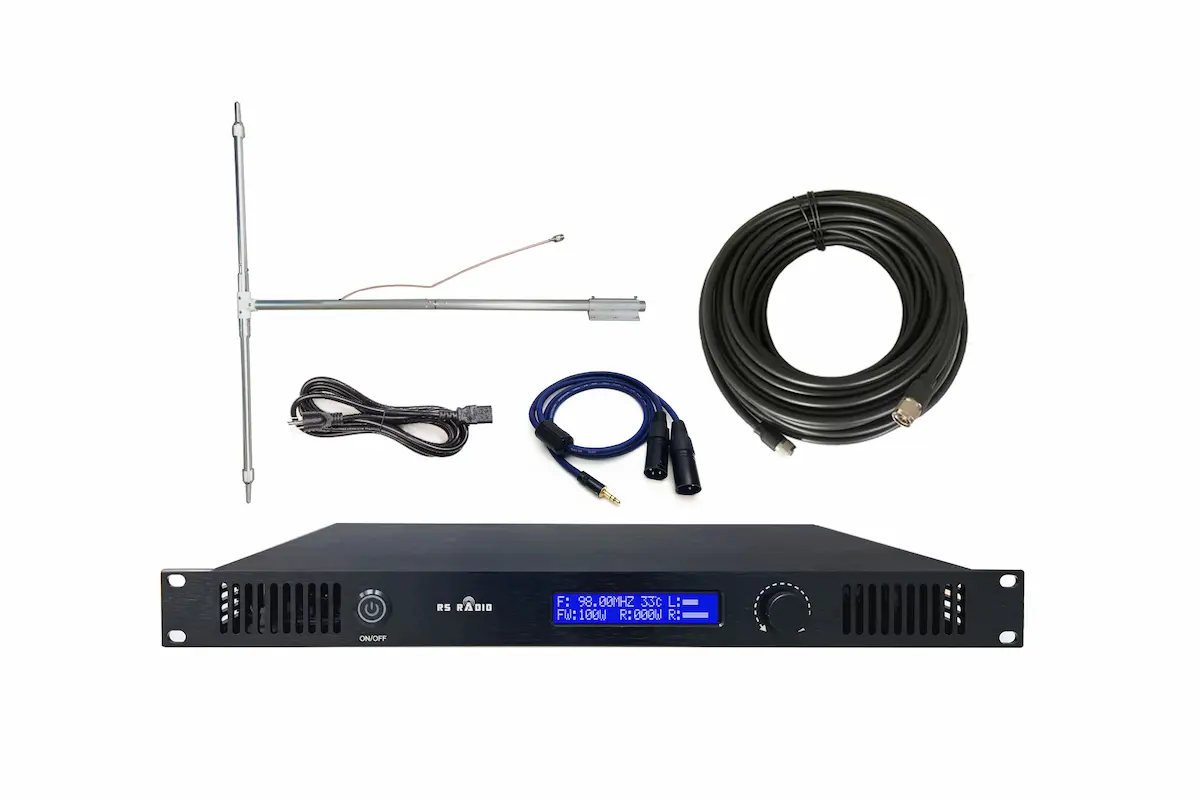
We offer complete broadcast kits that bundle all three components together -- transmitter, antenna, and matched coaxial cable -- at a combined price. For first-time buyers, this is the recommended option: all components are pre-matched for compatibility, so you don't need to worry about impedance, cable grades, or connector types.
If you already own an antenna or cable from a previous installation, we're happy to supply individual components. Just share your existing equipment specifications with us and we'll verify compatibility before you order.
Choosing the Right Low Power FM Transmitter
Ready to select your transmitter? Use this quick decision framework to identify the right model for your needs. If you can answer all five questions, you have everything you need to place a confident order.
What is my primary use case?
Drive-in, church, school, community station, farm, Christmas event, etc. -- this determines your required range.
What coverage radius do I need in kilometers?
Measure from your antenna location to the furthest point where you need reliable reception.
How high can I mount my antenna?
Rooftop, existing tower, or new mast -- the height you can achieve directly impacts how much power you actually need.
Do I need a complete kit or individual components?
Are you starting from scratch, or do you already have an antenna or cable from a previous setup?
Have I checked local FM frequency regulations?
Confirm licensing requirements and available frequencies with your national telecommunications authority before purchasing.
Not Sure Which Model Is Right for You?
Our engineers are ready to help you calculate the exact setup for your location.
As a direct manufacturer -- not a reseller -- we can provide free pre-sales consultation to help you choose the correct power level, antenna type, and cable specification for your specific terrain and coverage goals. All our transmitters come with a 5-year manufacturer warranty and dedicated WhatsApp engineer support after purchase.
- Free shipping to most countries worldwide
- FCC and CE certified models available
- Complete kits available -- transmitter, antenna, and cable bundled together
- Single units available -- no minimum order quantity required
Request a Quote or Ask a Question
Tell us about your broadcast project. Our team will recommend the right transmitter and provide a competitive factory-direct quote within 24 hours.
"As the source manufacturer, we can offer you the best price with the best quality. Single unit orders are welcome -- no minimum order quantity required."