How to Choose a High Power FM Transmitter for Radio Stations?
You may want to start a professional radio station but don’t know which high power FM transmitter matches your needs. Choosing the wrong transmitter wastes thousands of dollars and limits your coverage area. Understanding transmitter specifications, power requirements, and features helps you select equipment that serves your station reliably for years.
Choose a high power FM transmitter by matching power output to your coverage needs (1000W for 25-30km, 2000W for 30-60km), checking for DSP digital processing, adjustable power output, protection systems, and 5-year warranty. Professional transmitters should include SWR protection, fan monitoring, and temperature control.
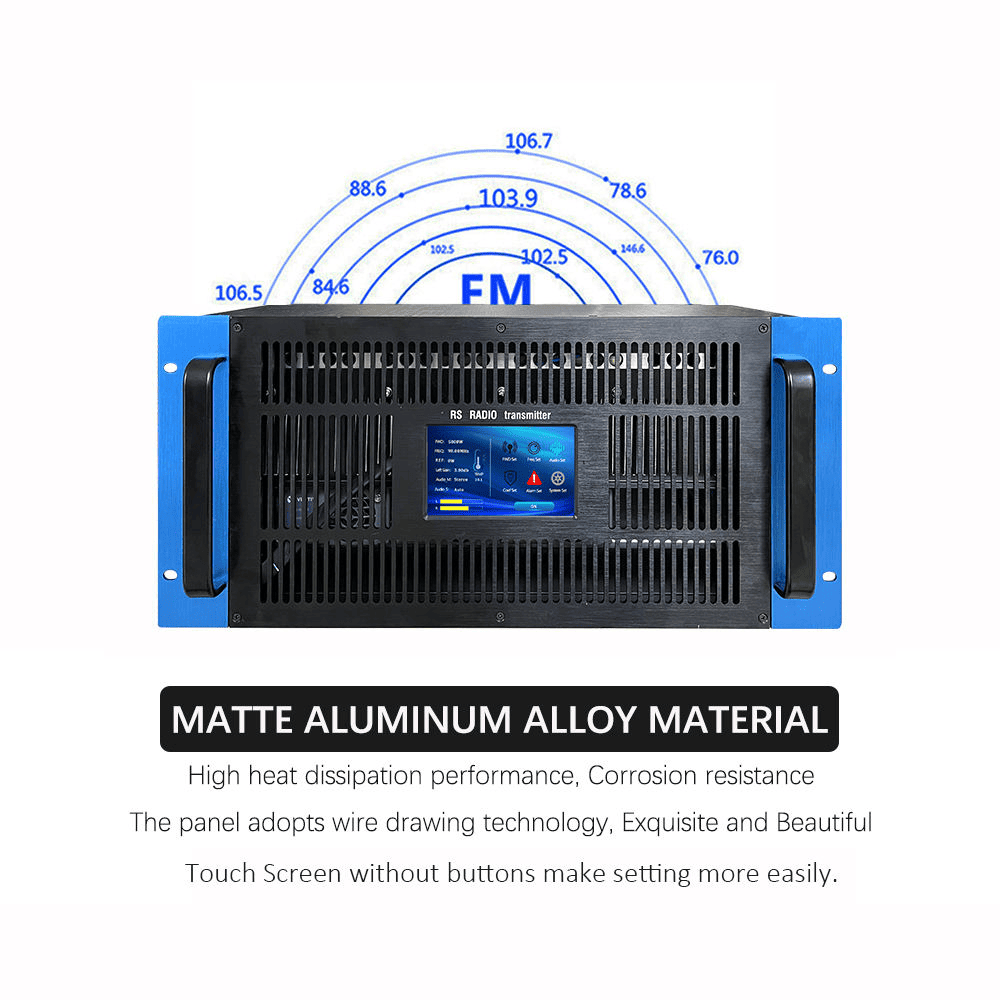
I work with radio station owners worldwide who struggle to match transmitter capabilities with their broadcast requirements. Most confusion comes from unclear power ratings and missing features that separate consumer equipment from professional broadcast gear. The right transmitter provides reliable service with minimal maintenance and maximum coverage efficiency.
How many watts do I need for my radio station?
Your station needs specific power output to reach your target audience effectively. Too little power leaves coverage gaps while excessive power wastes money and creates interference. Calculating required watts based on coverage distance, terrain, and antenna height ensures you purchase appropriate equipment.
Radio stations need 1000W for city coverage (25-30km radius), 2000W for regional coverage (30-60km), 3000W-5000W for multi-city coverage (40-80km), and 10KW for professional broadcasters covering entire regions. Community stations typically need 300W-1000W for local area broadcasting.
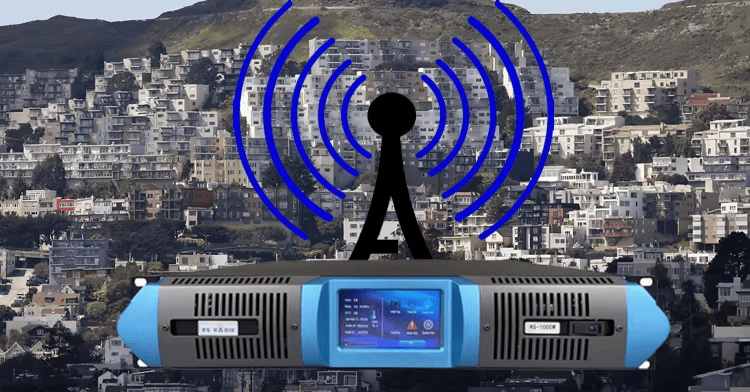
Coverage distance depends primarily on transmitter power but terrain affects actual results significantly. Flat terrain allows signals to reach maximum potential distance. Hills and mountains between transmitter and listeners block signals reducing coverage by 30-50%. I always ask customers about their local geography before recommending power levels.
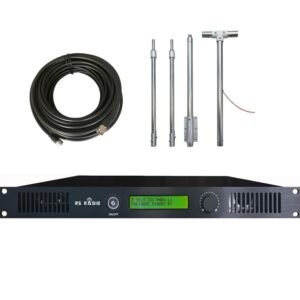
City radio stations serving urban areas need 1000W-2000W power. The RS-1000W transmitter covers typical city districts with 25-30 kilometer radius from a well-positioned antenna. Urban environments include many buildings that absorb and reflect signals. Higher power compensates for these obstacles ensuring clear reception throughout the city.
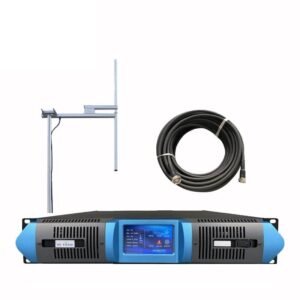
Regional broadcasters serving multiple towns need 2000W-5000W transmitters. Our RS-2000W model provides 30-60 kilometer coverage suitable for serving several communities from one transmitter location. The RS-5KW unit extends this to 60-80 kilometers making it ideal for broadcasters covering entire counties or provinces.
| Coverage Requirement | Recommended Power | Typical Coverage Radius | Best RS Model |
|---|---|---|---|
| Single neighborhood | 100W-300W | 7-20km | RS-300W |
| City district | 300W-1000W | 15-30km | RS-1000W |
| Entire city | 1000W-2000W | 25-60km | RS-2000W |
| Regional / multiple cities | 2000W-5000W | 30-80km | RS-5KW |
| Professional broadcaster | 5000W-10KW | 60-150km | RS-10KW |
Government broadcast systems and emergency networks require higher power for reliable coverage during disasters. These applications use 5000W-10KW transmitters ensuring signals reach remote areas even during severe weather. The RS-10KW transmitter serves national broadcasters and critical communication networks.
Antenna height multiplies the effectiveness of transmitter power. A 1000W transmitter with antenna at 10 meters height covers less area than the same transmitter with antenna at 50 meters. I recommend calculating coverage using both power and antenna height together rather than considering power alone.
Adjustable power output provides flexibility for different broadcasting needs. All RS high power transmitters feature continuously adjustable output. The RS-1000W adjusts from 0-1000W in 0.1W steps. This means you can operate it at 300W for local coverage and increase to 1000W when expanding service area. You buy one transmitter but get multiple power options.
How much does a high power FM transmitter cost?
You need to budget for transmitter purchase but prices vary dramatically across manufacturers and quality levels. Understanding price ranges for different power levels helps you allocate budget appropriately. Professional transmitters cost more initially but provide better reliability and lower operating costs over time.
High power FM transmitters cost $1900-$2500 for 1000W models, $3500-$4000 for 2000W units, $7000-$10000 for 3000W-5000W transmitters, and $23000 for 10KW professional systems. RS offers factory-direct pricing with 5-year warranty included at no extra cost.

Price differences reflect build quality and feature sets. Budget transmitters under $1000 use basic components and minimal protection systems. These units fail frequently and cost more to maintain than quality transmitters. Professional transmitters like RS models use NXP LDMOS transistor BLF188XR in the RF amplifier section. This premium component withstands severe load mismatch of more than 65:1 VSWR at 5dB compression point preventing damage from antenna problems.
The RS-1000W transmitter represents excellent value for professional stations. It includes DSP digital sound processing, touchscreen control without buttons, adjustable power output, and comprehensive protection systems. Many competitors charge extra for these features or omit them entirely. Our factory-direct pricing eliminates distributor markups saving customers 30-40% compared to similar quality transmitters.
Operating costs add to initial purchase price over the transmitter lifetime. Electricity consumption varies with power output and efficiency. The RS-2000W incorporates PFC (Power Factor Corrector) power supply providing maximum efficiency for energy saving. At full 2000W output it consumes approximately 3000 watts from the electrical supply achieving 67% efficiency. Budget transmitters often consume 4000-5000 watts for the same output wasting electricity and money.
Warranty coverage significantly affects total cost of ownership. RS provides 5-year warranty on all transmitters including high power models. This warranty covers manufacturing defects and component failures during normal operation. The warranty does not cover damage from lightning strikes, incorrect installation, or operation outside specifications. Most manufacturers offer only 1-2 year warranties requiring customers to purchase expensive extended coverage.
Shipping costs add to transmitter purchase price especially for international customers. RS offers free worldwide shipping to most countries for all transmitter models. We ship via DHL, FedEx, or UPS with tracking numbers provided. Delivery typically takes 5-7 business days to North America, 7-10 days to Africa and South America, and 3-5 days to Asia.
What features should I look for in a professional FM transmitter?
Professional transmitters include critical features that consumer equipment lacks. These features ensure reliable operation, protect equipment from damage, and simplify maintenance. Knowing which features matter most helps you evaluate transmitters and avoid purchasing inadequate equipment.
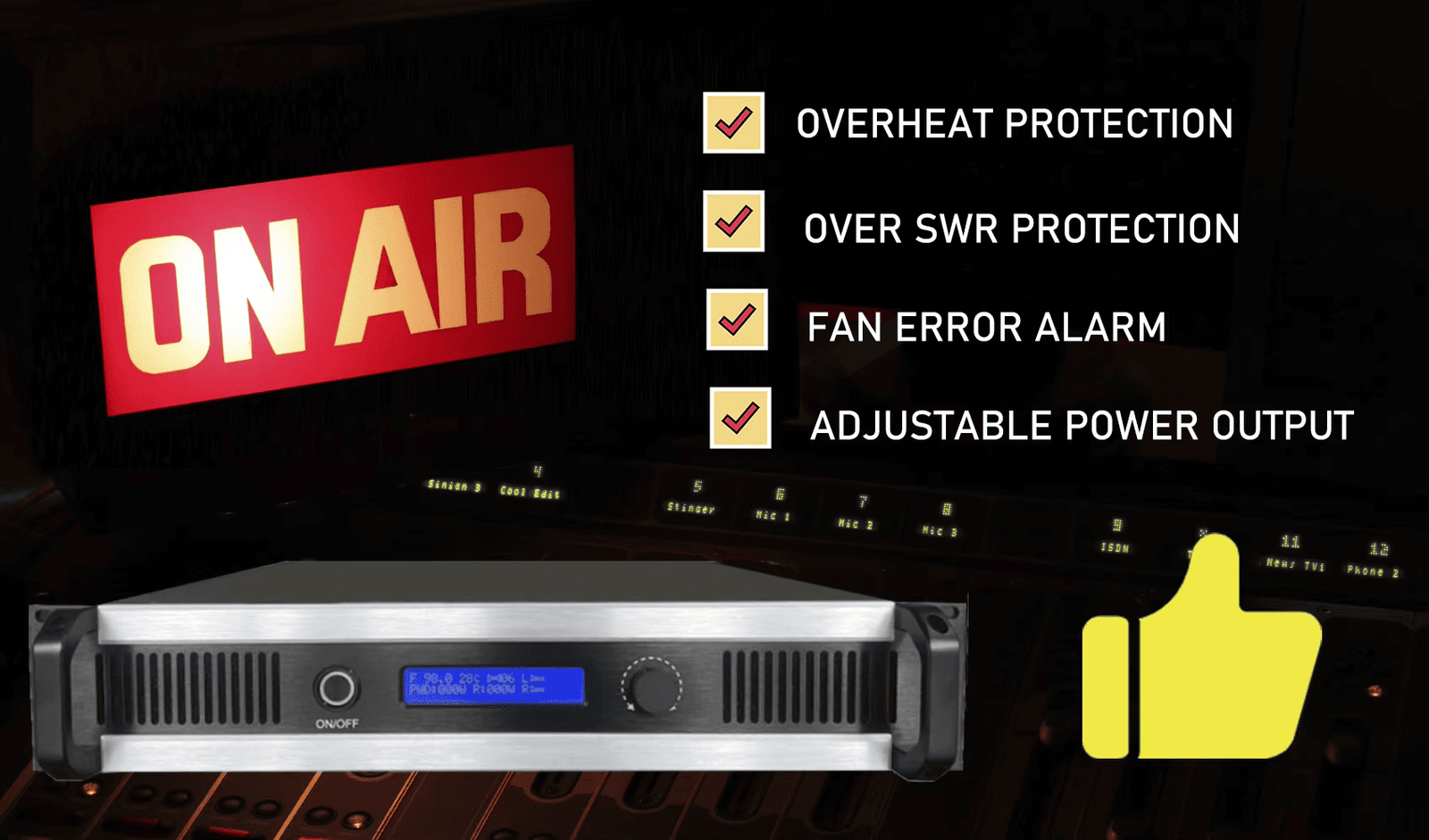
Professional FM transmitters should include DSP digital processing, continuously adjustable power output, SWR protection with automatic power reduction, fan error monitoring, over-temperature protection, stereo separation above 60dB, residual wave radiation above 65dBc, and balanced 600Ω audio inputs for studio equipment connection.
DSP digital sound processing represents the most important audio quality feature. Traditional transmitters use analog audio circuits that introduce noise and distortion. Professional transmitters like RS models implement digital FM modulator modules using DSP and DDS technology. These systems execute all-digital processing including digital filtering, pre-emphasis, pilot frequency generation, stereo coding, and FM modulating. The result is significantly cleaner audio with lower distortion and better stereo separation reaching 60dB.
Adjustable power output provides operational flexibility. Professional broadcasters need to vary transmitter power for different situations. Lower power reduces interference with nearby stations. Higher power extends coverage for special events. The RS-1000W and RS-2000W adjust continuously from 0 to maximum output in 0.1 watt steps. This fine control allows precise power setting matching any requirement. Budget transmitters operate at fixed power or offer only a few preset levels.
Protection systems prevent damage from common problems. SWR protection monitors antenna connection quality. When SWR exceeds safe levels indicating antenna problems, the transmitter automatically reduces power and displays alarm messages. This protection saves the transmitter from damage due to lightning strikes, damaged antennas, or water in cables. Fan error monitoring ensures cooling fans operate properly. When fans fail, temperature rises quickly causing component failure. The RS transmitters display fan error alarms allowing operators to replace failed fans before damage occurs.
| Essential Feature | Function | RS Implementation |
|---|---|---|
| DSP Processing | Clean digital audio | DSP & DDS modules |
| Power Adjustment | Flexible output control | 0.1W stepping |
| SWR Protection | Prevents antenna damage | Automatic power reduction |
| Temperature Control | Prevents overheating | 60°C limit with alarm |
| Stereo Separation | Audio quality | 60dB separation |
| Fan Monitoring | Cooling system check | Error alarm display |
Audio specifications determine broadcast quality. Professional transmitters should provide stereo separation of at least 60dB ensuring clear channel separation. Residual wave radiation above 65dBc prevents interference with other stations. Carrier frequency precision within ±200Hz maintains accurate frequency assignment. The RS transmitters meet all these specifications providing professional broadcast quality suitable for commercial stations.
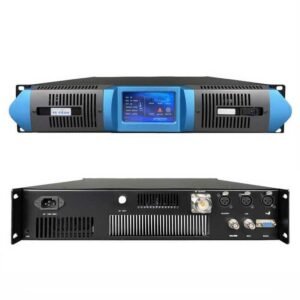
Control interfaces affect daily operation ease. Modern professional transmitters use touchscreen displays without mechanical buttons. The RS-300W, RS-1000W, and RS-2000W models feature intuitive touchscreen interfaces. Operators adjust frequency, power, and settings by touching the screen. This eliminates mechanical button failures and simplifies operation compared to older designs requiring multiple button presses for simple adjustments.
Frequency coverage determines operational flexibility. Professional transmitters should cover the complete FM band from 87.5MHz to 108MHz with 10KHz or smaller frequency steps. This allows operation on any assigned frequency without hardware modifications. All RS transmitters include this full frequency coverage using digitally synthesized frequency generation for stability and accuracy.
What affects FM transmitter coverage range?
Coverage range varies dramatically between installations using identical transmitters. Understanding factors affecting range helps you maximize coverage and troubleshoot weak signal problems. Multiple factors work together determining actual coverage distance achieved.
FM transmitter coverage range depends on transmitter power output, antenna height above ground, antenna gain and design, terrain between transmitter and receivers, building density, cable losses, and weather conditions. Antenna height often impacts coverage more than doubling transmitter power.
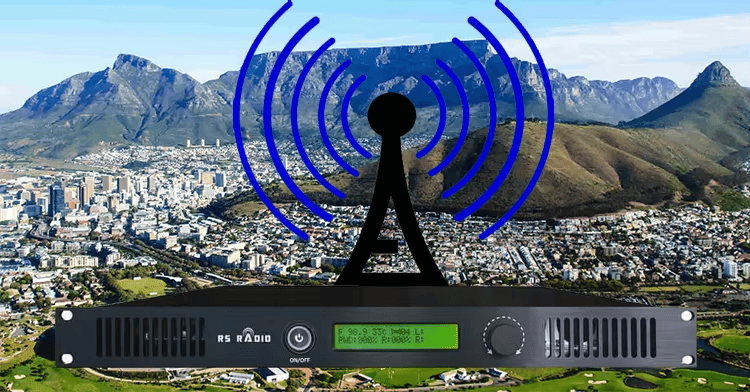
Transmitter power provides the basic signal strength foundation. Higher power transmitters produce stronger signals that travel farther and penetrate obstacles better. However, power alone does not determine coverage. I have seen 300W transmitters with proper antenna installation outperform 1000W transmitters using poor antennas at low height.
Antenna height above ground critically affects coverage distance. FM signals travel in straight lines and Earth’s curvature limits optical horizon. An antenna 10 meters high has optical horizon at approximately 11 kilometers regardless of transmitter power. Raising the antenna to 30 meters extends optical horizon to 20 kilometers. Receivers beyond optical horizon receive weak signals or no signal at all. This is why professional broadcasters install antennas on tall towers rather than building rooftops.
Terrain type dramatically changes coverage patterns. Flat terrain allows signals to reach maximum potential distance. Rolling hills reduce coverage by 20-30% because hills block signals to receivers in valleys. Mountains between transmitter and receivers can reduce coverage by 50-80% creating large shadow zones with no reception. Coastal stations broadcasting over water achieve exceptional range because water provides flat unobstructed signal path.
| Coverage Factor | Impact on Range | Optimization Method |
|---|---|---|
| Transmitter Power | Direct (baseline) | Select appropriate wattage |
| Antenna Height | Very High (40-60%) | Install on tallest structure |
| Antenna Gain | Medium (15-30%) | Use quality antenna design |
| Terrain Type | High (30-50%) | Choose elevated locations |
| Cable Quality | Medium (10-20%) | Use low-loss coaxial cable |
| Weather | Low (5-15%) | No control (temporary effect) |
Cable quality between transmitter and antenna affects how much power actually reaches the antenna. Poor quality coaxial cable loses 3-5dB per 10 meters. This means a 30 meter cable run loses half your transmitter power before it reaches the antenna. Professional low-loss cables like LDF4-50A lose only 1-2dB per 10 meters. Spending money on quality cable often improves coverage more than buying higher power transmitters.
Building density in urban environments absorbs and reflects signals. Dense downtown areas with tall buildings require 50-100% more power than suburban areas for equivalent coverage. Buildings create shadow zones where receivers get weak signals. Higher transmitter power and elevated antenna placement help overcome urban signal losses.
Weather conditions temporarily affect FM signal propagation. High humidity and rain cause additional signal attenuation of 1-3dB per kilometer. Heavy storms reduce coverage distance by 10-20% compared to clear weather. Temperature inversions occasionally create enhanced propagation conditions allowing signals to reach 2-3 times normal distance but this effect is unpredictable and temporary.
Conclusion
Choose high power FM transmitters by matching power to coverage needs, selecting professional features like DSP processing and adjustable output, considering total cost including electricity, and optimizing antenna height and cable quality for maximum range.