How to boost FM radio signal?
You might notice that your FM transmitter doesn’t seem to cover as much distance as you expected — perhaps the signal weakens at the edges, or the audio isn’t as clear as it should be. It’s a common concern for broadcasters who want stable, professional-quality transmission across their target area.
Boost FM radio signal by upgrading to higher transmitter power, installing a quality antenna at maximum height, using proper coaxial cable, and ensuring correct antenna connection with low SWR values. Power output and antenna height are the two most critical factors affecting coverage distance.
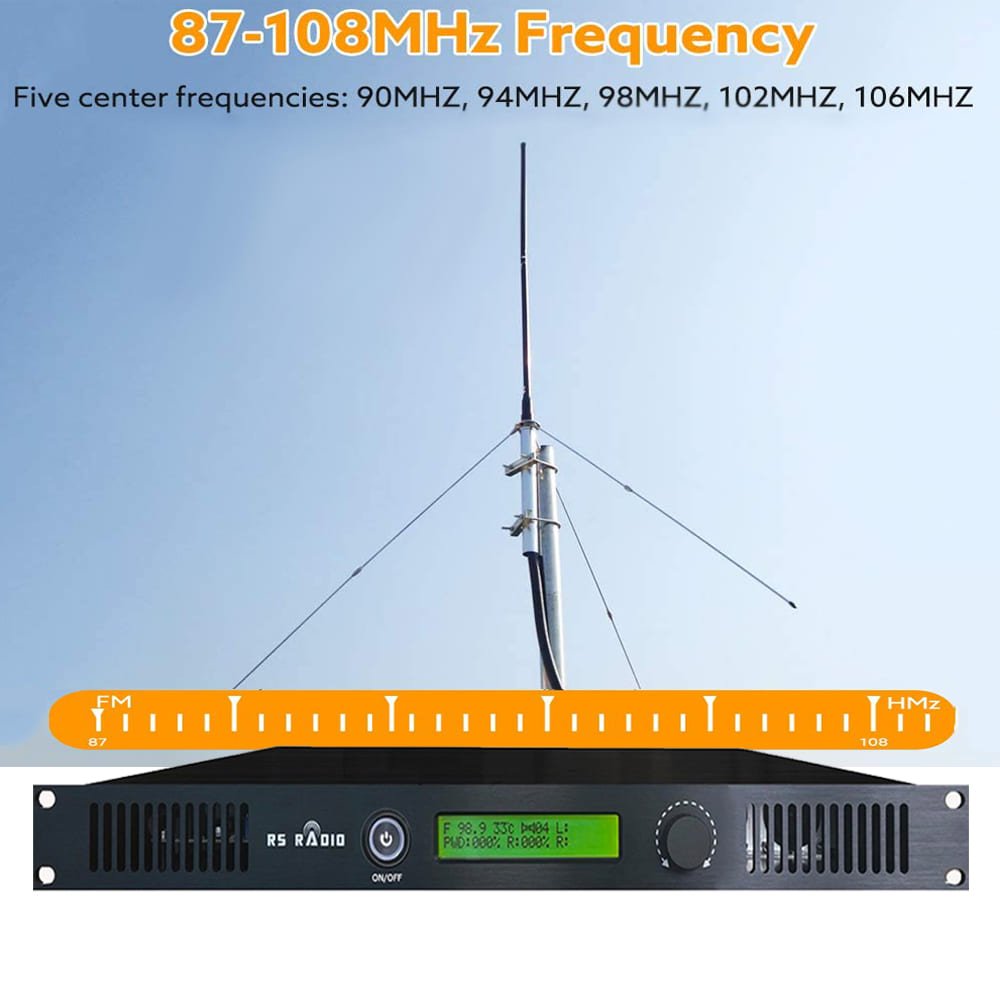
I’ve helped hundreds of church pastors and school administrators solve weak signal problems during my time at RS. Most signal issues come from three main causes that are easy to fix once you understand how FM broadcasting works. The right combination of power, antenna, and installation height transforms a weak signal into professional coverage.
Why is my FM transmitter signal so weak?
Your transmitter shows it’s working but the signal barely covers your building or sounds unclear at short distances. Weak signals result from insufficient power output, poor antenna quality, incorrect installation height, or bad cable connections. Understanding the root cause helps you apply the right solution instead of wasting money on unnecessary upgrades.
FM transmitter signals are weak due to low power output (under 50W), poor antenna design or placement, excessive cable losses, incorrect antenna impedance matching, or physical obstacles blocking signal propagation. The antenna system causes 70% of weak signal problems.
Power output is the first factor affecting signal strength. A 7W transmitter only reaches 200-500 meters in ideal conditions. A 15W unit extends this to 1-2 kilometers. If you need coverage beyond these distances, the transmitter power is simply too low for your needs.
Antenna problems cause most weak signal complaints I receive from customers. The antenna converts electrical power from the transmitter into radio waves. A poorly designed antenna wastes this power as heat instead of radiation. Using indoor antennas when you need outdoor coverage guarantees weak signals because building materials block FM frequencies.
Cable losses reduce power before it reaches the antenna. Poor quality coaxial cable loses 3-5dB per 10 meters, meaning half your transmitter power disappears in the cable. Our RS transmitters include protection against high SWR (Standing Wave Ratio) which indicates antenna connection problems. When the SWR exceeds safe levels, the transmitter automatically reduces power to protect itself, resulting in weaker signals.
| Weak Signal Cause | Impact Level | Solution Difficulty |
|---|---|---|
| Insufficient power output | Very High | Easy (upgrade transmitter) |
| Poor antenna quality | Very High | Medium (purchase better antenna) |
| Low installation height | High | Medium (relocate antenna higher) |
| Cable losses | Medium | Easy (upgrade cable) |
| SWR mismatch | High | Medium (fix connection/antenna) |
| Obstacles blocking signal | Medium | Hard (relocate antenna) |
Physical obstacles like hills, buildings, and trees absorb FM signals. FM radio operates on line-of-sight propagation, meaning signals travel in straight lines and don’t bend around obstacles effectively. Installing antennas below surrounding obstacles traps your signal and limits coverage regardless of transmitter power.
Temperature protection in RS transmitters also affects signal strength. Our units include overheat protection that automatically reduces power if internal temperature exceeds 60°C. This happens when ventilation is blocked or the transmitter operates in hot environments without proper cooling. The temperature alarm displays on screen when this protection activates.
What is the best antenna for FM broadcasting?
You need an antenna that efficiently radiates your transmitter’s power to maximize coverage area. Wrong antenna selection wastes money and limits broadcast range no matter how powerful your transmitter is. Choosing the right antenna design and specifications ensures you get maximum return on your transmitter investment.
The best FM broadcasting antenna is a vertically polarized dipole or circular polarized antenna rated for your transmitter power, with proper impedance (50Ω) and suitable gain (typically 0-2dBi for omnidirectional coverage). Dipole antennas provide the best cost-to-performance ratio for most applications.
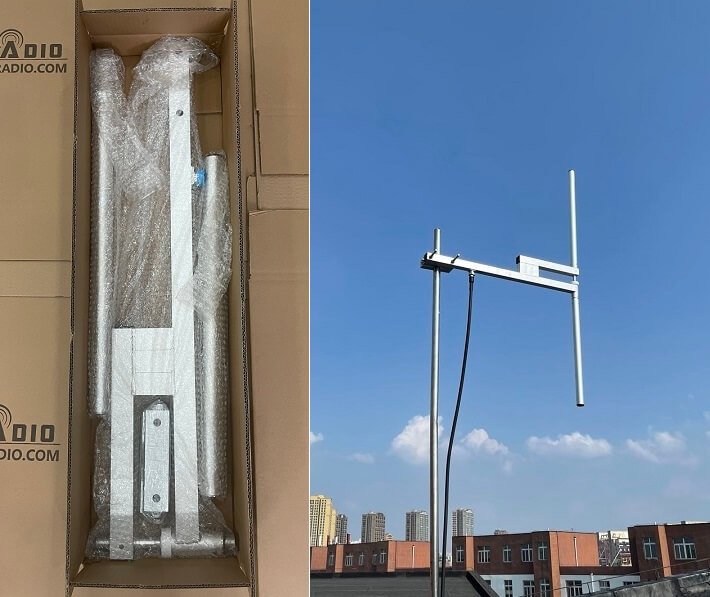
Antenna selection depends on your coverage goals and installation location. I recommend different antenna types based on whether customers need omnidirectional coverage or directional focusing. Most churches, schools, and community stations need omnidirectional antennas that broadcast equally in all horizontal directions.
The dipole antenna1 is the most popular choice for FM broadcasting. This simple design consists of two metal rods extending from a central feed point. A half-wave dipole measures approximately 1.5 meters long for FM frequencies around 100MHz. Dipoles provide omnidirectional horizontal coverage with approximately 2.15dBi gain. They work reliably and cost less than specialized designs.
Circular polarized antennas offer better performance than dipoles, especially in areas with signal reflection from buildings. These antennas radiate signals in both horizontal and vertical polarization simultaneously. Receivers pick up stronger signals regardless of antenna orientation. Circular polarized antennas cost 2-3 times more than dipoles but provide noticeably better reception quality.
| Antenna Type | Coverage Pattern | Gain | Best Application |
|---|---|---|---|
| Dipole | Omnidirectional | 0-2dBi | General broadcasting |
| Circular Polarized | Omnidirectional | 1-3dBi | Urban areas with reflections |
| Yagi | Directional | 6-12dBi | Point-to-point links |
| Collinear Array | Omnidirectional | 3-6dBi | Wide area coverage |
| Panel | Directional | 8-15dBi | Specific area targeting |
| Helical | Circular | 10-15dBi | Long distance directional |
Yagi antennas2 work best for directional applications. These antennas focus power in one direction providing higher gain (6-12dBi) than omnidirectional types. Use Yagi antennas2 when you need coverage in a specific direction or for relay links between stations. They don’t work well when you need coverage all around your location.
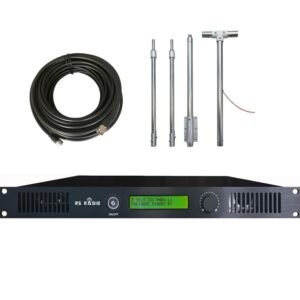
Antenna power rating must match or exceed your transmitter output. Our RS-300W transmitter requires an antenna rated for at least 300W continuous power. Using an antenna rated for only 100W with a 300W transmitter damages the antenna and creates dangerous situations. All RS transmitters use standard 50Ω impedance and 7/16" DIN connectors for reliable antenna connection.
Antenna gain doesn’t always mean better coverage. High gain antennas focus power horizontally while reducing vertical coverage. A 6dBi gain antenna concentrates power in a flatter pattern than a 0dBi dipole. This works well in flat terrain but performs poorly in hilly areas where you need vertical coverage. Most customers get best results with 0-3dBi gain antennas for general broadcasting.
How far can an FM transmitter reach under different power levels?
You need to know the expected coverage distance before purchasing transmitter equipment for your application. Unrealistic distance expectations lead to disappointment and additional costs for upgrades. Understanding the relationship between power and distance helps you select the right transmitter power level initially.
FM transmitter coverage distance depends on power output, antenna height, and terrain. A 7W transmitter reaches 1-3km, 50W reaches 5-10km, 300W reaches 15-25km, 1000W reaches 30-50km, and 2000W reaches 50-80km under ideal conditions with proper antenna installation.
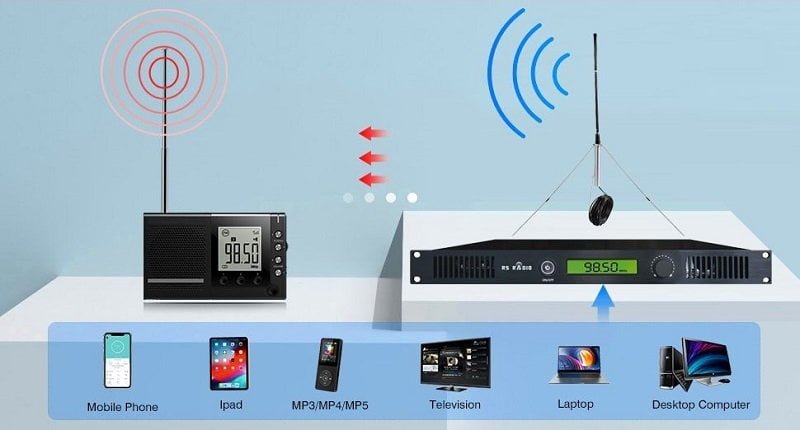
Power output directly affects coverage radius but not in a linear relationship. Doubling transmitter power only increases coverage distance by about 40%, not 100%. This happens because radio signal strength decreases with the square of distance. To double your coverage distance, you need four times more power.
I always tell customers that quoted distances assume ideal conditions that rarely exist in real situations. Ideal conditions mean flat terrain with no obstacles, antennas at proper height, perfect weather, and no interference from other stations. Real-world coverage typically reaches 60-80% of theoretical maximum distances.
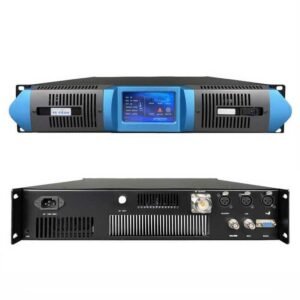
Our RS product line covers the complete power range from 7W compact units to 10KW professional systems. The RS-7W compact transmitter suits personal use and small venues like home churches or Christmas light displays. The RS-300W touchscreen transmitter works well for churches, schools, and small community stations. The RS-1000W and RS-2000W units serve larger churches, educational institutions, and professional broadcasters needing wider coverage.
| Transmitter Power | Ideal Range | Typical Range | Best Application |
|---|---|---|---|
| 7W | 1-3km | 0.5-2km | Personal use, home, small venue |
| 15W | 2-5km | 1-3km | Church, small campus, local event |
| 50W | 5-10km | 3-7km | Community station, drive-in cinema |
| 100W | 10-15km | 6-10km | Church, school, small town |
| 300W | 15-25km | 10-18km | City district, large campus |
| 500W | 20-35km | 15-25km | Regional station, multiple towns |
| 1000W | 30-50km | 20-35km | Professional broadcaster, county |
| 2000W | 50-80km | 35-60km | Major station, multiple counties |
Terrain significantly impacts actual coverage distance. Transmitters in flat areas reach their maximum potential distance. Hills and mountains between transmitter and receivers block signals and reduce coverage by 30-50%. Urban environments with many buildings create reflection and absorption that also limits distance.
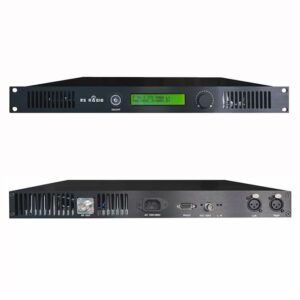
All RS transmitters feature adjustable power output in small steps. The RS-1000W model adjusts continuously from 0-1000W in 0.1W increments. This means you can run it at 50W, 100W, 300W, or any level up to the maximum 1000W. This flexibility lets you fine-tune coverage to your exact needs and avoid interference with nearby stations.
Weather conditions affect FM signal propagation3. High humidity and rain cause additional signal attenuation of 1-3dB per kilometer. This reduces coverage distance by 10-20% during storms compared to clear weather. Temperature inversions occasionally create enhanced propagation allowing signals to reach 2-3 times normal distance, but this is unpredictable and temporary.
Does antenna height significantly impact FM transmitter coverage?
You wonder if spending time and money to install antennas higher actually improves coverage meaningfully. Antenna height often gets overlooked when customers focus only on transmitter power. Understanding height impact helps you maximize coverage without purchasing more powerful transmitters.
Antenna height significantly impacts FM transmitter coverage, with each 10-meter height increase extending range by approximately 15-25%. An antenna at 30 meters height reaches 40-60% farther than the same antenna at 10 meters height. Height often matters more than doubling transmitter power.
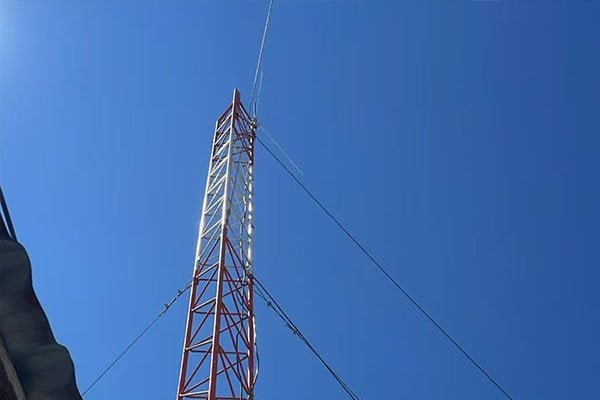
Height provides line-of-sight distance to receivers. FM signals travel in straight lines and the Earth’s curvature limits coverage at low heights. An antenna 10 meters high has optical horizon at approximately 11 kilometers. An antenna 30 meters high extends this horizon to 20 kilometers. Receivers beyond optical horizon receive weak or no signal regardless of transmitter power.
I’ve seen customers transform coverage by moving antennas from rooftops to towers. One church customer complained their RS-300W transmitter only covered 5 kilometers. Their antenna sat 8 meters high on a single-story building. We recommended installing the antenna on a 25-meter tower. Coverage extended to 18 kilometers without changing the transmitter. Height solved their problem better than upgrading to higher power.
Building rooftops provide convenient antenna locations but often limit height to 10-15 meters. Purpose-built towers allow 20-40 meter antenna heights for significantly better coverage. Local regulations typically limit tower heights without special permits, so check rules before planning tall installations.
| Antenna Height | Optical Horizon | Coverage Impact | Installation Difficulty |
|---|---|---|---|
| 5 meters | 8km | Baseline | Easy (short mast) |
| 10 meters | 11km | +38% range | Easy (roof mount) |
| 20 meters | 16km | +100% range | Medium (small tower) |
| 30 meters | 20km | +150% range | Hard (medium tower) |
| 50 meters | 25km | +213% range | Very hard (tall tower) |
| 100 meters | 36km | +350% range | Professional (major tower) |
Height also reduces obstacles blocking your signal. Antennas mounted 5 meters high sit below many nearby buildings and trees. These obstacles block signals and reduce coverage to small areas with direct line-of-sight. Raising the antenna to 20-30 meters elevates it above most local obstacles allowing signals to propagate freely.
Ground-mounted antennas perform poorly for FM broadcasting. Some customers try using antennas on short poles 2-3 meters high to avoid installation complexity. These installations rarely achieve satisfactory coverage because nearby objects block the signal. I always recommend minimum 10-meter height for any serious broadcasting application.
Cable length increases with height creating additional signal loss. Every 10 meters of low-quality coaxial cable loses 3-5dB of power. This means long cable runs to tall towers waste transmitter power in the cable. Use high-quality low-loss cable like LDF4-50A for runs over 20 meters. The cable cost is justified by improved signal delivery to the antenna.
Conclusion
Boost FM radio signal through higher transmitter power, quality antennas, proper installation height, and low-loss cables with correct connections. Antenna height often provides more coverage improvement than doubling transmitter power, making it the most cost-effective upgrade for weak signals.