How Far Can an FM Radio Transmitter Reach?
You want to know transmission range before buying equipment but wrong power estimates waste money or leave coverage gaps. Distance calculations confuse most station owners mixing transmitter power, antenna height, and terrain factors. Understanding these variables helps you choose correct equipment and predict actual coverage.
FM transmitter range depends on three factors: effective radiated power (ERP)1, antenna height above ground, and terrain type. A 100W transmitter with antenna at 30m height covers 7-12km on flat terrain. A 1000W transmitter at 30m height covers 25-30km. To triple the coverage distance, you need about ten times the transmitter power.
I work as a technical engineer at RS. I calculate coverage distances for customers every day. Most people focus only on transmitter power but antenna height matters more than they realize.
What affects FM transmitter range
Many factors determine signal distance. Understanding these helps you predict real coverage rather than guessing.
FM transmitter range depends on effective radiated power (ERP), antenna height above terrain, ground elevation, terrain shape (flat vs mountains), area type (rural vs urban), cable losses, antenna gain, and receiver sensitivity. Antenna height affects coverage more than transmitter power changes.
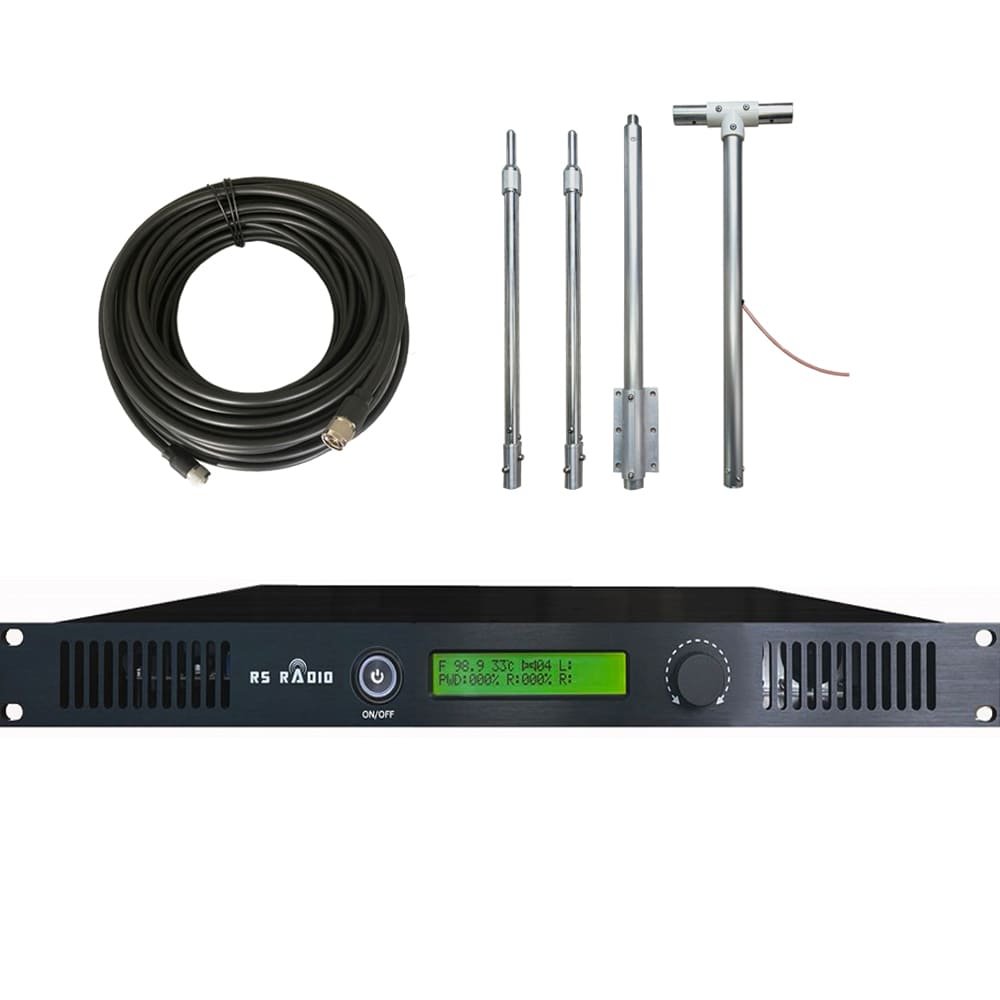
ERP represents actual radiated power after combining transmitter output, cable losses, and antenna gain. Calculate ERP using this formula:
ERP = Transmitter Power (W) × 10^((Antenna Gain dBd – Cable Loss dB) / 10)
Example calculation: 1000W transmitter with 4-bay antenna (8dBd gain) and 30m of 7/8" foam cable (2.1dB loss):
ERP = 1000W × 10^((8 – 2.1) / 10) = 1000W × 3.89 = 3890W
This system produces 3890W ERP. The antenna system multiplies transmitter power by 3.89 times through gain while cable loses about 38% of power over that distance.
Antenna height creates the biggest coverage difference. Signal propagates by line-of-sight primarily. The formula for line-of-sight distance is: d = 3.57√h (where d is distance in km and h is height in meters). At 10m height you see 11km. At 30m height you see 19.5km. At 100m height you see 36km. At 500m height you see 80km.
| Antenna Height | Line-of-Sight Distance | Coverage Area Increase |
|---|---|---|
| 10m | 11km | 1x baseline |
| 30m | 19.5km | 1.8x |
| 50m | 25.2km | 2.3x |
| 100m | 36km | 3.3x |
| 500m | 80km | 7.3x |
Terrain type changes everything dramatically. Flat plains allow maximum propagation approaching line-of-sight distances. Hills and mountains block signals creating shadow zones with no coverage. Urban buildings absorb and reflect signals reducing range by 30-40% versus rural areas with same power and antenna height.
Free space path loss increases 6dB each time distance doubles. This represents the fundamental physics of radio wave propagation. At 100MHz FM frequency, path loss at 1km is approximately 72.4dB. At 2km it becomes 78.4dB. At 4km it reaches 84.4dB. This means signal strength drops by 75% each time distance doubles, requiring 4x more power to maintain the same signal level.
Receiver location matters significantly. Signals penetrate rural areas easily with minimal obstructions. Urban environments need stronger signals to overcome building penetration losses. CCIR standards specify minimum signal levels: rural areas need 48dBμV (approximately 54dBμV/m), urban areas need 60dBμV (66dBμV/m), large cities need 70dBμV (76dBμV/m). You need roughly 10-15 times more power for urban coverage versus rural coverage at the same distance.
Cable losses waste transmitter power before reaching the antenna. RG213 cable at 100MHz loses approximately 0.2dB per meter, meaning 30m loses 6dB (wasting 75% of power). Professional 7/8" foam cable loses about 0.07dB per meter, meaning 30m loses 2.1dB (wasting 38% of power). Using quality cable increases coverage by 40-60% without changing transmitter power.
How to increase FM transmitter coverage?
You need more coverage but buying bigger transmitters costs thousands. Several methods extend range more cost-effectively than simply adding power.
Increase FM coverage by raising antenna height (most effective method), using higher gain antennas, upgrading to low-loss cable, improving antenna system efficiency, selecting elevated transmitter sites, optimizing frequency selection, and adding transmitter power (least cost-effective approach). Antenna height increases coverage more efficiently than power increases.
Raising antenna height delivers the biggest improvement per dollar invested. Moving antenna from 20m to 50m extends line-of-sight from 16km to 25km without changing transmitter power. This increases coverage area by 2.4x just by raising antenna 30m. Compare this to doubling transmitter power which extends coverage radius only 1.4x for the same increase in coverage area.
Install antennas on hilltops or mountains whenever possible. A 100W transmitter on a 300m mountain covers 40-50km. The same transmitter at 30m on flat ground covers only 7-12km. Elevated sites multiply coverage by 4-5x or more. I always recommend customers invest in good locations before buying more power. The site location often matters more than equipment specifications.
Use higher gain antennas systematically. Single bay dipole provides 0dBd gain (reference level). Two bay dipole provides 3dBd gain doubling ERP. Four bay dipole provides 8dBd gain increasing ERP by 6.3x. A 100W transmitter with 4-bay antenna produces 630W ERP matching a 630W transmitter with single bay antenna. Antenna investment costs less than transmitter power upgrades typically.
Upgrade coaxial cable to reduce losses substantially. RG213 cable wastes 75% of power over 30m runs at FM frequencies. Professional 7/8" foam cable wastes only 38% over the same distance. Upgrading cable on a 500W system saves 185W reaching the antenna compared to RG213. This equals adding 185W transmitter power but costs only $400-600 versus $1500-2500 for power upgrade.
| Improvement Method | Coverage Increase | Approximate Cost | Cost Effectiveness |
|---|---|---|---|
| Raise antenna 20m → 50m | 1.75x radius | $500-2000 | Highest |
| Upgrade to 4-bay antenna | 2.5x radius | $600-1200 | Very High |
| Replace RG213 with 7/8" cable | 1.6x radius | $400-700 | High |
| Double transmitter power | 1.4x radius | $1000-3000 | Moderate |
Optimize frequency selection to avoid interference completely. Adjacent stations on same frequency block your signal within their coverage area. Coordinate frequencies maintaining minimum separation from same-frequency stations. RS transmitters cover 87.5-108MHz allowing flexible frequency selection avoiding interference problems.
Site location affects propagation dramatically in all terrains. Choose locations with clear line-of-sight toward your target audience area. Avoid placing antennas in valleys or behind hills which create shadow zones. Survey multiple potential sites before deciding final location. A better location with lower power consistently beats a poor location with high power.
Combine multiple improvements for maximum results effectively. Customers achieving best coverage use elevated sites, professional antennas, quality cables, and appropriate power together. A 300W transmitter on a 300m mountain with 4-bay antenna and quality cable covers 50-70km serving 150,000-400,000 people. This performs better than a 2000W transmitter at poor location with basic equipment.
The RS transmitter line includes models from 7W to 10KW covering all applications. Most community and religious broadcasters use the 100W-1000W range. The RS-1000W includes adjustable output from 0-1000W in 0.1W steps allowing precise optimization. Start at lower power and increase gradually while monitoring actual coverage results.
How far does a 1000 watt / 100 watt FM transmitter reach?
Customers ask daily about coverage distances for different power levels. Specific distance predictions require knowing antenna height and terrain but general estimates help initial planning.
A 100W FM transmitter covers 7-12km radius in rural flat areas with antenna at 30m height. A 1000W transmitter covers 25-30km radius under same conditions. Urban areas reduce these ranges by 30-40%. Mountains and hills reduce ranges by 40-60% depending on terrain severity. Antenna height changes these distances more significantly than power level increases.
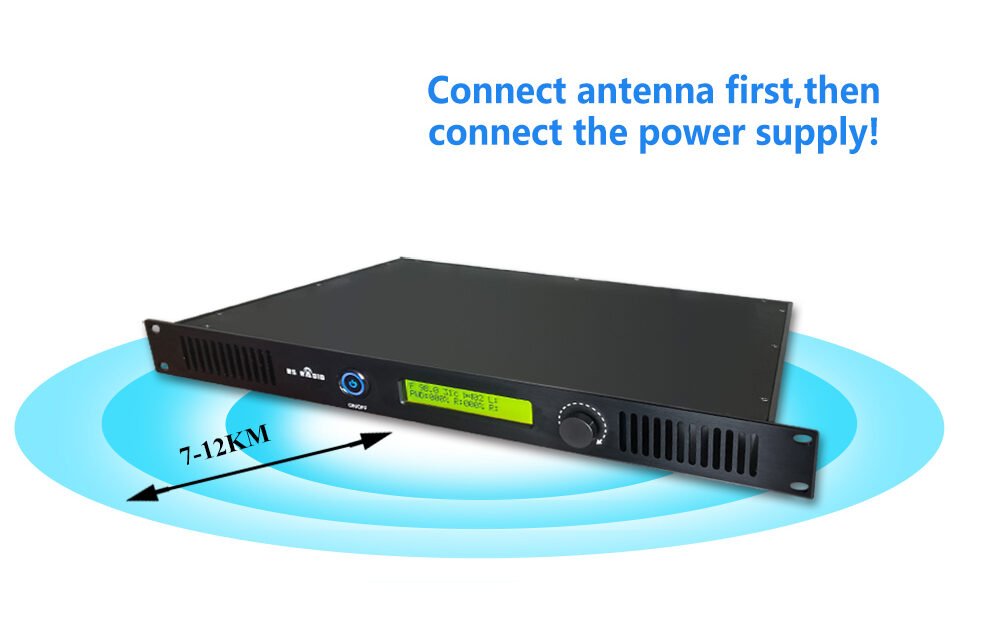
100W transmitter coverage varies dramatically with installation height and terrain. At 30m antenna height on flat terrain 100W covers 7-12km typically. At 50m height the same transmitter covers 12-18km. On a 200m hill 100W reaches 25-35km. The RS-100W serves small communities, churches, and local stations perfectly at these ranges.
1000W transmitter serves small cities and regional areas effectively. At 30m height on flat ground 1000W covers 25-30km. At 50m height coverage extends to 35-45km. On 300m mountains 1000W reaches 50-70km serving populations of 150,000-500,000. The RS-1000W includes DSP digital processing and professional components delivering reliable performance for these demanding applications.
| Power | 30m Height Flat | 50m Height Flat | 200m Elevation Hill |
|---|---|---|---|
| 100W | 7-12km | 12-18km | 25-35km |
| 300W | 15-20km | 22-30km | 40-55km |
| 500W | 20-25km | 28-38km | 50-70km |
| 1000W | 25-30km | 35-45km | 60-85km |
Terrain type dramatically changes these estimates in practice. Flat agricultural plains allow maximum distances approaching line-of-sight limits. Rolling hills reduce coverage by 20-30% due to terrain blocking. Mountains cut coverage by 40-60% creating large shadow zones. Dense cities decrease range by 30-40% due to building absorption and multipath reflections.
Real coverage examples from RS customers show actual performance. A church in Philippines uses RS-100W at 35m tower covering their city of 60,000 people at 10km radius. A religious network in Tanzania uses RS-1000W at 60m tower covering 35km radius reaching 300,000 listeners across multiple towns. A mountain station in Mexico uses RS-500W at 280m elevation covering 45km reaching into valleys below.
Weather affects coverage temporarily but significantly. Heavy rain attenuates signals by 10-15% at FM frequencies. Snow and ice accumulation on antennas decreases performance by 15-25% until physically removed. Atmospheric conditions occasionally extend coverage 15-30% during temperature inversions but this happens unpredictably and temporarily.
Calculate required power by working backwards from desired coverage distance. Want 20km coverage in rural areas with 30m tower? You need 300-500W. Want 40km coverage at 50m height? You need 1000-1500W. Want 70km coverage? You need high elevation site with 2000-3000W or mountain location with 1000W. These estimates assume proper antenna systems and quality cables.
The relationship between power and distance follows square law physics. Doubling distance requires quadrupling power approximately. 100W covers 10km. 400W covers 20km. 1600W covers 40km. This explains why antenna height matters more than power. Raising antenna 30m might double coverage but costs one-tenth the price of quadrupling transmitter power.
How to choose the right FM transmitter power for your radio station?
Wrong power selection wastes money or fails to cover your target area. Calculate required power based on actual coverage needs, antenna system capabilities, and site location characteristics.
Choose transmitter power by calculating required ERP for your coverage distance, dividing by antenna gain, adding cable losses, and selecting next higher standard power level. Small community stations need 50-200W. Town stations need 300-1000W. City stations need 1000-3000W. Regional broadcasters need 3000-10000W depending on terrain.
Start with desired coverage radius measurement. Measure from your transmitter location to the farthest listener you want to reach reliably. Use actual maps checking real distances. Add 20-30% safety margin for signal penetration into buildings and terrain variations.
Reference coverage tables showing approximate power needed for different distances. These estimates assume 30m antenna height on flat terrain:
| Desired Coverage | Rural Area | Urban Area | Small Community |
|---|---|---|---|
| 5km radius | 50W | 100W | Churches, schools |
| 10km radius | 100W | 200W | Small town |
| 20km radius | 300W | 500W | Multi-village area |
| 30km radius | 1000W | 2000W | City coverage |
| 50km radius | 3000W | 5000W | Regional network |
Calculate transmitter power from required ERP using antenna system specifications. Formula: Transmitter Power = ERP / (10^((Antenna Gain – Cable Loss) / 10))
Example: You need 1000W ERP for 30km coverage. Your 4-bay antenna provides 8dBd gain. Your 30m professional cable loses 2.1dB. Required transmitter power = 1000 / (10^((8 – 2.1) / 10)) = 1000 / 3.89 = 257W. Choose the RS-300W model for adequate margin.
Consider your broadcast application type carefully. Community radio serving local area needs 50-200W typically. Religious broadcasting for city coverage needs 300-1000W. Commercial station for regional area needs 1000-3000W. Government communications for province needs 3000-10000W depending on geography.
Budget constraints affect decisions significantly. The RS-100W costs $650 complete. The RS-1000W costs $1,890. The RS-5000W costs $9,900. Calculate total system costs including antenna ($600-2000), cable ($300-1000), tower ($2000-8000), and installation labor ($1000-5000). Sometimes better location with lower power costs less than high power at poor location.
Regulatory limits restrict maximum allowed power in many countries. Check your broadcasting license carefully for power limits. Some licenses specify ERP limits rather than transmitter power limits. Calculate carefully ensuring full compliance with regulations.
Future growth planning matters for expanding stations. Station expecting to expand coverage area later should buy adjustable power transmitters now. The RS transmitter series includes 0.1W step adjustment. Buy the RS-300W now and operate at 150W initially. Increase power later when expanding coverage without replacing expensive equipment.
Multiple transmitter sites work better than single high-power site in mountainous terrain consistently. Two RS-300W transmitters at different strategic locations cover valleys better than one RS-1000W blocked by mountains. Calculate per-site coverage areas and plan network accordingly for best results.
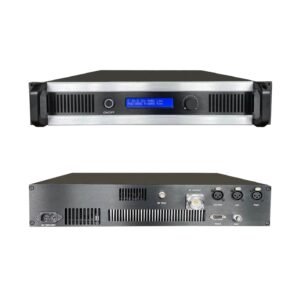
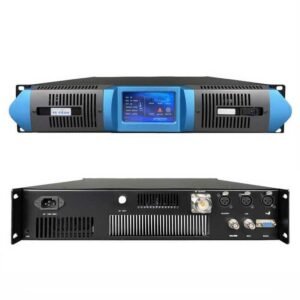
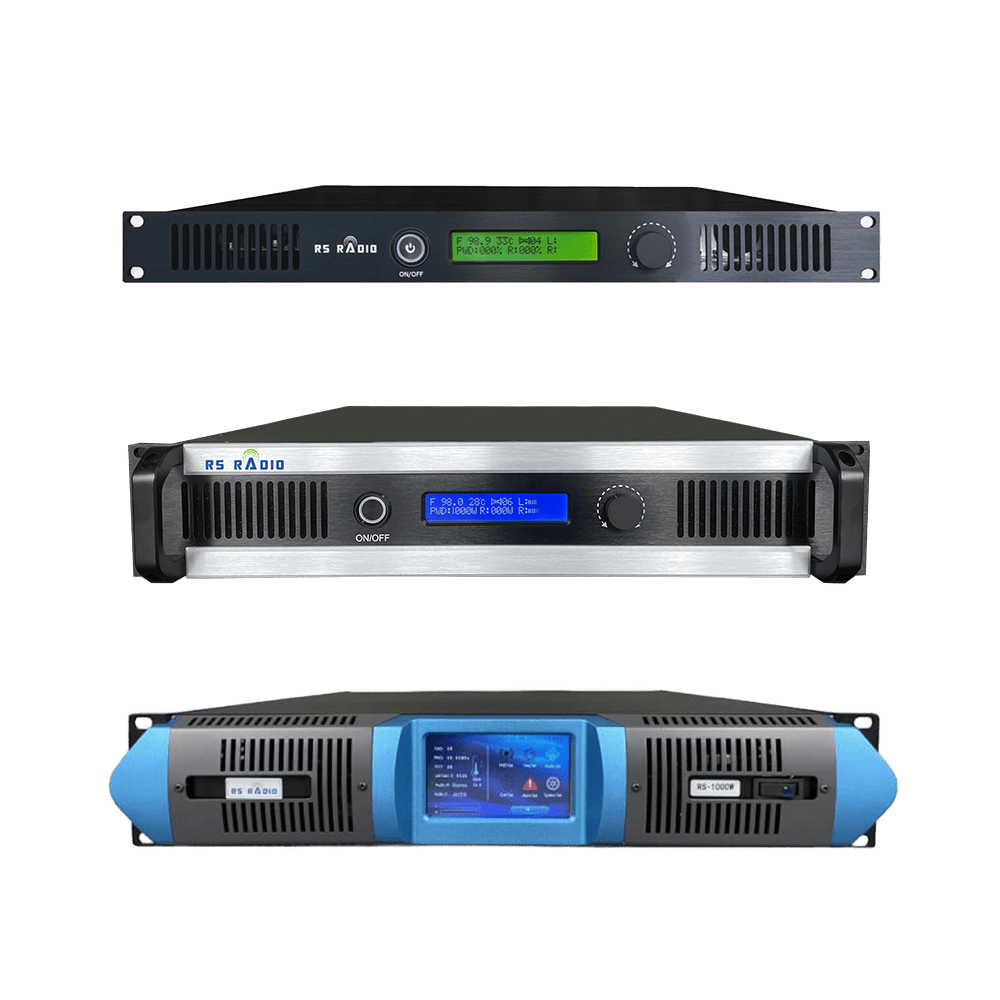
The RS transmitter range covers all broadcasting applications. The 7W-50W compact series serves micro-community radio and campus stations. The 100W-200W series serves small towns and communities. The 300W-2000W touchscreen series serves cities and regions. The 3000W-10000W cabinet series serves major cities and provinces.
Conclusion
FM transmitter range depends primarily on ERP, antenna height, and terrain type together. A 100W transmitter covers 7-12km while 1000W covers 25-30km with 30m antenna height on flat terrain. Increase coverage by raising antenna height before adding power since height improvements cost less and work better. Calculate required ERP for your target distance and choose appropriate transmitter power matching your antenna system specifications and site conditions.
-
Understanding ERP is crucial for optimizing your FM transmitter’s range and ensuring effective coverage area. ↩