How an FM Broadcast Station Works?
Starting an FM radio station seems complicated with all the technical equipment and settings required. Many people give up before they begin because they feel overwhelmed by the technical requirements. Understanding how FM broadcast stations work simplifies the entire process and helps you launch successfully.
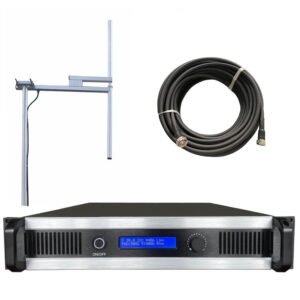
An FM broadcast station1 works by converting audio signals into radio waves through a transmitter2, sending those waves through a coaxial cable to an antenna, which broadcasts the signal so FM radios can receive it. The three essential components are the transmitter2, antenna, and connecting cable.
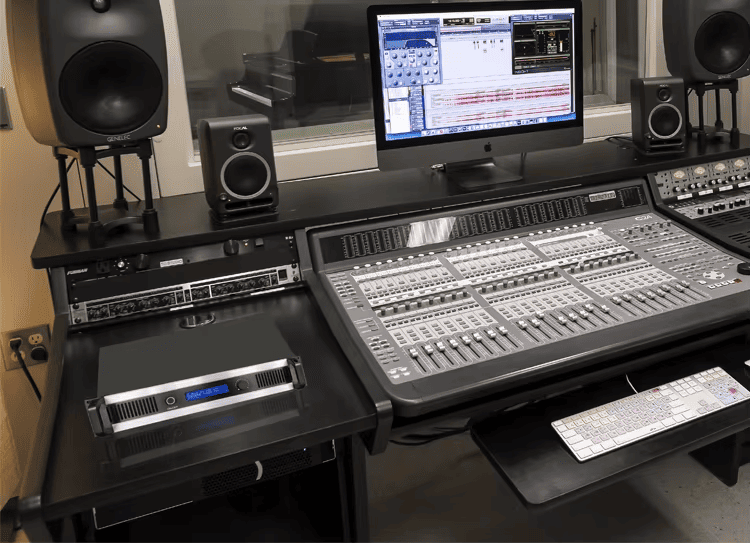
I have helped over 500 customers build FM stations during my years at RS. Most beginners worry about technical complexity but discover that FM broadcasting uses straightforward principles once you understand the basic signal flow. The audio goes into the transmitter, gets converted to radio frequency, travels through the cable, and radiates from the antenna to listeners.
What Equipment Do You Need to Build an FM Radio Station?
You want to start broadcasting but don’t know which equipment to purchase or how much to invest. Buying wrong equipment wastes money and delays your launch while you wait for correct replacements. Knowing the essential equipment and their functions helps you build a complete working station from the start.
To build an FM radio station you need a transmitter, antenna, coaxial cable, audio source, and power supply. Optional equipment includes audio processor, mixer, microphone, computer for automation, and monitoring receiver. A basic station can start with as little as $500 for small coverage.
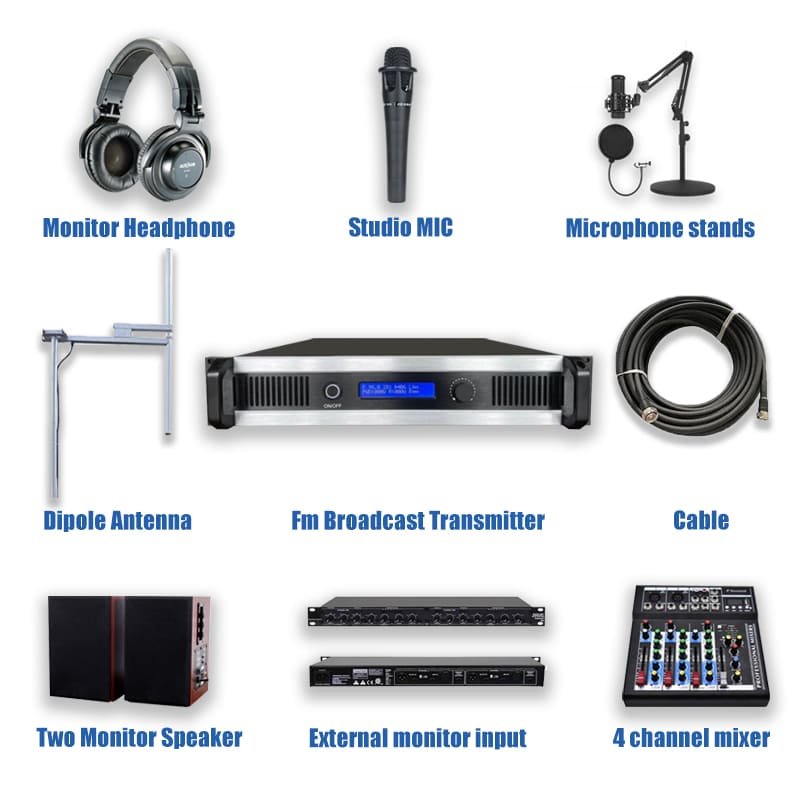
The transmitter is the heart of your station. It converts audio into FM radio signals at your chosen frequency. RS manufactures transmitters from 7W to 10KW covering all power needs. Our RS-300W touchscreen transmitter is the most popular choice for churches and schools. It uses DSP digital signal processing and DDS technology for high quality audio. The transmitter operates on any frequency from 87.5MHz to 108MHz with 10KHz stepping.
Antennas radiate the signal from your transmitter to listeners. You need an antenna that matches your transmitter power rating and provides the coverage pattern you want. A dipole antenna costs $50-150 and works well for most applications. Circular polarized antennas cost $200-400 but provide better reception quality. All RS transmitters use standard 50Ω impedance with 7/16 DIN connectors.
Coaxial cable connects transmitter to antenna. Cable quality directly affects signal strength because poor cable loses power as heat. Use LDF4-50A or equivalent low-loss cable for professional installations. Budget cables lose 3-5dB per 10 meters while professional cables lose only 1-2dB. This difference means more signal reaches your antenna instead of disappearing in the cable.
| Essential Equipment | Typical Cost | Function |
|---|---|---|
| Transmitter (7W-300W) | $70-$1500 | Converts audio to FM signal |
| Antenna | $50-$400 | Radiates signal to listeners |
| Coaxial Cable | $3-$10 per meter | Connects transmitter to antenna |
| Audio Source | $0-$500 | Provides content (phone/computer/mixer) |
| Power Supply | Included | Powers the transmitter |
Audio sources provide content for broadcasting. Simple stations use a smartphone or computer connected directly to the transmitter. Professional stations use audio mixers combining multiple microphones, music players, and telephone lines. The RS transmitters accept standard balanced 600Ω audio input with left and right channels for stereo broadcasting.
Supporting equipment improves broadcast quality. An audio processor automatically adjusts volume levels and enhances sound quality. A mixer lets you combine multiple audio sources and control levels. A monitoring receiver allows you to hear exactly what your listeners receive. You can add these items later as your station grows.
Power requirements depend on transmitter size. Our RS-7W and RS-15W compact transmitters run on 12V DC power supplies included with the unit. The RS-300W requires 110V or 220V AC power and draws about 150 watts. Larger transmitters like our RS-1000W and RS-2000W need dedicated electrical circuits with proper grounding.
How to Choose the Right FM Transmitter Power for Your Broadcast Station
You need to select transmitter power but don’t know which level covers your target area adequately. Buying too little power leaves gaps in coverage while buying too much power wastes money and creates interference risks. Matching transmitter power to your coverage needs ensures listeners receive clear signals throughout your service area.
Choose FM transmitter power based on desired coverage radius, terrain type, and antenna height. Use 7-15W for 1-3km radius, 50-100W for 5-10km, 300W for 15-20km, 1000W for 25-30km, and 2000W for 30-60km coverage under typical conditions.
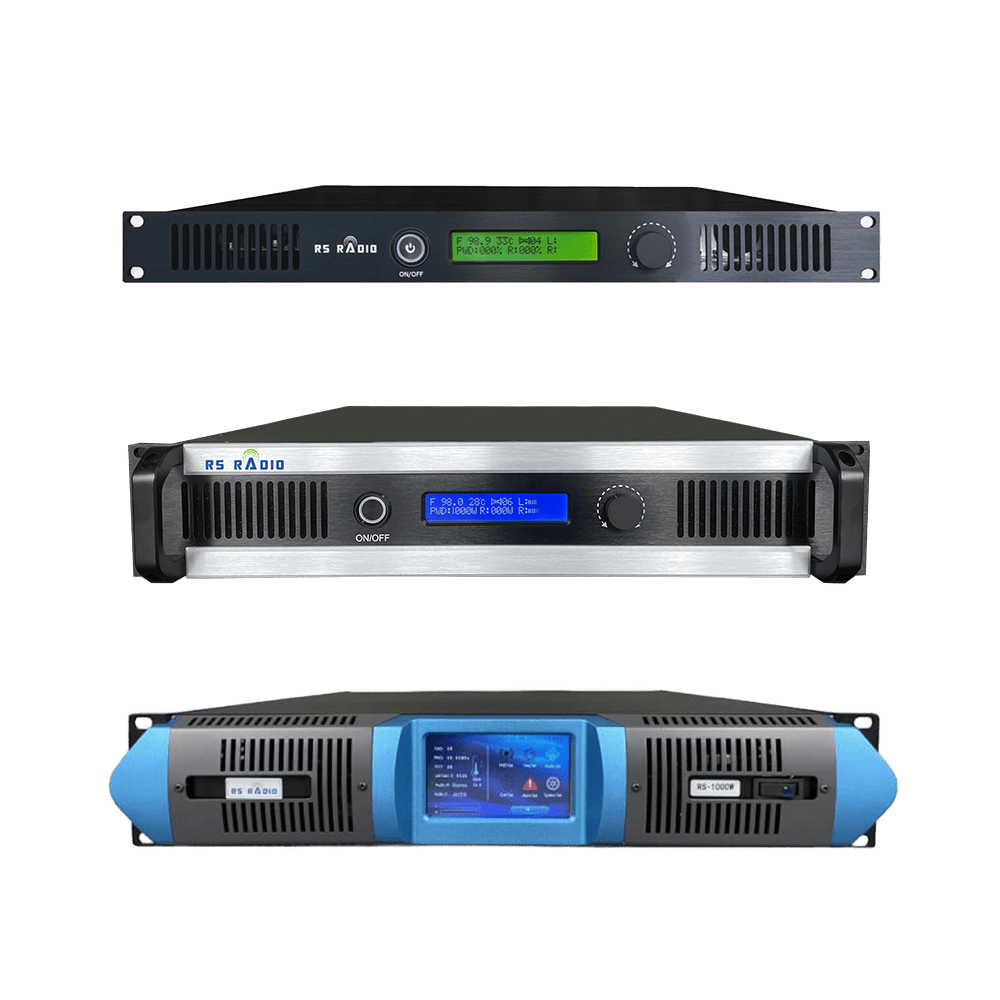
Coverage distance depends on three main factors working together. Transmitter power provides the signal strength. Antenna height extends line-of-sight distance. Terrain affects how far signals travel. I always ask customers about all three factors before recommending transmitter power.
Churches represent my most common customer type. A church with a single building needs 7W-15W transmitter for parking lot coverage up to 1 kilometer. A church wanting to reach the surrounding neighborhood needs 50W-100W for 5-7 kilometer radius. A church broadcasting to the entire city needs 300W-1000W depending on city size. Our RS product line covers all these applications with appropriate models.
Schools and universities have different coverage patterns than churches. Campus broadcasting typically needs 50W-300W to cover buildings spread across 3-15 kilometers. Drive-in cinemas need 7W-50W since cars park close to the transmitter location. Community radio stations serving small towns use 300W-1000W for 15-30 kilometer coverage.
| Application Type | Typical Coverage Need | Recommended Power | RS Model |
|---|---|---|---|
| Parking lot / venue | 0.5-1km | 7W-15W | RS-7W, RS-15W |
| Neighborhood / campus | 3-12km | 50W-100W | RS-50W, RS-100W |
| Small town / city district | 15-25km | 300W-500W | RS-300W, RS-500W |
| City / multiple towns | 25-30km | 1000W | RS-1000W |
| Regional coverage | 30-60km | 2000W | RS-2000W |
| Professional broadcaster | 40-100km | 3000W-10KW | RS-3KW to RS-10KW |
The RS transmitters feature adjustable power output. Our RS-1000W model adjusts continuously from 0-1000W in 0.1W steps. This means you buy one transmitter but can operate it at 50W, 300W, 500W, or any level up to 1000W. This flexibility helps when you start small and want to expand coverage later without buying a new transmitter.
Regulatory limits affect power selection. The United States allows low power FM (LPFM) stations up to 100W. Other countries have different limits. Check local regulations before purchasing high power transmitters. RS provides FCC and CE certification for international compliance.
Budget considerations also influence power selection. Higher power transmitters cost more to purchase and more to operate due to electricity consumption. The RS-7W uses 12V DC and draws minimal power. The RS-2000W requires 220V AC and consumes about 3000 watts at full power. Consider both purchase cost and operating expenses when selecting power level.
How to Maintain and Service Your FM Transmitter
Your transmitter operates perfectly now but you worry about future problems and don’t know how to prevent failures. Neglecting maintenance causes unexpected shutdowns during important broadcasts and expensive emergency repairs. Regular maintenance keeps transmitters running reliably and extends equipment life by years.
Maintain FM transmitters by cleaning air filters monthly, checking fan operation, monitoring temperature, cleaning dust from internal components every 6 months, checking cable connections, and verifying SWR values stay below 1.5:1. Preventive maintenance prevents 90% of transmitter failures.
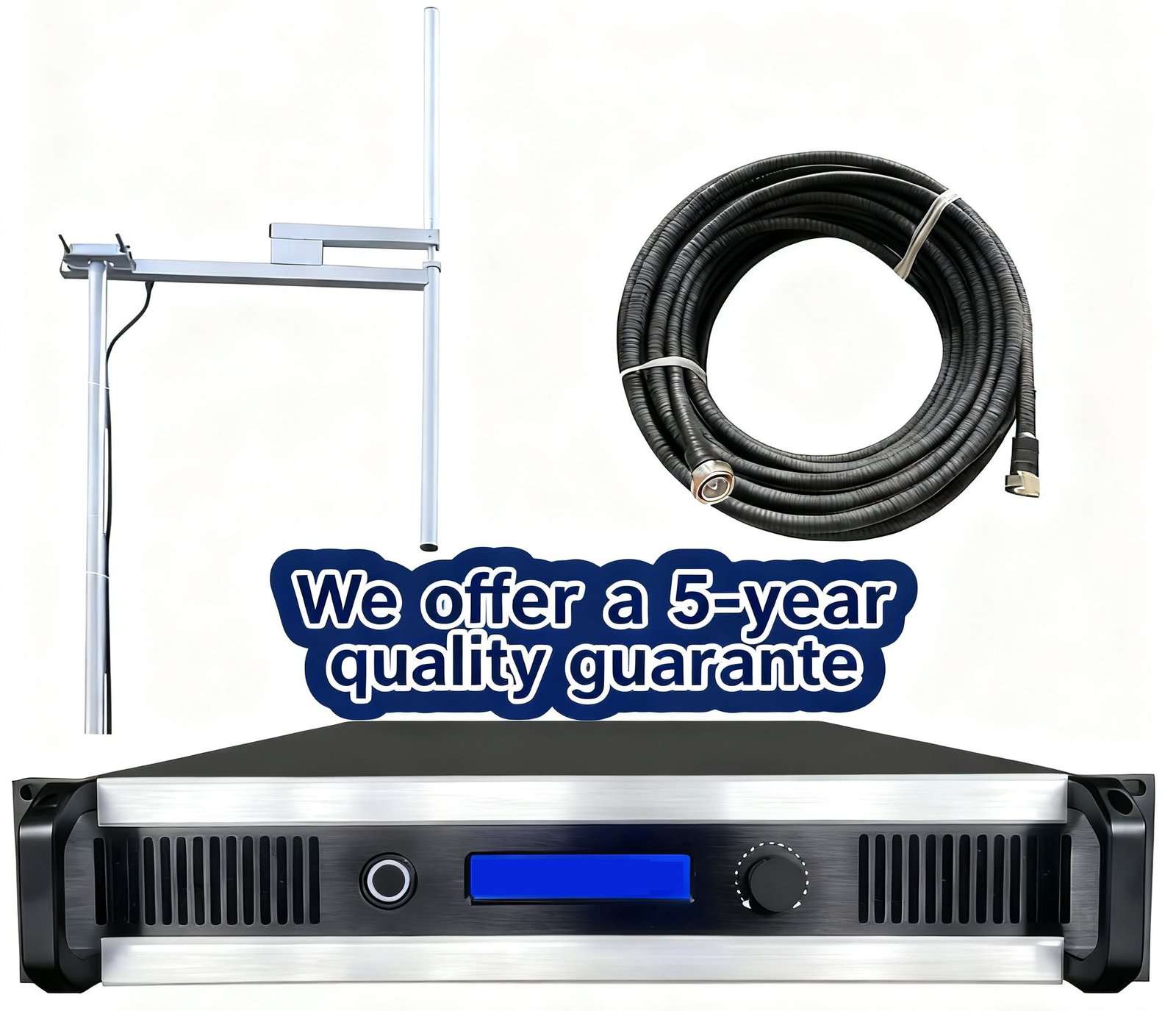
Air filter cleaning is the most important maintenance task. All RS transmitters include high performance air filters that remove dust before it enters the unit. Dust accumulation blocks airflow causing overheating and component failure. I tell every customer to clean filters monthly in dusty environments and every two months in clean environments. Remove the filter, wash it with water, let it dry completely, and reinstall it.
Temperature monitoring prevents damage from overheating. Our RS transmitters include automatic over-temperature protection. When internal temperature exceeds 60°C, the transmitter reduces power automatically and displays an alarm message. This protection saves the transmitter from damage but indicates a cooling problem you need to fix. Check that fans run properly and air vents stay clear.
Fan inspection should happen during each filter cleaning. The RS-1000W and RS-2000W transmitters include fan error alarms. When a fan stops running, an alarm message displays on screen with beeping sound. Don’t ignore fan alarms because the transmitter will overheat quickly without proper cooling. Replace failed fans immediately with correct specifications to maintain adequate cooling.
| Maintenance Task | Frequency | Time Required | Difficulty |
|---|---|---|---|
| Clean air filter | Monthly | 10 minutes | Easy |
| Check fan operation | Monthly | 5 minutes | Easy |
| Clean internal dust | Every 6 months | 30 minutes | Medium |
| Check cable connections | Every 6 months | 15 minutes | Easy |
| Verify SWR readings | Monthly | 5 minutes | Easy |
| Check output power | Monthly | 5 minutes | Easy |
Internal cleaning removes dust from circuit boards and components. Turn off power, remove the cover, and use compressed air to blow dust from components. Pay special attention to the RF amplifier section and power supply area where heat attracts dust. Dust creates electrical paths between components causing short circuits and failures.
SWR monitoring protects transmitters from antenna problems. SWR stands for Standing Wave Ratio and measures how well the antenna matches the transmitter. All RS transmitters include SWR protection that activates when SWR exceeds safe levels. Check SWR monthly and investigate any increase above 1.5:1. High SWR indicates antenna damage, water in cables, or loose connections.
Cable connections require periodic inspection. Check that all RF connections stay tight because vibration loosens connectors over time. Inspect cable condition looking for cracks, kinks, or damage. Water entering damaged cables causes high SWR and signal loss. Replace damaged cables before they cause transmitter problems.
Differences Between Low Power and High Power FM Transmitters for Broadcast Use
You need to understand whether low power or high power transmitters better suit your broadcasting needs. The differences go beyond just coverage distance and include construction quality, features, and operating costs. Knowing these differences helps you make informed equipment decisions and avoid costly mistakes.
Low power FM transmitters (under 100W) use compact designs, simple controls, and cost $200-$800 for local coverage up to 10km. High power transmitters (300W-2000W+) use professional construction, advanced features like touchscreens and remote control, adjustable output, and cost $1000-$5000 for coverage of 20-80km radius.

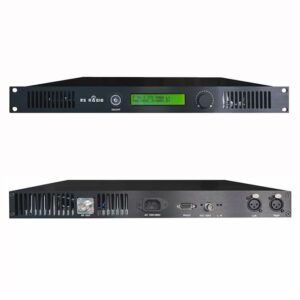
Construction differences start with physical size and build quality. Low power transmitters like our RS-7W and RS-15W fit in compact housings smaller than a book. They use simple power supplies and basic components. High power units like the RS-1000W and RS-2000W require standard 19-inch rack mounting with 2U height. These professional units use NXP LDMOS transistor BLF188XR in the RF amplifier section, allowing them to withstand severe load mismatch of more than 65:1 VSWR at 5dB compression point.
Control interfaces differ significantly between power levels. Low power transmitters use simple LED displays or basic LCD screens with button controls. The RS-300W introduces touchscreen control without buttons making settings easier to adjust. High power transmitters include microprocessor control with LCD displays showing all key parameters including forward power, reflected power, SWR, temperature, and frequency.
Power adjustment capabilities separate low from high power units. Basic transmitters operate at fixed power output. Our professional RS transmitters feature continuously adjustable power output. The RS-1000W adjusts from 0-1000W in 0.1W steps. The RS-2000W adjusts from 0-2000W in the same fine increments. This means you can operate one high power transmitter at any level from 50W to full rated power.
| Feature | Low Power (7W-100W) | High Power (300W-2000W+) |
|---|---|---|
| Coverage Range | 1-10km | 15-80km |
| Physical Size | Compact desktop unit | 19-inch rack mount 2U |
| Control Interface | LED/LCD with buttons | Touchscreen or advanced LCD |
| Power Adjustment | Fixed or limited | Continuous 0.1W steps |
| Audio Processing | Basic or none | DSP digital processing |
| Protection Systems | Basic thermal | Full protection with alarms |
Audio processing technology differs greatly. Low power transmitters use analog audio circuits or basic digital processing. Professional high power transmitters implement advanced digital FM modulator modules using DSP and DDS. These systems execute all-digital processing including digital filtering, pre-emphasis, pilot frequency generation, stereo coding, and FM modulating. The result is significantly better audio quality with lower distortion and better stereo separation reaching 60dB.
Protection systems become more sophisticated in high power transmitters. All RS transmitters include over-temperature protection. High power models add SWR protection with automatic power reduction, fan error alarms, and AGC (Automatic Gain Control) circuits to keep output power stable. These protection systems prevent damage from antenna problems, cooling failures, or power supply issues.
Operating efficiency affects electricity costs over time. Low power transmitters consume minimal electricity making them inexpensive to operate. The RS-7W uses only 12V DC power. High power transmitters incorporate PFC (Power Factor Corrector) power supplies providing maximum efficiency for energy saving. The RS-2000W achieves better than 70% efficiency across the bandwidth using LD-MOSFET technology.
Conclusion
FM broadcast stations work by converting audio to radio waves through transmitters, cables, and antennas. Choose equipment matching your coverage needs, maintain it regularly through filter cleaning and monitoring, and select between low or high power based on your broadcast range requirements.