9 Questions to Answer Before Choosing Your FM Transmitter Power
I’m an RF engineer at RS, and I’ve helped hundreds of radio stations across Africa choose the right transmitter power. Maybe the most common mistake I see is stations either buying too much power (wasting money and electricity) or too little power (frustrating listeners with weak signals).
The power decision isn’t just about technical specs. It’s about matching your budget, coverage goals, legal limits, and operating conditions. These 9 questions will help you figure out exactly what power level makes sense for your station.
Answer these honestly, and you’ll know whether you need 15W, 50W, 100W, 300W, or higher power. Let’s start.
Question 1: How Large Is Your Target Coverage Area?
Why This Matters
Maybe you think you need to cover 50 km radius, but your actual target audience lives within 10 km. Or you’re planning campus radio thinking 15W is enough, but your university spreads across 8 km requiring more power. Getting the geographic scope right is the foundation of power selection.
Think About Your Actual Service Area
Campus Radio: Most university campuses fit within 2-5 km radius. Student housing, academic buildings, nearby neighborhoods. You don’t need regional coverage—just strong signal across campus.
Village or Community Station: Single village might be 1-3 km radius. Multiple villages could spread 10-15 km. Count the actual communities you need to reach.
Town Station: Small town and immediate surroundings typically 5-10 km radius. Larger towns or district centers might require 15-20 km coverage.
Regional Station: Covering multiple towns or districts means 20-40 km radius. This jumps you into much higher power requirements.
Terrain Affects Everything
Flat Rural Areas: Open farmland lets signals travel far. Lower power reaches larger areas.
Hilly or Mountainous: Valleys create shadow zones. You might cover 20 km in one direction but only 5 km toward mountains. Higher power helps but can’t overcome all obstacles.
Urban Dense Buildings: Concrete and steel absorb signals. Urban coverage needs stronger field strength than rural coverage of same area.
Coverage Reality by Power Level
This table shows typical coverage radius with 30m antenna height on relatively flat terrain:
| Power | Coverage / Price / Typical Application |
|---|---|
| 15W | 1–3 km;$249;Single village, very small campus |
| 50W | 3–5 km;$488;Community station, standard campus |
| 100W | 7–12 km;$650;Small town, multiple villages |
| 300W | 15–20 km;$1,339;District center, small city |
| 500W | 20–25 km;$1,560;Large town and surroundings |
| 1000W | 25–30 km;$1,890;Regional coverage |
Practical Exercise
Open Google Maps. Mark your transmitter location. Draw circles at 3 km, 5 km, 10 km, 15 km radius. Which circle includes all your target listeners? That tells you your power requirement range.
Maybe you discover 50W actually covers your entire service area. Or you realize 100W won’t reach all the villages you want to serve. This simple exercise prevents expensive mistakes.
Question 2: How Many People Are You Actually Trying to Reach?
Population Density Changes Everything
Maybe you’re comparing two scenarios: covering 10 km radius in rural area with scattered villages (total population 5,000), versus covering 5 km radius in town center (population 20,000). Same coverage area means very different power needs.
Dense Population Requires Stronger Signal
Urban or Town Coverage: More buildings mean more signal absorption. Indoor reception needs stronger signal than outdoor. Multiple floors, concrete walls, electronic interference—all demand higher power for same reliability.
Rural Coverage: Fewer obstacles, mostly outdoor or light construction reception. Lower power provides adequate service.
Think About Coverage Goals
Minimum Coverage: "Can be heard with good radio and outdoor antenna." Lowest power that technically reaches the area.
Reliable Coverage: "Clear signal for car radios and indoor reception." Middle power providing good signal strength throughout area.
Premium Coverage: "Strong signal everywhere, works with cheap radios, perfect indoor reception." Higher power providing margin above minimum requirements.
Match Power to Audience Type
| Station Type | Population / Coverage / Recommended Power |
|---|---|
| Campus Radio | 2,000–10,000 students;2–5 km radius;15–50W |
| Village Station | 1,000–5,000 people;1–3 km radius;15–30W |
| Community Multi-Village | 5,000–20,000 people;5–10 km radius;50–100W |
| Town Station | 10,000–50,000 people;8–15 km radius;100–300W |
| Small City | 50,000–200,000 people;15–25 km radius;300–1000W |
Revenue Consideration
If you’re commercial or ad-supported station, population size directly affects revenue potential. Covering 50,000 people justifies investment in 300W transmitter ($1,339) because ad revenue supports the cost. Covering 5,000 people probably needs to stay with 50W ($488) because revenue won’t support higher equipment and operating costs.
Example Scenarios
University Campus (8,000 students): Campus is 3 km across with scattered housing within 5 km. You need reliable indoor reception in dorm rooms and good mobile reception across campus. Answer: 50W transmitter ($488) provides strong coverage meeting your needs.
Rural Community (12 villages, 15,000 people): Villages spread across 15 km radius in agricultural area. Light construction buildings, mostly outdoor work, car and portable radio listening. Answer: 100W transmitter ($650) covers the geographic area with adequate signal for outdoor and mobile reception.
District Town (35,000 people): Town center plus surrounding neighborhoods within 12 km radius. Mix of commercial buildings, residential areas, some concrete construction. You want good indoor reception for advertisers’ customers. Answer: 300W transmitter ($1,339) provides strong signal throughout town and surroundings.
Question 3: Where Will Most Listeners Actually Hear You?
Reception Environment Determines Required Power
Maybe your signal measures perfectly on field strength meter, but listeners complain they can’t hear you indoors. Or your rural station works great, but when you try to serve nearby town, reception becomes problematic. The listening environment might matter more than raw distance.
Indoor vs. Outdoor Reception
Outdoor or Vehicle: Radio waves travel freely. Lower power provides good reception. Car radios have good antennas positioned high on vehicle. Portable radios used outdoors get clean signal path.
Indoor Reception: Buildings absorb and block signals. Concrete walls might reduce signal 10-20 dB (90-99% power loss). Metal roofing creates shielding. Electronic devices generate interference. Indoor reception needs 5-10 times more power than outdoor reception for same signal quality.
Building Construction Types
Light Construction: Wood, light metal, single-story structures. Minimal signal loss. Common in rural Africa.
Standard Construction: Brick or block walls, metal roofs, 1-2 story buildings. Moderate signal loss (5-10 dB). Typical for small towns.
Heavy Construction: Reinforced concrete, multi-story buildings, metal framing. Significant signal loss (10-20 dB). Found in cities and modern developments.
Urban vs. Rural Environment
Rural Open Areas: Signals propagate efficiently. Fewer obstacles, less electronic noise. Lower power reaches farther with better quality.
Urban Dense Areas: Buildings create shadow zones and multipath distortion. Electrical equipment generates interference raising noise floor. Higher power needed to overcome obstacles and noise.
Listening Scenarios by Station Type
| Station Type | Listening / Challenges / Power Adjustment |
|---|---|
| Campus Radio | Dorms, cars, outdoor;Indoor dorms need good signal;+30% power |
| Community | Homes, shops, farms;Mix of outdoor and light construction;Standard power |
| Religious | Churches, homes, cars;Need strong indoor church reception;+50% power |
| Commercial | Cars, offices, homes;Urban mix of environments;+50–100% power |
Real Example Comparisons
Scenario A – Rural Agricultural Area:
Station covers 15 km radius reaching farming communities. Listening mostly outdoors during work, in vehicles, or in light construction homes. Terrain is flat. Power needed: 100W ($650) provides strong signal throughout area.
Scenario B – Same 15 km Radius in Small City:
Town center with shops, offices, and residential areas. Two-story buildings, concrete construction. Listeners want indoor reception at work and home. More electrical interference. Power needed: 300W ($1,339) to achieve similar reception quality in harder environment.
The geographic coverage is identical, but environmental challenges require 3x the power in Scenario B.
Practical Decision Guide
If your listeners are mostly:
- Outdoor workers, farmers, mobile: Standard power calculations work
- Indoor residential, light construction: Add 30-50% more power
- Indoor commercial, offices, concrete buildings: Double the power estimate
- Dense urban, multi-story, metal construction: Triple the power estimate
Test Reception Reality
Before finalizing power decision, test reception in your actual environment. Visit locations where listeners will use your station:
- Can they receive other FM stations clearly? If yes, you need similar power.
- Do they struggle with FM reception generally? You need more power than other stations.
- Is reception perfect outdoors but poor indoors? Plan for indoor environment challenges.
Question 4: What Tower or Antenna Height Can You Access?
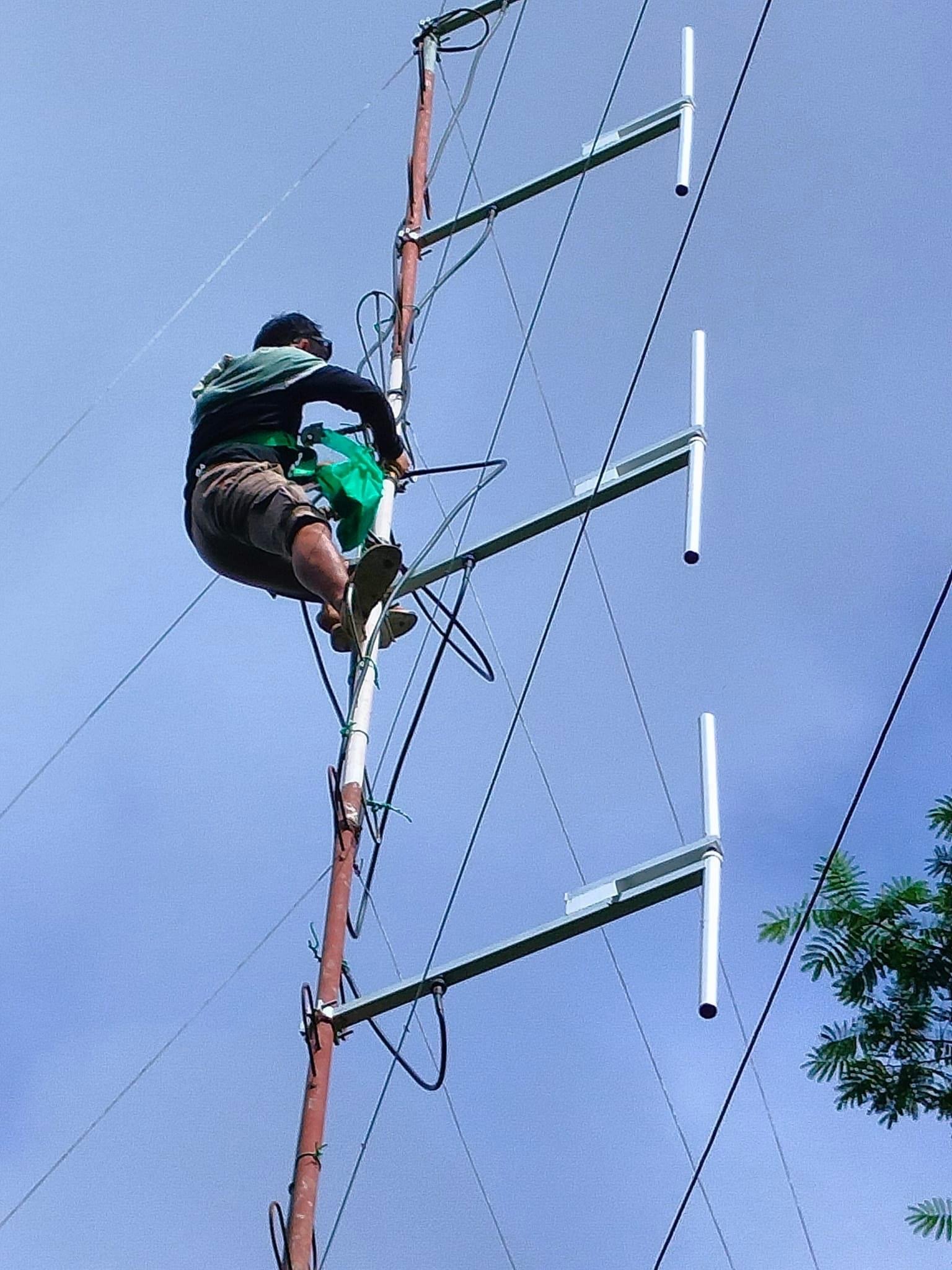
Height Might Matter More Than Power
Maybe you’re debating between 100W and 300W transmitters—a $689 difference. But if you can mount your antenna 40m high instead of 20m, you get more coverage improvement than tripling the power, at much lower cost. Tower height and transmitter power work together. Getting height right might let you use less power.
The Height Advantage
Line of Sight Matters: FM signals travel in straight lines. They can’t bend over obstacles. Higher antenna sees over buildings, trees, and terrain features. Every meter higher increases your coverage area.
Approximate Coverage Gain: Doubling antenna height increases coverage radius about 40%. Going from 20m to 40m tower turns 100W transmitter into equivalent of 200W+ at lower height.
Height vs. Power Trade-Off
This table compares coverage approaches:
| Approach | Cost / Coverage Result |
|---|---|
| 100W at 20 m height | Equipment $650;Modest pole;7–12 km radius |
| 100W at 40 m height | Equipment $650;Tall tower/building;10–16 km radius |
| 300W at 20 m height | Equipment $1,339;Modest pole;12–18 km radius |
| 300W at 40 m height | Equipment $1,339;Tall tower/building;18–24 km radius |
Finding Antenna Height
What You Might Already Have Access To:
Water Towers: Often 30-50m high, located on high ground. Municipal authorities might allow broadcasting use for modest rental.
Cell Phone Towers: Communication towers usually 30-60m high. Tower companies sometimes rent space to broadcasters.
Tall Buildings: Office buildings, hotels, grain silos, government buildings. Rooftop installation adds building height to antenna tower height.
Natural High Points: Hills, ridges, mountain sides. Ground elevation counts—transmitter at 1200m elevation on 20m tower beats valley site at 800m elevation with 40m tower.
Church Steeples or Minarets: Religious buildings often have tall structures. Religious broadcasters might negotiate installation.
Height Budget Reality
Simple Pole Mount (10-20m): Costs $200-500 for pole, mounting hardware, and installation. Suitable for very local coverage or low-power stations.
Medium Tower (20-30m): Costs $1,000-2,000 for guyed tower, foundation, and installation. Standard for community stations.
Tall Tower (30-50m): Costs $2,000-5,000+ for tower, foundation, guy wires, and professional installation. Justified for stations with significant coverage requirements.
Existing Structure Rental: Costs $50-200 per month. Avoids tower construction cost but creates ongoing expense.
Strategic Height Decisions
Starting on Budget: If you can access 30m+ existing tower for modest rental, use lower power transmitter (50-100W). The height provides coverage at lower equipment and operating cost.
No Height Available: If limited to 15-20m mounting, budget for higher power transmitter to compensate. You’ll need 300W to achieve what 100W accomplishes at good height.
Growth Planning: Start with moderate power at best available height. Later, add power is easier than adding height. But getting height right first is more cost-effective.
Real World Example
Community station debating two options:
Option A: 300W transmitter ($1,339) on 20m pole at ground level site ($500)
- Total investment: $1,839
- Coverage: 15-18 km radius
- Operating cost: $70/month electricity
Option B: 100W transmitter ($650) on existing 40m cell tower ($100/month rental)
- Equipment investment: $650
- Annual rental: $1,200
- Coverage: 14-17 km radius (similar to Option A)
- Operating cost: $25/month electricity
Option B provides similar coverage at lower initial cost and much lower operating costs. The height advantage makes lower power work effectively.
Question 5: How Many Hours Per Day Will You Broadcast?
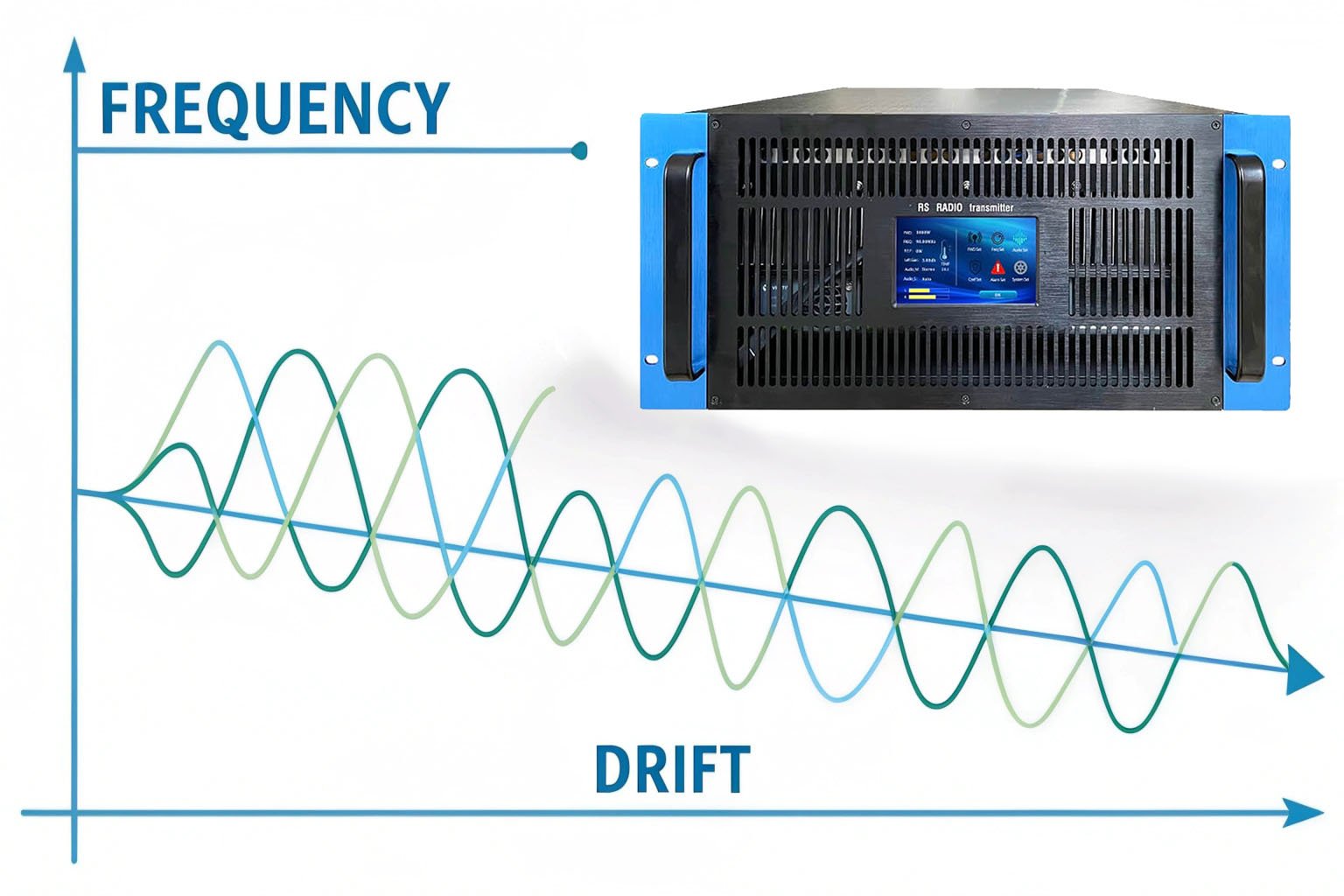
Operating Schedule Affects Power Decision
Maybe you’re planning 24/7 continuous broadcasting, or maybe you’ll broadcast 4-6 hours daily for specific programming. The operating schedule changes how you think about power, equipment quality, and cost-effectiveness.
Continuous vs. Part-Time Operation
24/7 Broadcasting: Equipment runs constantly under full load. Component stress is continuous. Heat builds up. Power consumption never stops. You need professional-grade equipment built for continuous duty.
Part-Time Schedule: Equipment runs intermittently. Components cool between broadcasts. Power consumption only during operating hours. You might tolerate slightly less robust equipment.
Power Considerations by Schedule
| Schedule Type | Operating Hours / Power Strategy / Quality |
|---|---|
| 24/7 Continuous | 168 hours/week;Conservative power rating;Professional grade |
| Daily 12–16 hours | 84–112 hours/week;Standard power rating;Broadcast quality |
| Part-time 4–8 hours | 28–56 hours/week;Can push power limits;Good consumer grade |
| Weekend only | 20–40 hours/week;Flexible power use;Adequate quality OK |
Equipment Reliability Matters
24/7 Operation: Equipment failure means dead air until repairs complete. You might lose audience who tune to other stations. Advertisers get upset. Consider:
- Buying transmitter with power margin (use 100W transmitter for 70W output)
- Professional-grade components rated for continuous duty
- Backup transmitter for emergency failover
- Higher initial investment justified by reliability needs
Part-Time Operation: Equipment failure is inconvenient but doesn’t create continuous dead air. Repairs between broadcast sessions might be acceptable. You can:
- Use transmitter closer to full rated power
- Accept slightly lower equipment grade
- Skip backup transmitter investment
- Lower initial budget acceptable
Operating Cost Impact
Example: 100W Transmitter (250W consumption)
Daily operating hours and monthly electricity cost (at $0.15/kWh):
| Operating Schedule | Hours / Energy / Cost |
|---|---|
| 24/7 continuous | 24 hours/day;180 kWh/month;$27 |
| Daily 12 hours | 12 hours/day;90 kWh/month;$13.50 |
| Daily 6 hours | 6 hours/day;45 kWh/month;$6.75 |
| Weekend 16 hours | 2.3 hours avg/day;17 kWh/month;$2.55 |
Part-time schedule cuts electricity costs proportionally. This matters for budget-conscious stations. Maybe you can afford 100W transmitter operating 6 hours daily, but 50W is more sustainable for 24/7 operation.
Power Rating Margin for 24/7
Conservative Approach: Buy transmitter rated 30-50% above your needed power. Use 100W transmitter to output 70-80W continuously. This reduces component stress, lowers operating temperature, and extends equipment life.
Standard Approach: Use transmitter at or near rated power. Our transmitters are designed for continuous full-power operation, but some margin provides reliability insurance.
Aggressive Approach (not recommended for 24/7): Running transmitter above rated power. This shortens component life and increases failure risk—unacceptable for continuous broadcasting.
Practical Recommendations by Station Type
Campus Radio (typically 6-12 hours daily during term):
- Can use transmitter at full rated power
- 50W transmitter adequate for 50W output needs
- Lower operating hours reduce electricity costs
- Acceptable to skip backup transmitter
Community Station (typically 12-18 hours daily):
- Use transmitter at rated power or with slight margin
- 100W transmitter for 80-100W output
- Moderate operating costs
- Consider backup for important programming
Religious Broadcaster (variable schedules, maybe 24/7):
- Conservative power rating if continuous operation
- 100W transmitter for 70-80W output if 24/7
- Full power acceptable if 6-12 hours daily
- Budget for backup transmitter for continuous stations
Commercial Station (typically 18-24 hours daily):
- Professional equipment with power margin
- 300W transmitter for 250-300W output
- Backup transmitter essential
- Operating costs fully budgeted
Question 6: What Are the Legal Power Limits in Your Country?
Legal Limits Override Technical Preferences
Maybe you calculated you need 300W for coverage goals, but your country limits community radio to 100W maximum. Or you’re planning 50W station but discover you could legally use 200W. Understanding regulatory limits is essential before investing in equipment.
Common African Regulatory Frameworks
Community Radio Limits: Many countries restrict community or LPFM stations to lower power protecting them from commercial competition while preventing interference. Common limits:
- 50W maximum (Kenya, Ghana community licenses)
- 100W maximum (Nigeria community stations)
- 300W maximum (South Africa community class)
Commercial Station Limits: Commercial or general broadcasting licenses usually allow higher power:
- 300-1000W for local stations
- 1000-5000W for regional stations
- 5000W+ for national coverage
Campus Radio: Educational/university licenses often limited:
- 10-50W for campus-only coverage
- 100W if serving surrounding community
Religious Broadcasting: Varies significantly by country:
- Same as community limits in some countries
- Special religious broadcast class in others
- Commercial power levels if religious organization broadcasts commercially
Why Regulators Limit Power
Interference Management: FM spectrum is crowded. Higher power stations create wider interference zones. Limiting power allows more stations to coexist.
Service Area Control: Regulators want community stations serving specific areas, not broadcasting regionally. Power limits enforce local service.
Fair Competition: Preventing community or religious broadcasters from competing unfairly with commercial stations through excessive power.
Spectrum Efficiency: Lower power stations use spectrum more efficiently, allowing more services in same geographic area.
License Application Strategy
Apply for What You Need: Don’t request maximum allowed power if you need less. Regulators appreciate realistic applications. Requesting 100W when you need 50W might raise questions.
Justify Your Request: If you need higher power, document reasons:
- Geographic coverage requirements
- Population to be served
- Terrain challenges requiring additional power
- Listening environment factors
Start Smaller, Grow Later: Some regulators approve power increases for established stations. Start with 50W license, demonstrate responsible operation, later request upgrade to 100W.
Coordinate Frequency and Power: Power and frequency assignment work together. Regulators coordinate to prevent interference. Your power limit depends partly on how close other stations are on spectrum.
Regulatory Compliance Requirements
Beyond power limits, compliance includes:
Frequency Stability: Must maintain assigned frequency within tolerance (typically ±2 kHz)
Harmonic Suppression: Emissions outside assigned channel must be suppressed
Coverage Area: Must not exceed licensed service area
Technical Specifications: Equipment must meet national broadcast standards
Equipment Considerations for Compliance
Choose Adjustable Power Transmitters: Our transmitters allow precise power setting. You adjust to exactly match your license—100W license gets 100W output, not 120W because that’s the model rating.
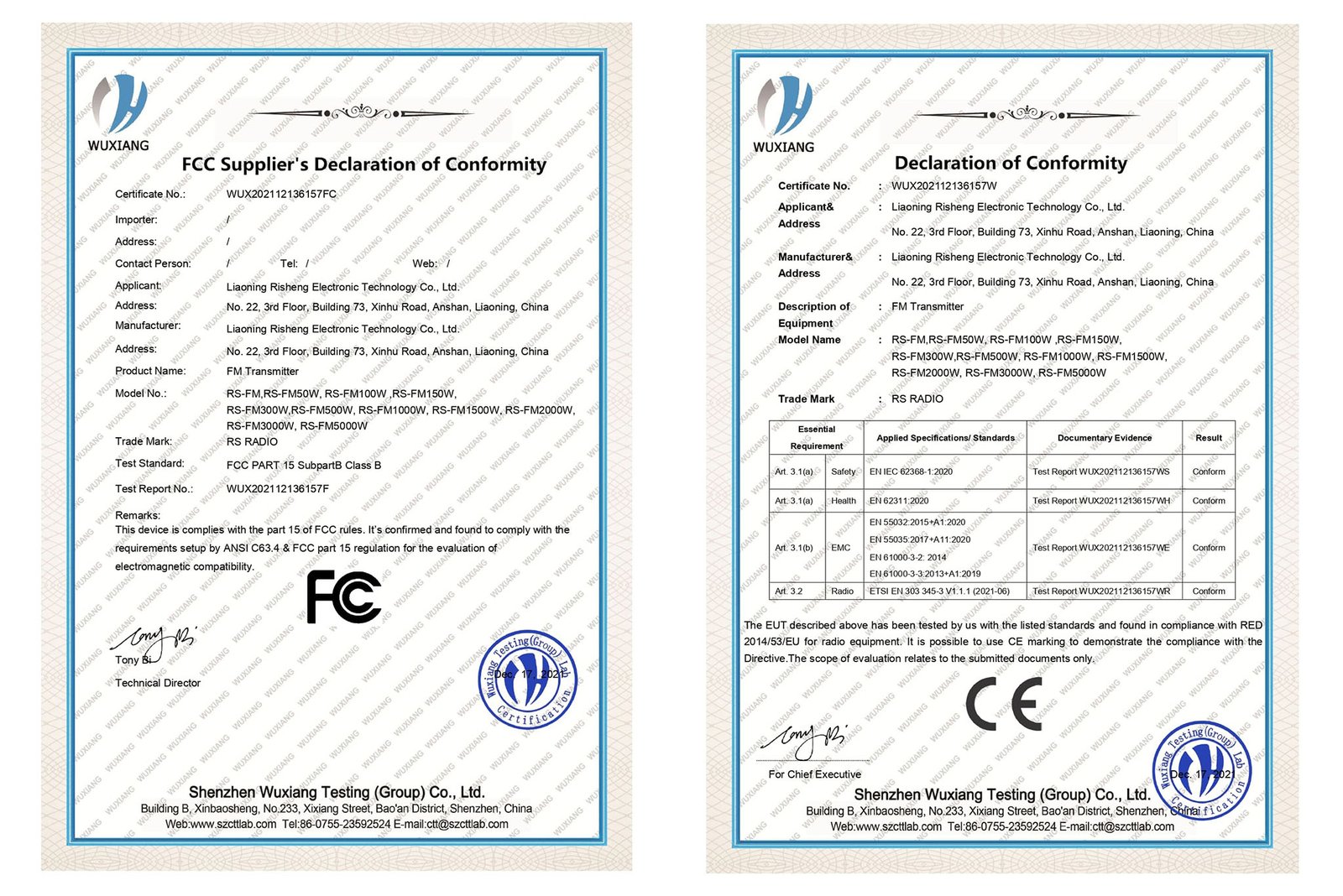
Get Certified Equipment: FCC and CE certified transmitters meet international broadcast standards, usually acceptable to African regulators.
Keep Documentation: Maintain records proving equipment compliance—test reports, certificates, operation logs.
Country-Specific Examples
Kenya: Community stations typically limited to 50W. Applying for 100W requires special justification. Our 50W transmitter ($488) perfectly matches typical Kenyan community license.
Nigeria: Community radio often approved for 100W. Some states allow up to 300W with justification. Our 100W ($650) or 300W ($1,339) transmitters suit Nigerian regulations.
Tanzania: Education/campus stations usually 30-50W. Community stations may get 100W. Religious broadcasters sometimes approved for 300W.
South Africa: Community stations can get 100-300W depending on area. Commercial stations 300-1000W typical. Clear regulatory framework with specific power classes.
Ghana: Community radio typically 100W maximum. Commercial stations 300-1000W. Religious broadcasters follow community limits unless operating commercially.
Practical Advice
Before Buying Equipment:
- Confirm power limit for your license class
- Get written confirmation from regulator if unclear
- Purchase transmitter matching licensed power
- Keep headroom—don’t buy exactly minimum allowed equipment
If Regulations Change: Some countries are revising broadcast regulations. If you expect power limit increases, buy modular transmitter that accepts power amplifier upgrades. Start with 100W, add amplifier later if regulations allow 300W.
Question 7: What’s Your Realistic Budget—Now and Long-Term?
Total Cost Goes Beyond Purchase Price
Maybe you found transmitter for $300 and think that’s your budget. But total cost includes antenna ($150-500), cables ($50-200), installation ($200-500), monthly electricity ($15-100), site rental ($50-200), maintenance ($20-50/month), and eventual repairs or replacement. Understanding total cost prevents financial surprises.
Initial Investment Breakdown
Complete station setup costs more than just transmitter:
| Component | Cost by Station Power |
|---|---|
| Transmitter | 50W $488;100W $650;300W $1,339 |
| Antenna | 50W $150;100W $200;300W $500 |
| Cables | 50W $80;100W $100;300W $150 |
| Installation | 50W $200;100W $300;300W $400 |
| Total Initial | 50W $918;100W $1,250;300W $2,389 |
Monthly Operating Costs
Power level significantly affects ongoing expenses:
| Expense Category | Cost by Station Power |
|---|---|
| Electricity (24/7) | 50W $16;100W $27;300W $70 |
| Site rental | 50W $50;100W $75;300W $100 |
| Maintenance fund | 50W $15;100W $25;300W $40 |
| Monthly Total | 50W $81;100W $127;300W $210 |
| Annual Operating | 50W $972;100W $1,524;300W $2,520 |
3-Year Total Cost of Ownership
| Power Level | Initial / 3-Year Operating / Total |
|---|---|
| 50W | Initial $918;3-year operating $2,916;Total $3,834 |
| 100W | Initial $1,250;3-year operating $4,572;Total $5,822 |
| 300W | Initial $2,389;3-year operating $7,560;Total $9,949 |
The operating costs over three years exceed initial equipment investment. A station buying cheaper equipment to save $200 upfront but spending extra $500/year on electricity and repairs loses money long-term.
Budget-Conscious Power Selection
Very Limited Budget (<$1,000 total):
- 15W transmitter kit ($249) or 50W basic ($488)
- Simple antenna and short cable run
- DIY installation where possible
- Part-time broadcasting to reduce electricity
- Suitable for: Village radio, small campus, volunteer church station
Modest Budget ($1,000-2,000):
- 50W complete system ($918) or 100W ($1,250)
- Professional antenna with moderate cable run
- Semi-professional installation
- Can support 12-18 hours daily broadcasting
- Suitable for: Community station, standard campus radio, church with some budget
Established Budget ($2,000-4,000):
- 100W complete ($1,250) or 300W system ($2,389)
- Professional antenna with optimized cable system
- Professional installation including proper grounding
- 24/7 operation sustainable
- Suitable for: District station, commercial, established community broadcaster
Revenue-Supported Budget ($4,000+):
- 300W ($2,389), 500W ($1,560 + system), or 1000W ($1,890 + system)
- Professional multi-bay antenna system
- Complete professional installation with backup systems
- Full-time operation with redundancy
- Suitable for: Commercial stations, government broadcasting, large religious broadcasters
Hidden Costs to Budget For
Spare Parts: Budget $50-100 for fuses, fans, minor components. Having spares on hand prevents extended outages.
Test Equipment: Frequency counter ($60), SWR meter ($50), basic multimeter ($30). Essential for troubleshooting and compliance verification.
Lightning Protection: Surge suppression, grounding system ($100-300). Cheap insurance against equipment damage.
Backup Power: Batteries, UPS, or generator depending on local power reliability ($200-2,000). Critical for continuous operation.
License Fees: Annual broadcast license costs vary by country ($50-500/year). Factor into operating budget.
Insurance: Equipment and facility insurance provides security ($100-300/year). Consider especially for expensive installations.
Financial Planning Strategies
Start Small, Grow Deliberately: Begin with 50W covering core audience. Establish revenue or donation base. Upgrade to 100W or 300W after 1-2 years when finances stabilize.
Phase Implementation: Get on air quickly with modest power and basic system. Improve antenna, add power, enhance facilities gradually from operating revenue rather than borrowing everything upfront.
Operating Cost Priority: Stations fail more often from unsustainable operating costs than inadequate equipment. Choose power level you can afford to operate long-term, even if coverage is initially limited.
Equipment Quality vs. Power: Better to buy quality 50W transmitter with professional installation than cheap 100W with poor antenna and installation. Quality foundation provides better long-term value.
Revenue Reality Check
Non-Commercial Stations: If depending on donations, grants, or minimal advertising, be conservative with power selection. Can you really sustain $200/month operating costs? If not, stay with 50W ($81/month) until funding improves.
Commercial Stations: Calculate realistic advertising revenue based on coverage area and population. If covering 20,000 people justifies $500/month ad revenue, investing in 300W ($210/month operating cost) makes business sense.
Religious Broadcasters: Congregational giving
supports operating cost. If congregation can sustain $150/month, 100W station works. If limited to $80/month budget, 50W is more sustainable.
Question 8: Do You Plan to Expand Coverage in the Next 2-3 Years?
Growth Planning Affects Today’s Decision
Maybe you’re starting small but already know you’ll expand. Or you’re unsure whether your station will grow. Thinking about future expansion helps you make smarter power choices today. Buy too small and you replace everything soon. Buy too big and you waste money on unused capacity.
Growth Scenarios to Consider
Definite Expansion Plans: You’re launching with village coverage but already have funding commitments to expand district-wide within two years. Or you’re starting campus-only but university administration approved expanded community service in 18 months.
Likely Growth: Your community station is starting modestly, but based on similar stations’ experience, you’ll probably need wider coverage as audience develops. Not guaranteed but probable.
Stable Coverage: You’re serving specific community or campus with no expansion plans. Church broadcasting to congregation. Campus serving student body. No plans to grow beyond current scope.
Uncertain Future: You honestly don’t know if the station will grow. Testing the concept. Seeing if funding materializes. Unclear whether audience will support expansion.
Equipment Approaches for Each Scenario
| Growth Scenario | Approach / Recommended Strategy |
|---|---|
| Definite expansion | Buy modular/upgradeable;Start 100W, plan 300W upgrade path |
| Likely growth | Buy with margin;100W transmitter for 50W coverage need |
| Stable coverage | Buy exact need;50W for 50W requirement, no excess |
| Uncertain | Buy conservative;50W quality equipment, can add more later |
Modular Transmitter Advantages
Our transmitters can be upgraded with external amplifiers. Start with 100W transmitter ($650), later add 300W amplifier module if coverage needs increase. This approach:
Spreads Investment: Pay $650 now, add $700 amplifier in two years when revenue supports it.
Reduces Risk: If growth doesn’t happen, you didn’t overspend on excess capacity.
Maintains Quality: Using same manufacturer’s amplifier ensures compatibility and consistent performance.
Multiple Transmitter Strategy
Instead of one large transmitter, consider multiple smaller transmitters for expansion:
Phase 1: Single 100W transmitter covering main town (7-12 km radius)
Phase 2: Add 50W relay transmitter covering valley the main site doesn’t reach
Phase 3: Add another 50W relay for additional outlying area
Total investment spreads over time. Initial cost $650 (100W) versus $1,339 (300W). Add $488 and $488 for relays only when expansion is ready.
Antenna System Scalability
Start With Good Antenna: Invest in professional antenna even if starting with modest power. When you upgrade transmitter power, the antenna is ready. Cheap antenna becomes bottleneck requiring replacement.
Tower Height: Get maximum practical tower height initially. Doubling power is easy. Raising tower later is expensive and disruptive.
Cable Capacity: Use cable rated for higher power than your initial transmitter. If starting with 100W, install cable rated for 500W. Cable installation is major work—oversizing cable initially is cheap insurance.
Real Growth Examples
Campus Radio Success Story:
- Year 1: Started with 15W ($249) covering dorms and main campus
- Year 2: Student population grew, added surrounding neighborhood listeners. Upgraded to 50W ($488)
- Year 3: University community station status approved. Upgraded to 100W ($650) covering 10 km radius
- Total investment: $1,387 over three years versus $650 upfront for 100W they didn’t initially need
Community Station Realistic Path:
- Year 1: Launched with 100W ($650) covering main town
- Year 2: Added programming, built audience, but coverage adequate. No expansion needed.
- Year 3: Secured grant for expanded service. Added 50W relay ($488) for valley coverage
- Approach: Started with appropriate power, added strategically when justified
Questions to Ask Yourself
Do you have documented expansion plans? Written plans, funding commitments, or official approvals for expansion suggest buying equipment with growth capacity.
Is your initial coverage sustainable? If starting small requires such limited coverage that audience development is impossible, you might need to start bigger even if budget is tight.
Can you afford to upgrade later? Buying smaller now and upgrading in 2 years costs more total than buying bigger initially. But spreading costs over time might match your cash flow better.
What’s your competition doing? If other stations in your area use 300W and you start with 50W, you might struggle to build audience. Matching competitive coverage might require higher initial power.
Practical Recommendations
For Definite Growth: Buy 100W now even if 50W would work. When you expand to 300W in two years, keep 100W as backup transmitter. Total investment $650 + $1,339 = $1,989 gives you working station plus backup.
For Possible Growth: Buy quality 50W ($488) or 100W ($650) matching current needs. Invest savings in good antenna and tower. When growth happens, upgrade transmitter keeping the antenna system.
For Stable Requirements: Buy exactly what you need. Don’t pay for "future capacity" you’ll never use. 50W for village station stays 50W. No waste.
For Uncertain Future: Start modest (15-50W) with lowest operating costs. If station succeeds, growth funding will be available. If station struggles, you haven’t over-invested in equipment.
Question 9: How Important is Signal Quality and Professional Image?
Quality Expectations Drive Power Decisions
Maybe you’re thinking "as long as people can hear us, that’s good enough." Or maybe you’re saying "we need perfect signal quality throughout our coverage area to maintain professional image." These different quality expectations lead to very different power requirements.
Reception Quality Levels
Barely Audible: Signal strength where listeners with good radios and outdoor antennas can receive programming. Lots of noise, occasional dropouts, inconsistent quality. Minimal signal strength.
Acceptable: Car radios and decent portable radios receive clearly in most locations. Some indoor spots have weak signal. Occasional interference or noise. Basic coverage.
Good: Clear reception throughout coverage area on car radios and most portables. Indoor reception works in most buildings. Minimal noise or interference. Professional quality.
Excellent: Strong, clean signal throughout coverage area. Perfect indoor reception even in concrete buildings. Works on cheap radios and phones. Stereo quality maintained. Premium coverage.
Who Needs Different Quality Levels
| Station Type | Quality / Coverage Philosophy / Power Recommendation |
|---|---|
| Volunteer community | Acceptable;“People find us if interested”;Standard calculation |
| Church/Campus | Good;“Serve our defined audience well”;+30% power margin |
| Commercial | Excellent;“Compete with other stations”;+50–100% power |
| Government/Official | Excellent;“Reliable public service”;+100% power margin |
Commercial Station Quality Requirements
If you’re selling advertising, signal quality directly affects revenue. Advertisers want their message heard clearly by maximum audience. Weak signal means:
Lost Audience: Listeners tune to stations with better signal quality. They’re not loyal enough to tolerate poor reception.
Advertiser Complaints: Businesses paying for ads get upset if customers report "I couldn’t hear your ad clearly."
Competitive Disadvantage: Other stations with better coverage take your potential listeners and advertisers.
Revenue Impact: Maybe weak signal loses 20-30% of potential audience. That’s 20-30% less advertising revenue. Investing extra $700 for higher power might generate $200/month additional revenue—payback in 4 months.
Example: Small Town Commercial Station
Coverage need: 15 km radius reaching 40,000 people
Minimum Approach: 100W transmitter provides basic coverage. Signal reaches area but quality is marginal in edges. Indoor reception poor in concrete buildings. Cost: $650
Professional Approach: 300W transmitter provides strong signal throughout area. Excellent indoor reception. Quality comparable to competing stations. Cost: $1,339
Revenue Math:
- 100W approach might capture 60% of potential audience = 24,000 people
- 300W approach might capture 85% of potential audience = 34,000 people
- 10,000 additional listeners × $0.03 CPM × 100 spots/month = $30 additional monthly revenue
- $689 higher equipment cost ÷ $30/month = 23 months payback
Actually, better signal quality probably captures more like $100-200 extra monthly revenue through higher ratings and advertiser confidence, making payback 4-7 months.
Church or Religious Broadcasting
Religious broadcasters often prioritize message reach over costs. Considerations:
Mission Priority: "We want everyone in our ministry area to hear clearly." This might justify higher power than pure cost analysis suggests.
Congregation Satisfaction: Members who support the station financially expect good signal quality. Poor quality might reduce donations.
Image Concerns: Professional-quality broadcast reflects on the church or organization’s image.
Example: Church Station
Coverage goal: Church plus 12 km surrounding community
Budget Approach: 50W transmitter reaches area but quality varies. Church members with good radios hear fine. Others struggle. Cost: $488
Mission Approach: 100W transmitter ensures all church members receive excellent signal. Community members get strong signal. Professional image. Cost: $650
The $162 difference is modest compared to ministry value of ensuring everyone hears clearly. Religious broadcasters might prioritize coverage quality over cost savings.
Campus Radio Quality Standards
Campus stations serve defined student population. Quality needs depend on purpose:
Student-Run Entertainment: Acceptable quality is fine. Students will find the station and tolerate some quality compromises. Standard power calculation works.
University Communications: If station broadcasts official announcements, emergency info, or academic content, quality becomes more important. Add 30-50% power margin.
Community-Facing Campus: If university wants station representing institution to outside community, professional quality matters. Match commercial station standards.
Community Radio Quality Philosophy
Community stations balance mission and resources:
Community Service Focus: Primary goal is serving the community, not technical perfection. Adequate quality enabling community voice is sufficient. Don’t overspend on excess power when money could support programming.
Growth-Oriented: Station building audience and developing into stronger service might invest in better quality to attract listeners and demonstrate professionalism to funders.
Established Service: Mature community station with loyal audience might invest in quality improvements as operating revenue allows.
Practical Quality Testing
Before committing to power level, test what quality level actually satisfies your audience:
Survey Similar Stations: Visit stations similar to yours. How strong is their signal? Is that quality acceptable for your purposes?
Test Reception: Borrow or rent equipment to test. Set up temporary low-power broadcast. Check reception at key locations. Does 50W quality satisfy you, or do you clearly need more?
Audience Expectations: What quality are your listeners accustomed to? If they listen to regional stations with strong signals, they expect similar quality from you. If they’re used to weak community stations, they’re more tolerant.
Cost-Quality Balance
Don’t let "we want the best" drive you to excessive spending. Balance:
Coverage Goals: Strong signal throughout defined service area is reasonable goal.
Excessive Perfection: Perfect signal 40 km away when your coverage goal is 20 km is wasteful.
Competitive Parity: Matching similar stations’ signal quality makes sense. Exceeding it provides diminishing returns.
Budget Reality: Quality within your financial sustainability is better than "perfect" quality that bankrupts the station.
Recommendation by Quality Priority
Minimum Acceptable Quality: Standard coverage calculations from Questions 1-4 work. Select power matching geographic and population needs.
Good Professional Quality: Add 30-50% to standard calculation. If geography suggests 100W, buy 150W (use 100W unit and consider next size up).
Excellent Premium Quality: Add 50-100% to standard calculation. If coverage math suggests 100W, strongly consider 200-300W for quality margin.
Reality Check: The vast majority of stations succeed with power levels matching their geographic coverage needs calculated in Questions 1-4. Don’t overthink quality as reason to buy excessive power.
Summary: Calculate Your Right Power Level
You’ve answered nine questions about your broadcasting situation. Now combine those answers to determine your appropriate transmitter power:
Step 1: Calculate Geographic Coverage Need (Questions 1-4)
Using the coverage radius from Question 1, terrain from Question 3, and tower height from Question 4, identify your baseline power:
| Coverage Radius | Terrain Power / Recommended Power |
|---|---|
| 1–3 km | Flat 15W;Hilly 30W;Urban 50W;Recommended 15–50W |
| 3–7 km | Flat 50W;Hilly 100W;Urban 100W;Recommended 50–100W |
| 7–15 km | Flat 100W;Hilly 300W;Urban 300W;Recommended 100–300W |
| 15–25 km | Flat 300W;Hilly 500W;Urban 500W;Recommended 300–500W |
| 25–40 km | Flat 500W;Hilly 1000W;Urban 1000W;Recommended 500–1000W |
Step 2: Adjust for Operating Schedule (Question 5)
- 24/7 continuous: Add 30% margin for reliability
- 12-18 hours daily: Use baseline calculation
- Part-time 4-8 hours: Can accept baseline or slightly lower
Step 3: Verify Legal Compliance (Question 6)
- Check your power calculation against regulatory limits
- If calculated power exceeds legal limit, use maximum allowed
- Consider license upgrade if calculation significantly exceeds limit
Step 4: Validate Budget Reality (Question 7)
| Power Level | System Cost / Operating / Budget |
|---|---|
| 15W | System $600;$50/month operating;Sustainable with $30–50/month budget |
| 50W | System $920;$80/month operating;Sustainable with $60–100/month budget |
| 100W | System $1,250;$130/month operating;Sustainable with $100–150/month budget |
| 300W | System $2,390;$210/month operating;Sustainable with $180–250/month budget |
| 500W | System $3,100;$320/month operating;Sustainable with $280–380/month budget |
If your calculated power exceeds sustainable budget, either:
- Reduce power to match budget
- Develop additional funding before launching
- Start smaller with expansion plan
Step 5: Factor in Growth Plans (Question 8)
- Definite expansion: Buy current need, plan upgrade path
- Stable coverage: Buy exact requirement
- Uncertain: Start conservative, expand if successful
Step 6: Adjust for Quality Standards (Question 9)
- Basic quality: Use calculation as-is
- Professional quality: Add 30% margin
- Premium quality: Add 50% margin
Final Power Selection Examples
Example 1: Campus Radio
- Coverage need: 3 km radius, flat terrain = 50W baseline
- Operating: 12 hours daily = no adjustment needed
- Legal limit: 50W = compliant
- Budget: $920 initial, $80/month = affordable
- Growth: Stable = buy exactly 50W
- Quality: Good enough = use baseline
- Decision: 50W transmitter ($488)
Example 2: Community Multi-Village
- Coverage need: 12 km radius, hilly terrain = 300W baseline
- Operating: 16 hours daily = no adjustment
- Legal limit: 300W = compliant
- Budget: $2,390 initial stretches budget, but monthly $210 manageable
- Growth: Possible expansion to 20 km in 2 years = acceptable starting point
- Quality: Professional sound = 30% margin desired but budget limits
- Decision: 300W transmitter ($1,339), upgrade antenna later if expanding
Example 3: Small Town Commercial
- Coverage need: 15 km radius, urban area = 300W baseline
- Operating: 20 hours daily = add 30% reliability margin = 400W
- Legal limit: 1000W = no restriction
- Budget: Revenue-supported, cost not limiting factor
- Growth: Expanding to 25 km within 18 months = plan for growth
- Quality: Compete with other stations = premium quality needed
- Decision: 500W transmitter ($1,560) with expansion to 1000W path
Your Action Plan
After answering the nine questions:
1. Calculate your baseline power need from coverage area, terrain, and tower height
2. Adjust for your specific situation using operating schedule, quality standards, and growth plans
3. Verify against legal limits in your country and license class
4. Confirm budget sustainability for both initial and ongoing costs
5. Contact RS engineering to review your calculation and finalize equipment selection
Common Power Selections
Based on working with hundreds of African stations:
- 70% of new community stations choose 50-100W: Covers typical town or multi-village area at affordable cost
- 20% choose 15-50W: Campus, village, or backup applications
- 10% choose 300W+: District coverage, established stations, commercial broadcasters
Most stations succeed with mid-range power (50-100W) and good antenna systems. Very few actually need 1000W+.
Don’t Overthink It
If you’ve answered the questions honestly and your calculation suggests 100W, that’s probably right. Maybe you could get by with 50W or benefit from 300W, but 100W will work. Buy quality equipment matching your calculation, install professionally with good antenna, and you’ll have reliable broadcasting.
The power decision isn’t perfect science. It’s informed judgment combining technical factors, budget reality, and operational requirements. Trust your answers to the nine questions.
Ready to Move Forward?
Visit https://fmradiotx.com/ to review transmitter specifications for your calculated power level. Our engineering team can verify your power selection and recommend complete system configuration including appropriate antenna, cables, and installation approach for your specific situation.